Category Archives: Rockclimbing

Mountains, Climbing and a Broken Heart

A JOURNEY THROUGH DARKNESS AND LIGHT

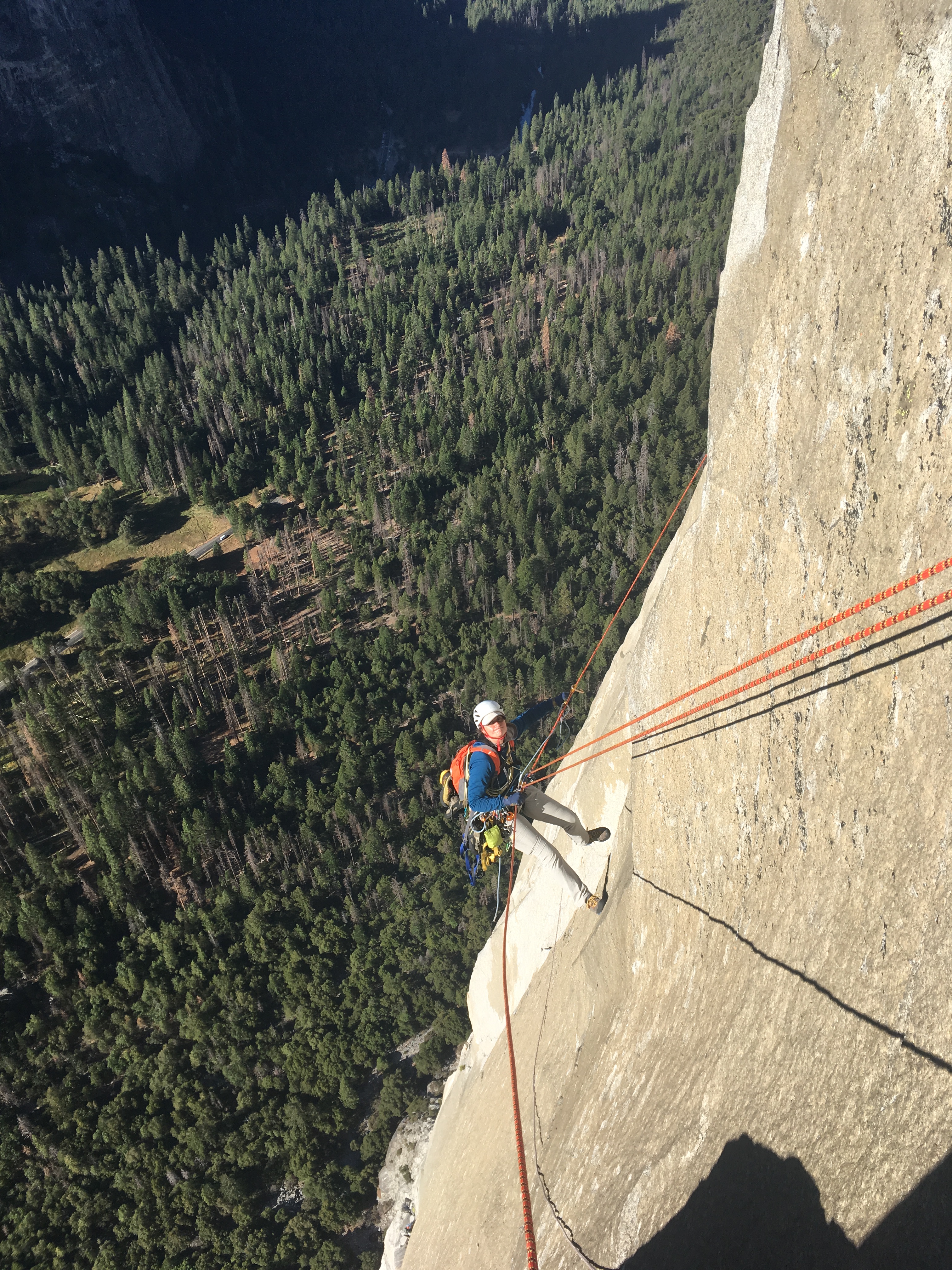
This narrative is bookended by accounts of climbs of Ozymandias Direct (aid) and Flight Of The Phoenix. Beta and detailed info for climbers is at the end of the narrative.

Part 1                 Forebodings

OZZY

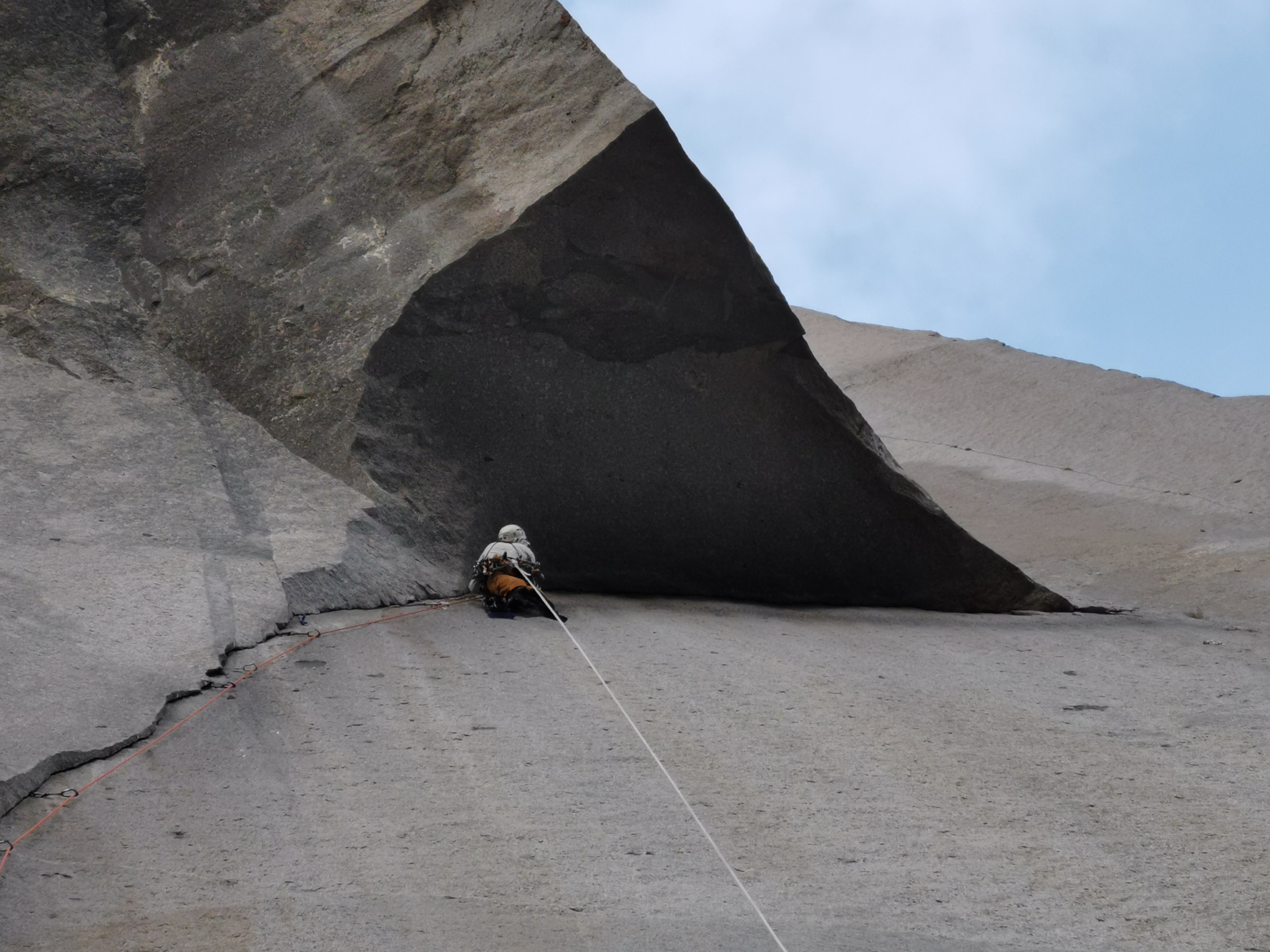
“Ozymandias Direct”, a rockclimb at Mt Buffalo, Victoria, 300 meters, one of the longest and most renowned climbs in Australia. December 2021.

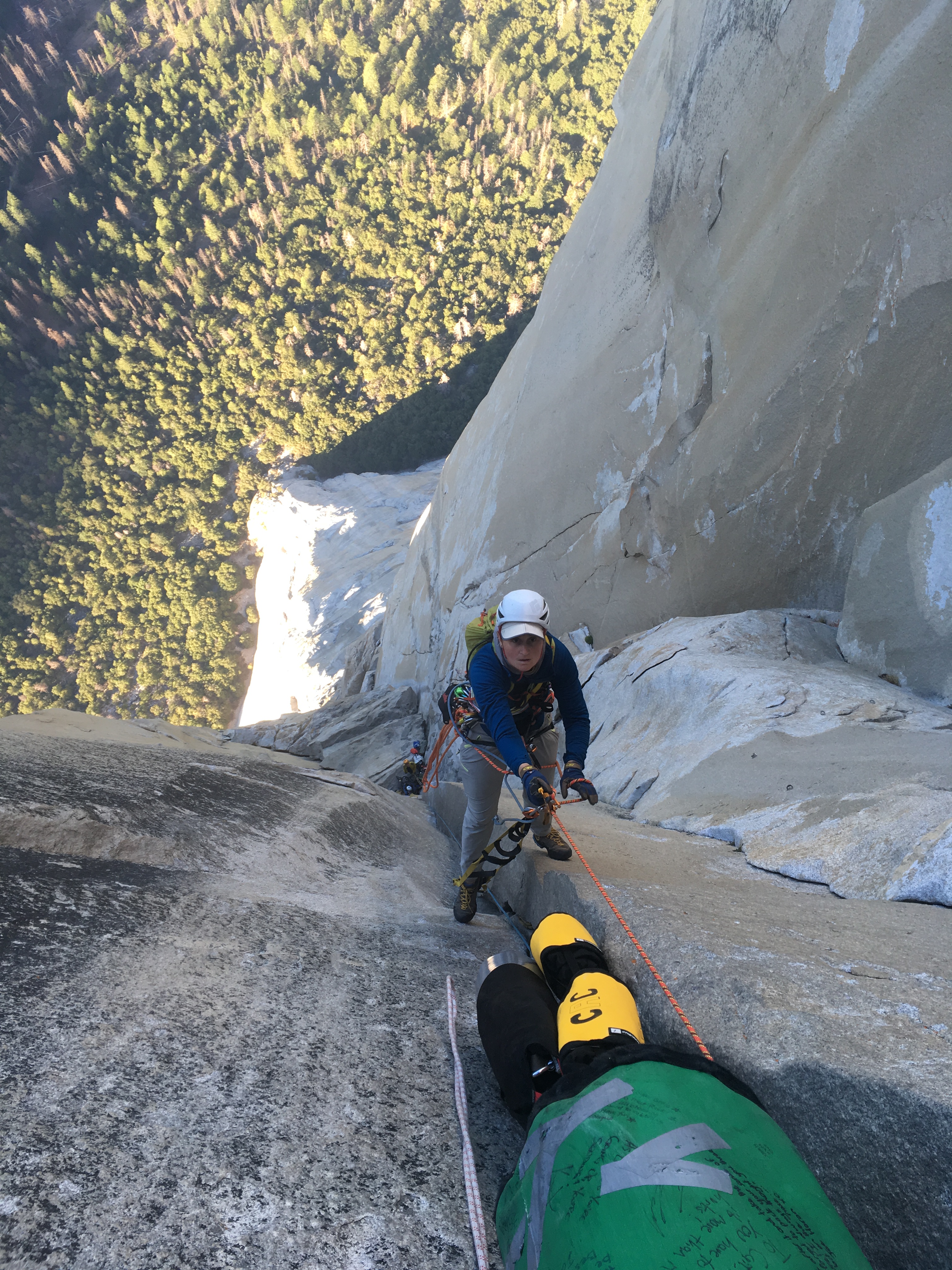
Suspended from slings 200 meters above the sucking void on Ozymandias, I dropped the camera and watched it zoom down in a spinning arc to crash into the scrub, lost, way below – after we had just finished the hardest sections of the climb and were now on somewhat easier pitches to the top. I was unaware that this might have been an omen of things to come – my own fate aligned to that of the tough little red camera that had accompanied me on so many adventures.

­­­­­­­­­­­­­­­——————————————————————————————

A song and a poem – “Ozymandias” by Shelley (the source of the climb’s name) and “Viva la Vida“ by Coldplay had somehow become entwined together in my psyche.

“My name is Ozymandias, king of kings:

Look on my works, ye Mighty, and despair!

Nothing around remains. Round the decay

Of that colossal wreck, boundless and bare

The lone and level sands stretch far away.”                 Shelley, Ozymandias

What is the worth of a life?

Death, whatever do we leave behind?

Monuments? To matter for a while?

Unknowns – cosmic consciousness, God, the random chances of life.

Challenge – the rope and our skills the lifeline that keeps us safe

Above the growing, beckoning space below.

Like edgework, dipping a toe into the abyss

Not cheating death, just opening the door a crack

Into our own mortality.

Even the hard, vertical granite isn’t permanent,

Minerals once deep under the earth’s crust,

Eventually eroding to dust.

A different timescale.

Geological epochs shrink a human lifetime

Into a mere split second,

Across the ebb and flow of the universe.

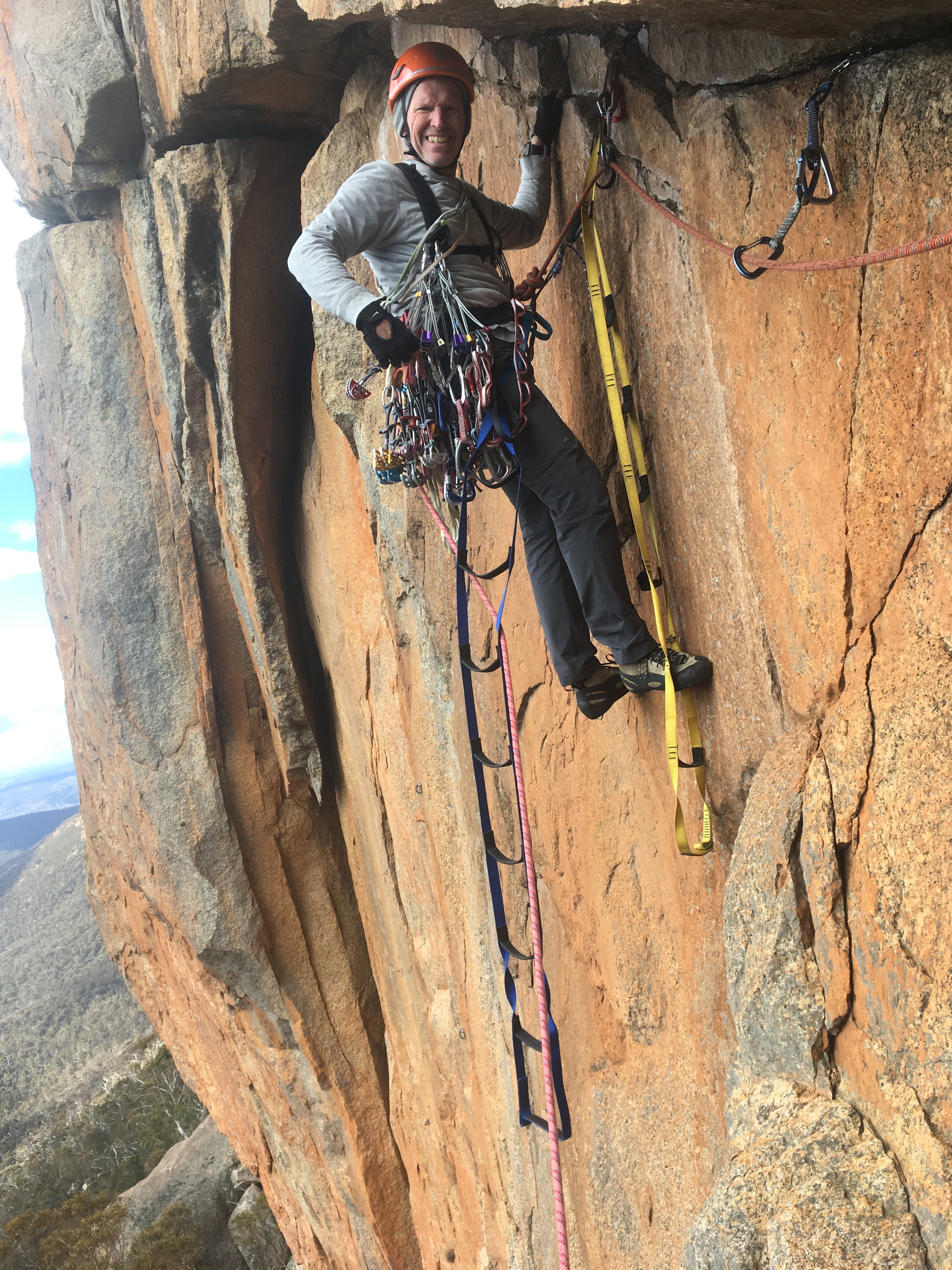
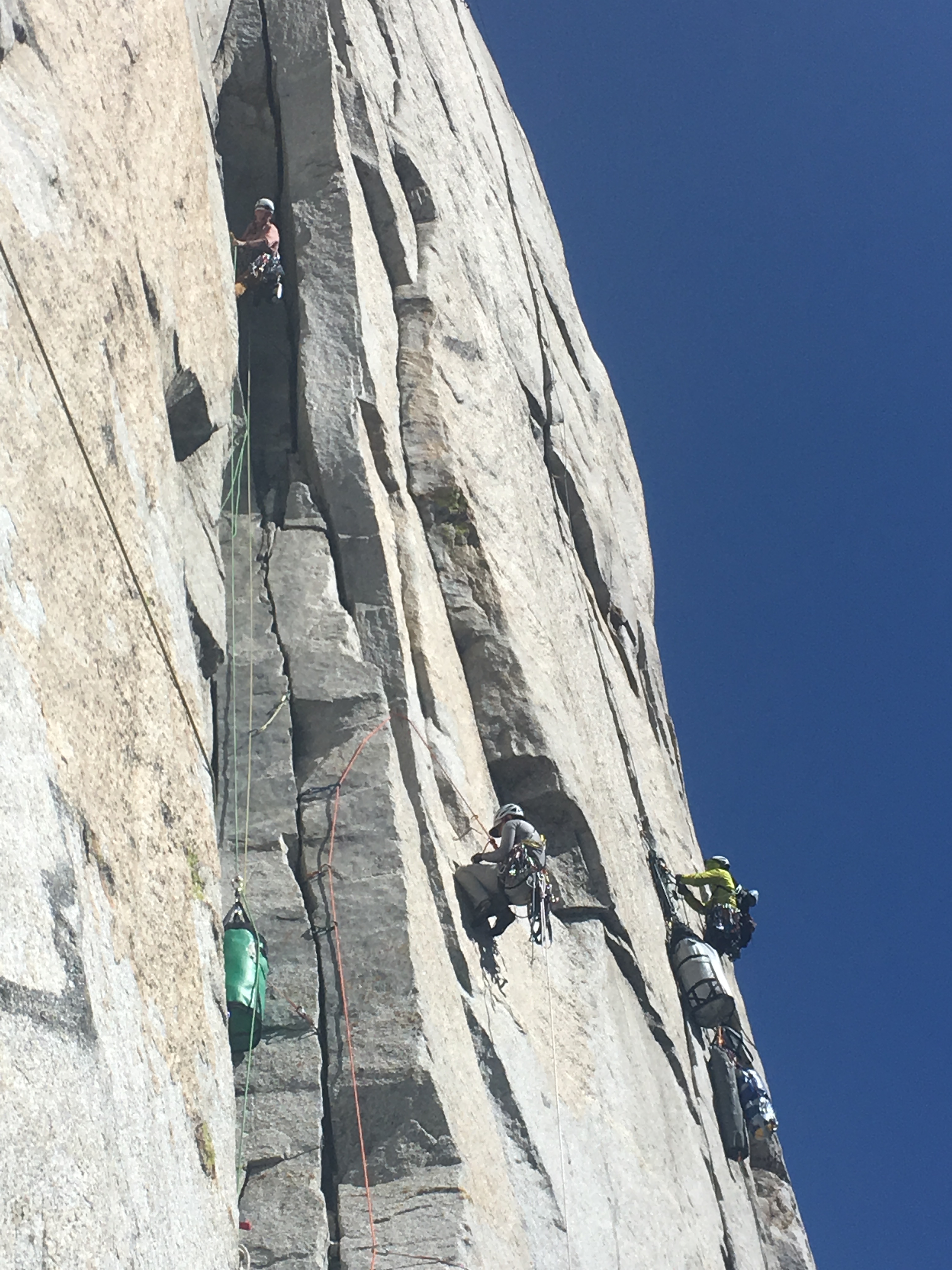
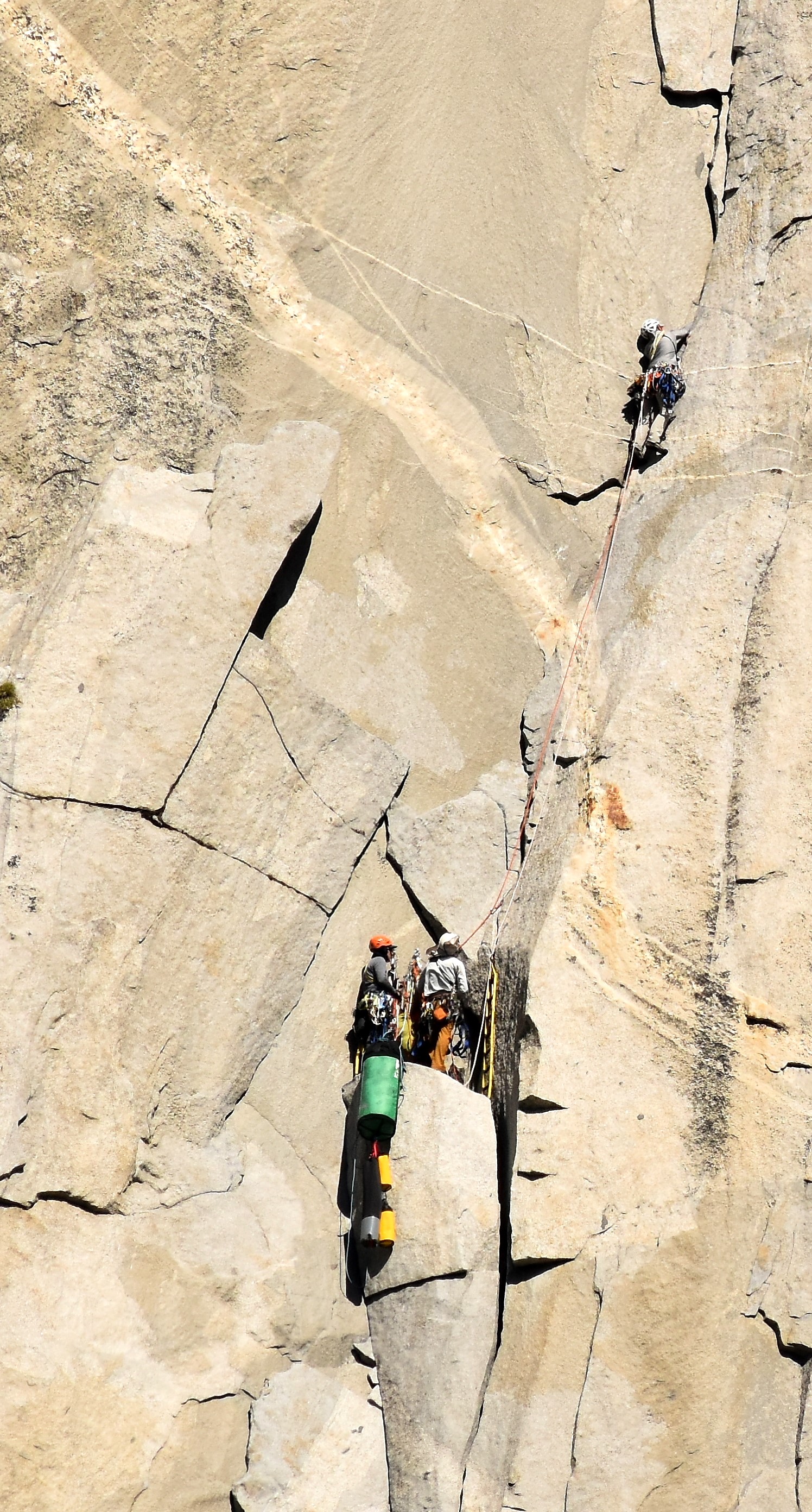
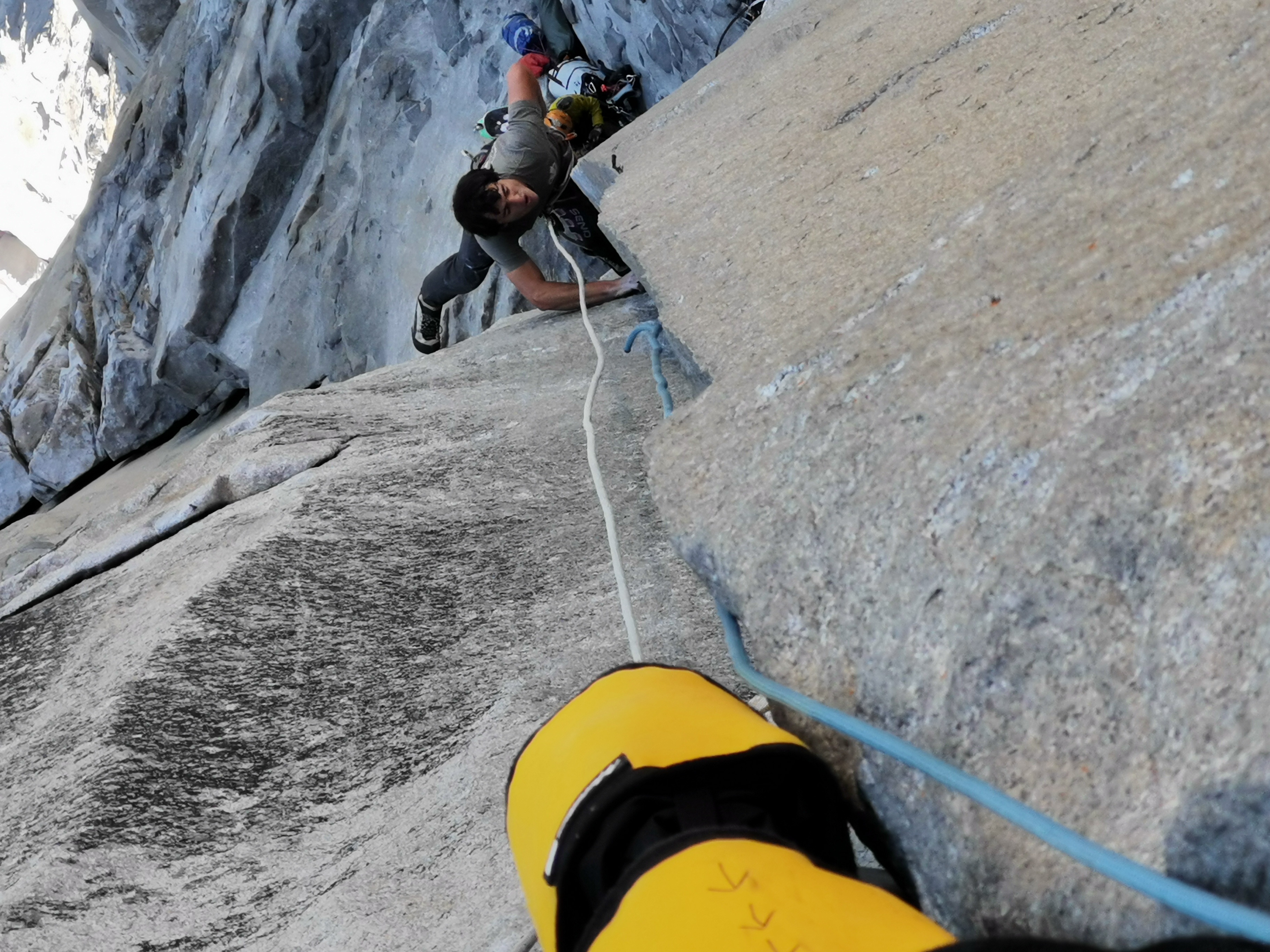
Hanging. Two good bolts and an old rusty one. Below “The Big Roof” – pitch 7. Matt fed the lead rope through his device while I managed the flow our two ropes. We chatted and photoed. Greg moved up smoothly, aid climbing up a ladder of old rusty bolts until he was at the roof. He reached out and placed a nut in the crack and tentatively moved out, gingerly transferred his weight. Then again onto a small cam. At the lip he struggled a small metal nut into the thin crack, 180m of yawning air below. Combining strenuosity and delicate care he pulled through onto the wall above the roof, repeated, and then was out of sight to us.

The ropes pulled up a little.

“Scream!!” In an instant Greg was dangling, swinging in space below the roof. Swimming in the ocean of emptiness between the waterfall and Mt Bogong on the horizon. Like a giant spider on our 10mm diameter nylon thread. His top two pieces had ripped out as he’d tried to place a higher one. In climbing terminology this was a definite whipper. Spectacular. Matt and I gulped at the epic dimensions of the situation. Ozymandias Direct, the “King of Kings” of Australian big wall climbs, Mt Buffalo North Wall. A “vast and trunkless leg of stone standing” high above the valley.

Greg had plunged from above The Big Roof. He didn’t seem to be afraid of falling. A terrifying screamer over the lip into the beckoning void below. Swinging in space. Then he just got on with the job. Pulled himself back in and up to the roof then tried again. Had he taught himself how to do this? I had only taken a few falls in my climbing career. The biggest one had been while leading a new route on the bottom tier of Point Perpendicular. I had checked it all out on abseil first and removed some loose rock. At about 2/3 height, having done the hardest part I reached up to pull myself onto a triangular shaped ledge. As I did this the whole ledge eased outwards. As an automatic reaction I tried to push it back in. Of course this didn’t work on the fridge sized block but it probably saved my life by propelling me backwards away from the plummeting block. Miraculously it missed hitting my rope and also one of the Ians below – one was belaying me off to the side and the other was lounging around nearby. The rock exploded at the base while I was brought to a stop in mid air by the rope. Completely uninjured I dusted myself off, regained composure and led up to the top, a little slower. One Ian never climbed again. I named the climb “Into the Mystic”.

              I can hear the seabirds sing

              Feel the sea and touch the sky

              Let my soul and spirit fly

              Into the mystic                            Van Morrison

Confident, committed, muscles bulging. Greg hauled himself back into the rock. Climbed back up to the lip then placed new tiny protection pieces in the crack above and moved stealthily upwards. Out of sight again. In his more regular climbing exploits Greg is a roof specialist, thrashing himself on some of the hardest climbs in our region. Hanging upside down and falling. He seemed unfazed. His extensive experience in this hostile upsidedown world had conditioned him to respond with passionate self-possession?

——————————————————————————————
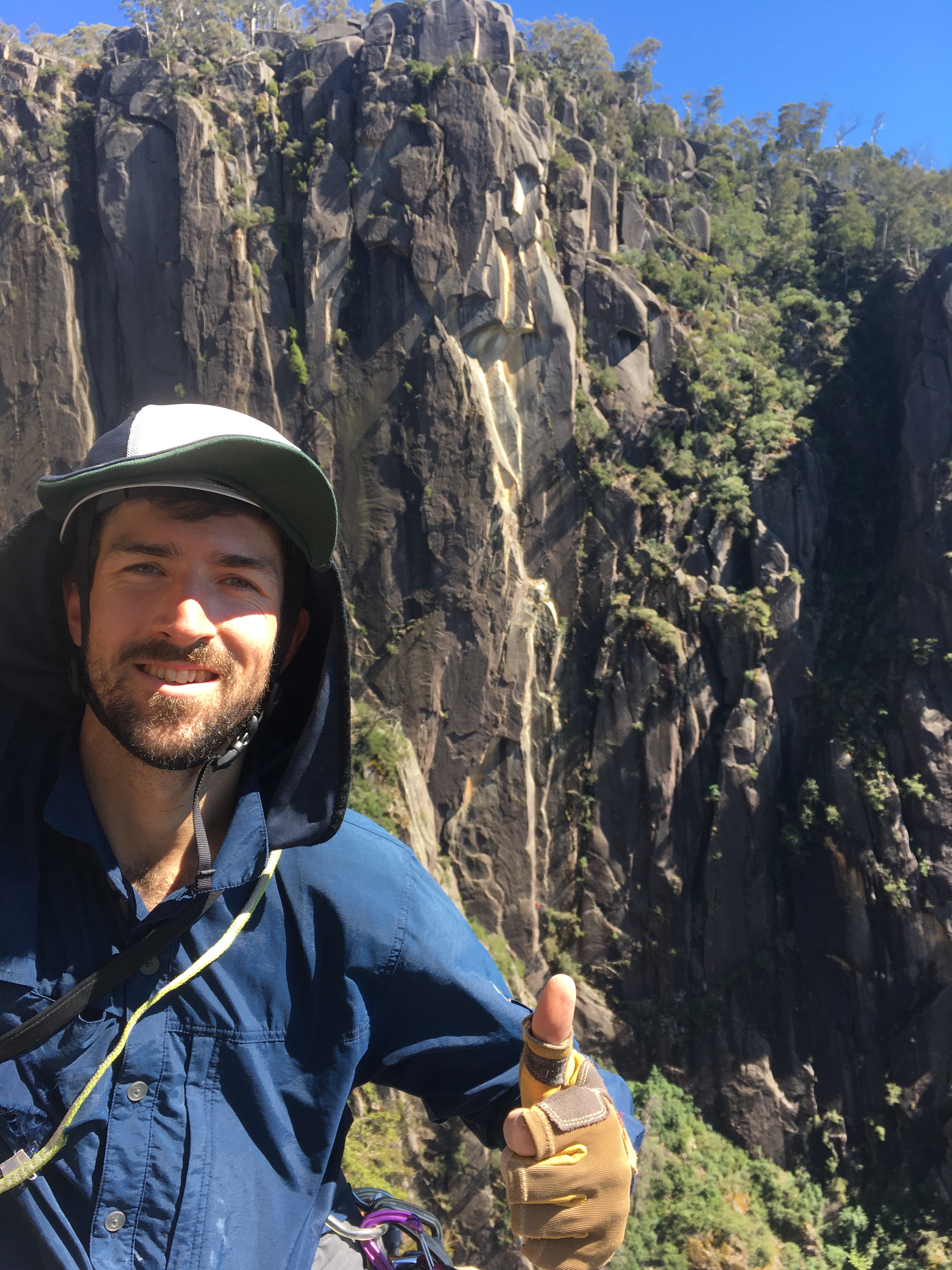
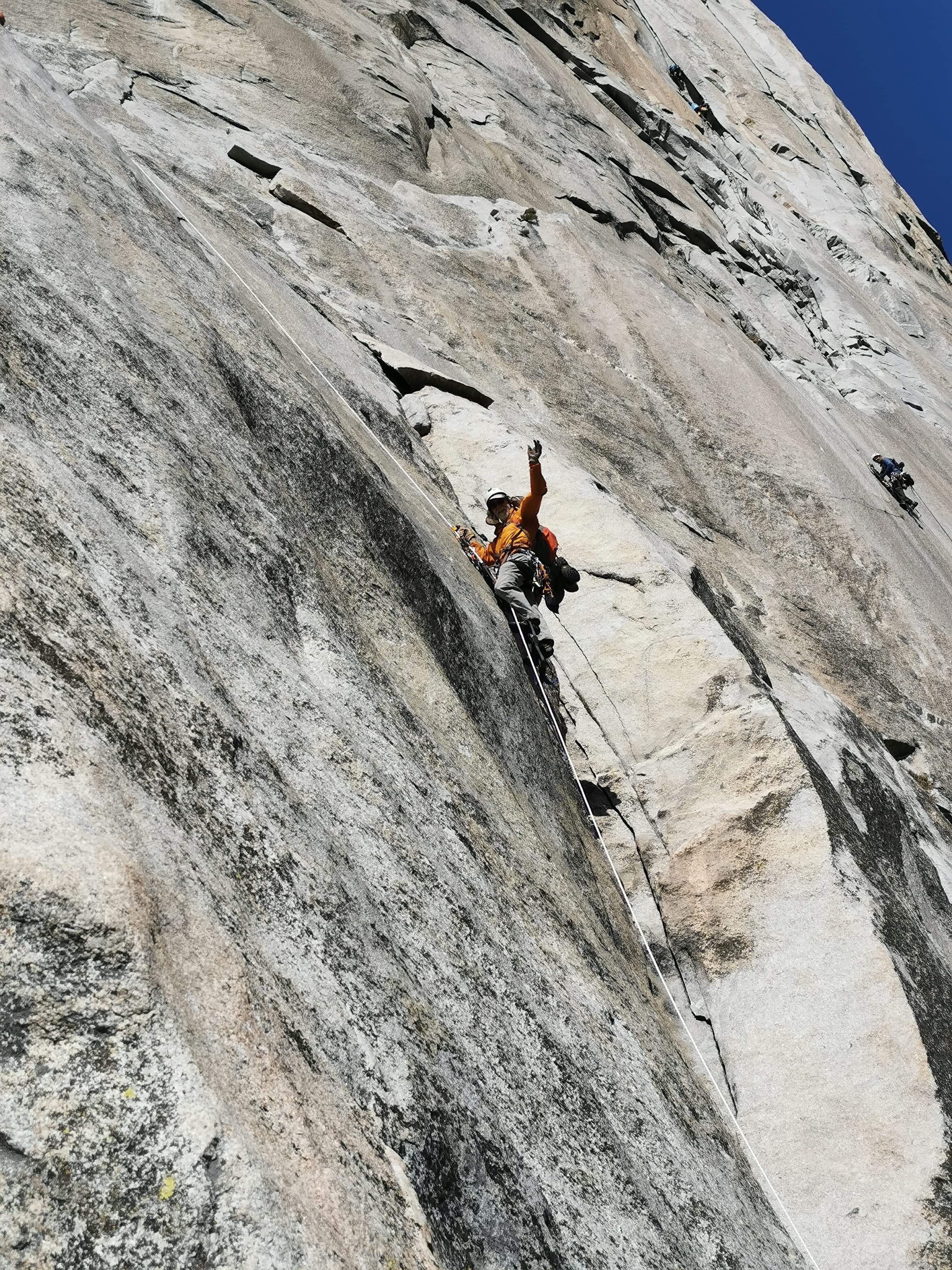
The line of Ozzy goes straight up from just left of Matt’s thumb

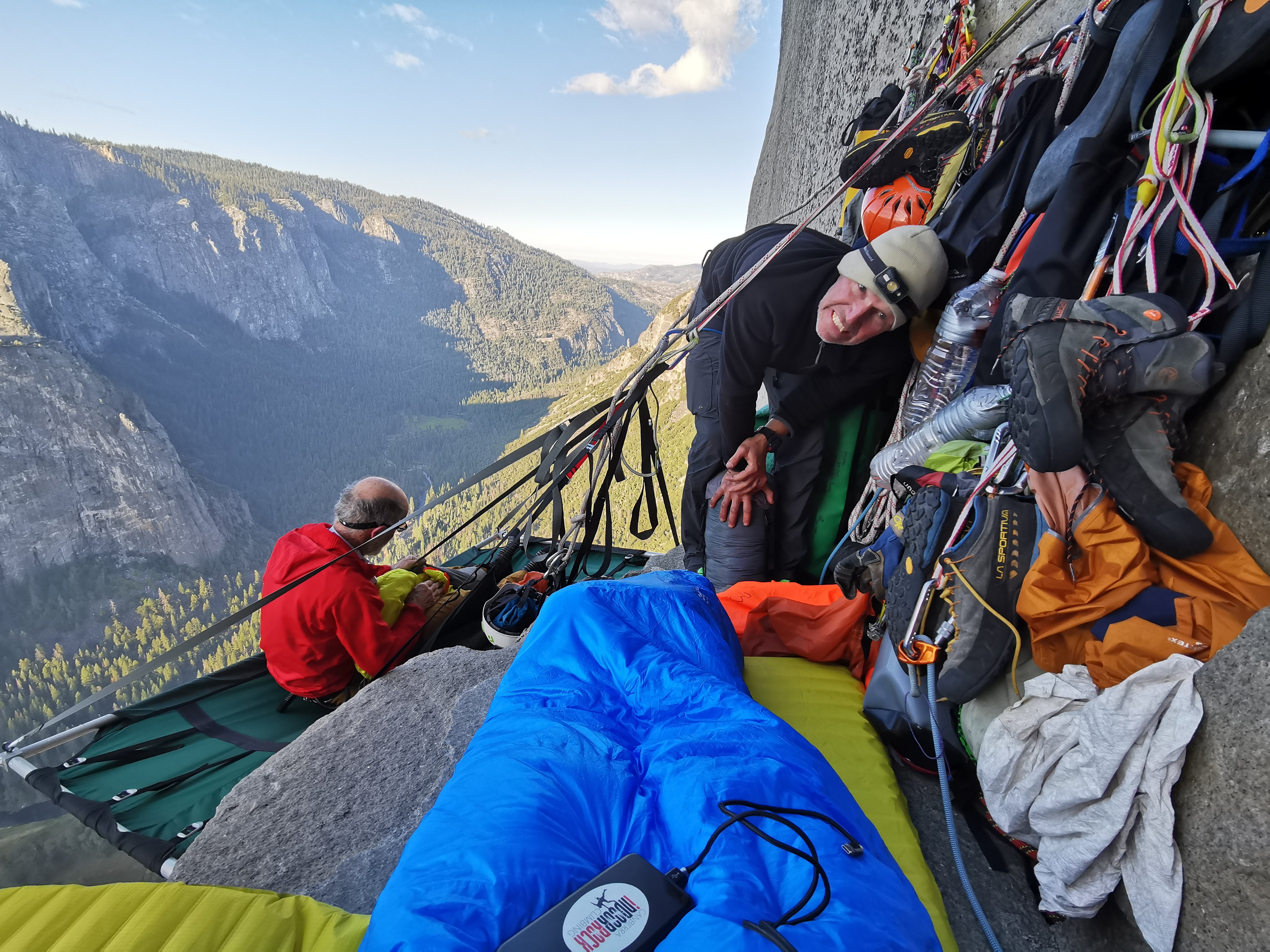
2020. A year earlier Matt and I had attempted Ozzy. All had gone well early on – logistics, hauling, teamwork, climbing. Then on the crux 3rd pitch I had led up the tenuous, thin aid (harder than anything Greg and I had done on the Nose of El Cap two years before that). In a moment of premonition I placed a dodgy micro cam and looked down at a bulge below and thought “if this comes out I will likely clip the edge of the bulge on the way past”. This is exactly what happened. Like a fall from grace. My ankle hurt but otherwise I was ok. So I pushed on back up and to the next belay and then to Big Grassy, the bivvy ledge. We stayed a comfy night on our portaledge. In the morning I removed my shoe and sock to reveal extensive bruising, swelling and pain.

We made the decision to bail out as I couldn’t guarantee to be able to lead all the 6 remaining pitches and Matt was still learning the ropes of big wall climbing. We abseiled down, Matt with the haul bag. Then we hiked slowly back up the southside of the gorge – me with a light pack and Matt with half our heavy stuff. Fit as a fiddle and keen as mustard Matt then hiked back down again and up with the rest of the heavy stuff.

The colossus of granite had remained lifeless, unaware of our comings and goings, rooted in deep time. I had felt deflated. Humbled. Weak. Fleeting. Damaged. Long Live Life – “Vida La Viva” – my favourite motivational theme song now came back to haunt me. I had been the king of my own climbing world. Now “One minute I held the key, Next the walls were closed on me, And I discovered that my castles stand, On pillars of salt and pillars of sand. I used to rule my (the) world”. Now my place in that world seemed a little insecure. In the overall scheme of things what were our climbing achievements worth anyway, in the long run? Around the corner in Australia lay fires and floods and covid and war.

Coldplay – Viva La Vida – Live in Sao Paulo  https://www.youtube.com/watch?v=-ZvsGmYKhcU

The ankle was fractured. I was 63. Could I come back from this? My aging arms were seeming to whither away before my eyes. Would I have a weak and painful ankle from now on?

————————————————————————————————–

Matt had got us up to the big roof the day before, on Day 2. He’d led pitches 5 and 6 with finesse up thin cracks and the beautiful long corner, then stretched out across a blank wall past old bolts to the hanging belay.

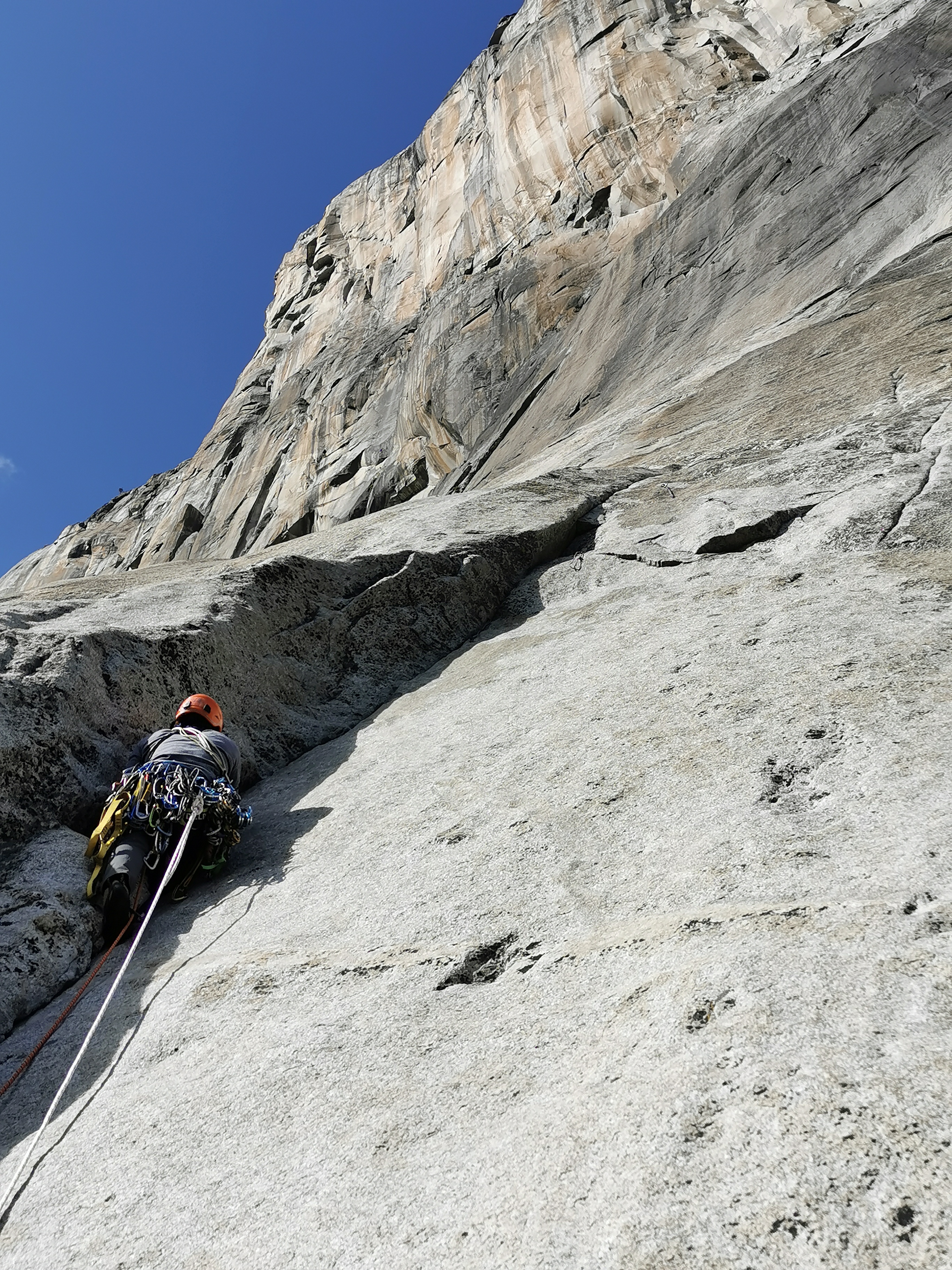
Matt leading Pitch 6

On our approach day, Day 1, we had carried everything down into the Gorge and up to the base of the north wall. While I sorted out the bivvy on the ground and filled the water bottles from the stream Matt had led pitch 1 and then Greg led the long hard aid pitch 2. Hungry possums and mossies invaded our slumber overnight.

——————————————————————————————

The ankle healed surprisingly fast. A deep love of climbing, the mountains and of being active in natural landscapes kept drawing me back to thoughts of Ozzy. I started researching training for older climbers and unexpectedly found info on the possibilities of muscle building even after diminishing testosterone levels during aging. Consultations with a top climbing nutritionist and a sports physiologist led me into a detailed training and eating program. Results started to show, my confidence and capabilities developed. Greg launched me jubilantly into hitherto never before even contemplated, steep, overhanging sport climbs. My running fitness improved as well.

————————————————————————————————–

After our bivvy on the ground we ascended, on Day 2, up our fixed ropes to the high point at the top of pitch 2. I challenged myself to lead pitch 3. We had brought some better (DMM) micro cams. Time slowed down, the world closed in, fear bubbled away in the background, concentration focused on each single component of the climbing process. “Watch me here. I’m at the bulge, Moving up Matt.” Micro cam, cam hook, good wired nut. Tension eased, the view, the rock, the landscape, mates. Life is good. “Safe.” Greg then led some more difficult aid on pitch 4 up to Big Grassy. No falls, no blood. Overnight I curled myself between some rocks while the others slept on the portaledge.

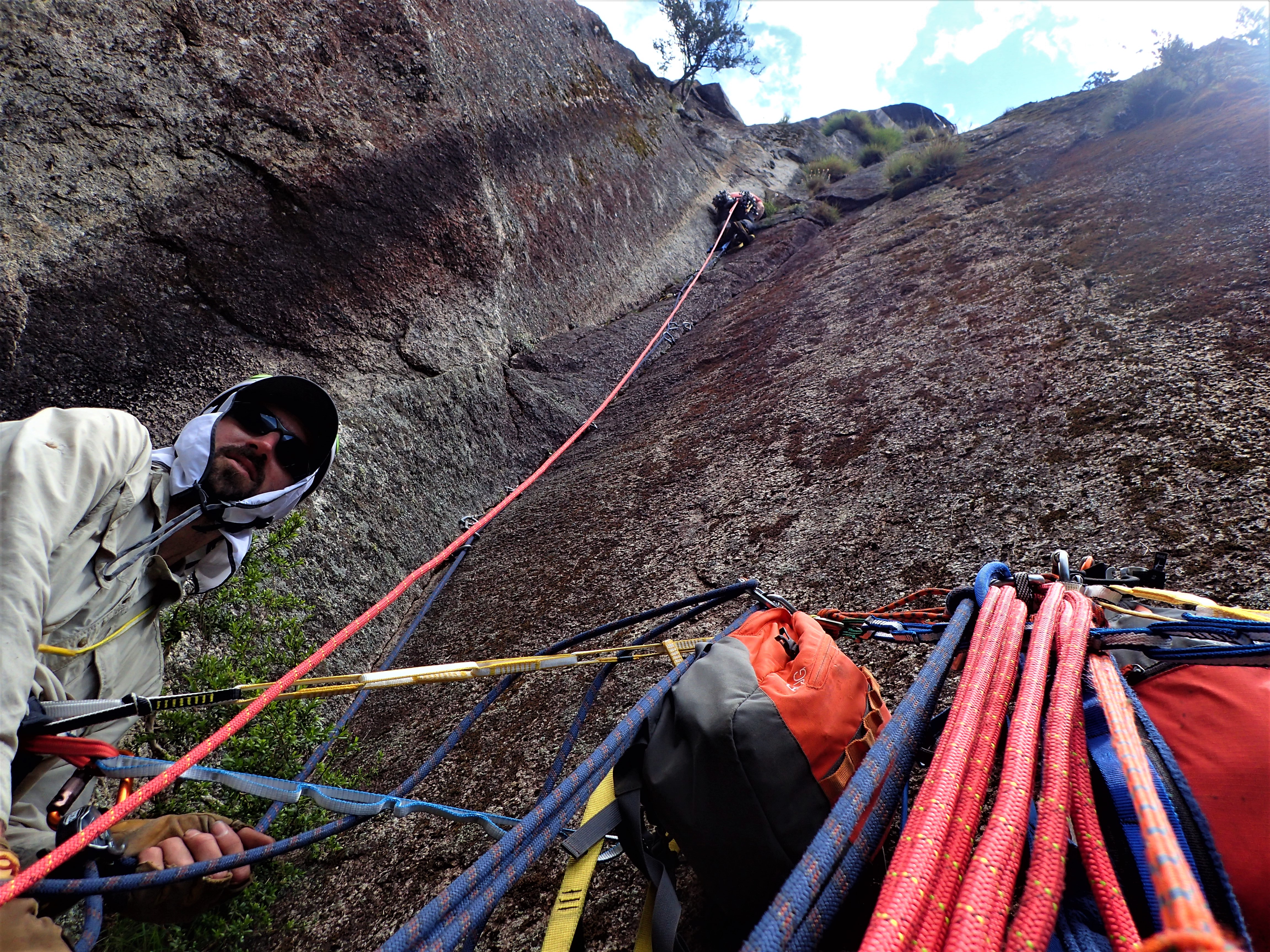
Matt cleaning Pitch 7 after the Big Roof

(the next day, after the Big Roof) “Ropes fixed.” “Yahoo,” Greg. Phew. “Nothing’s gonna stop us now”. I let go from the belay and swung out under the roof. Attached to both ropes for extra safety I soon got tangled up transferring from one to another while swinging free but eventually made it up to smiley Greg at another hanging belay. As we hauled the bag Matt cleaned the gear from the thin crack. Matt then led out right across a blank wall and round an edge out of sight. He quickly dispensed with the wide Fang courtesy of a couple of BIG cams. I took the wandery pitch 9 to a big flat ledge where we could all just relax and stretch out. Matt topped us out up a crack system and an offwidth that gobbled up the big cams again. Afternoon Day 3. Brilliant. The sun shone warm and bright on our celebrations.

I was back in the game. Big time. Firing. My heart was overflowing. The mountains were smiling.

RUNNING

Marathon – April 2022

Dawn. The sky was already bright. Hot blue. 5.30am. The range of hills to the east would shade the route for another half hour or so. For the last hour pre dawn it had been cool, no sunglasses needed through the darkness. Summer. The pointy end of marathon training for Canberra always rolls around January, Feb. 20 to 35 kilometer long runs. You’ve got to be finished by 8.am otherwise you just get cooked. 2 to 3 1/2 hours steady, and longer on the last one under the run walk run regime – run for a kilometer, walk for a minute. I would drive out and hide drinks beside the road in the farmland and bush beside the road the day before. It’s pretty flat, peaceful, quiet. Not much traffic on the country road. Twelve times I trained and ran marathons, mostly alone recently. Lots of time in my own head. Sometimes quiet. Occasional podcasts. Mostly with a playlist soundtrack. 60 to 70 running tunes. Over and over and over again. Like the paces, hundreds, thousands. Cushioned shoes on hard ground. Cool air. Alone. Movement. Wonderful movement of legs and arms and whole body in motion and rhythm. Number 1 at age 34, inspired by a mate. Then several with friends – a loose running group, Sunday mornings together then the bakery. The year 2000 with a friend – the Sydney blue line Olympic trial finishing in the stadium. Supporting others through their own “walls”. And more recently alone, with the music cranking. Lucky with my able body.

Marathon number 12 was a milestone at 65. At the start I was full of gratitude to just make it there, not sick, not injured, feeling ok (especially as Covid had struck me down 6 weeks prior).  New research was out that running in the long term can be good for your body, for your knees. 4 hours 41 – slow, but I managed to maintain run walk run, didn’t hit the wall, came out injury free. And in Marathon Week I reached my other objective of 1000 km and 10,000m of ascent for the year of running! Objectives I set for myself give structure to training, running, getting fitter, stronger. And in each run there’s a visualisation of reaching the goal, probably all tangled up with those feel good hormones that kick in during the latter stages. 
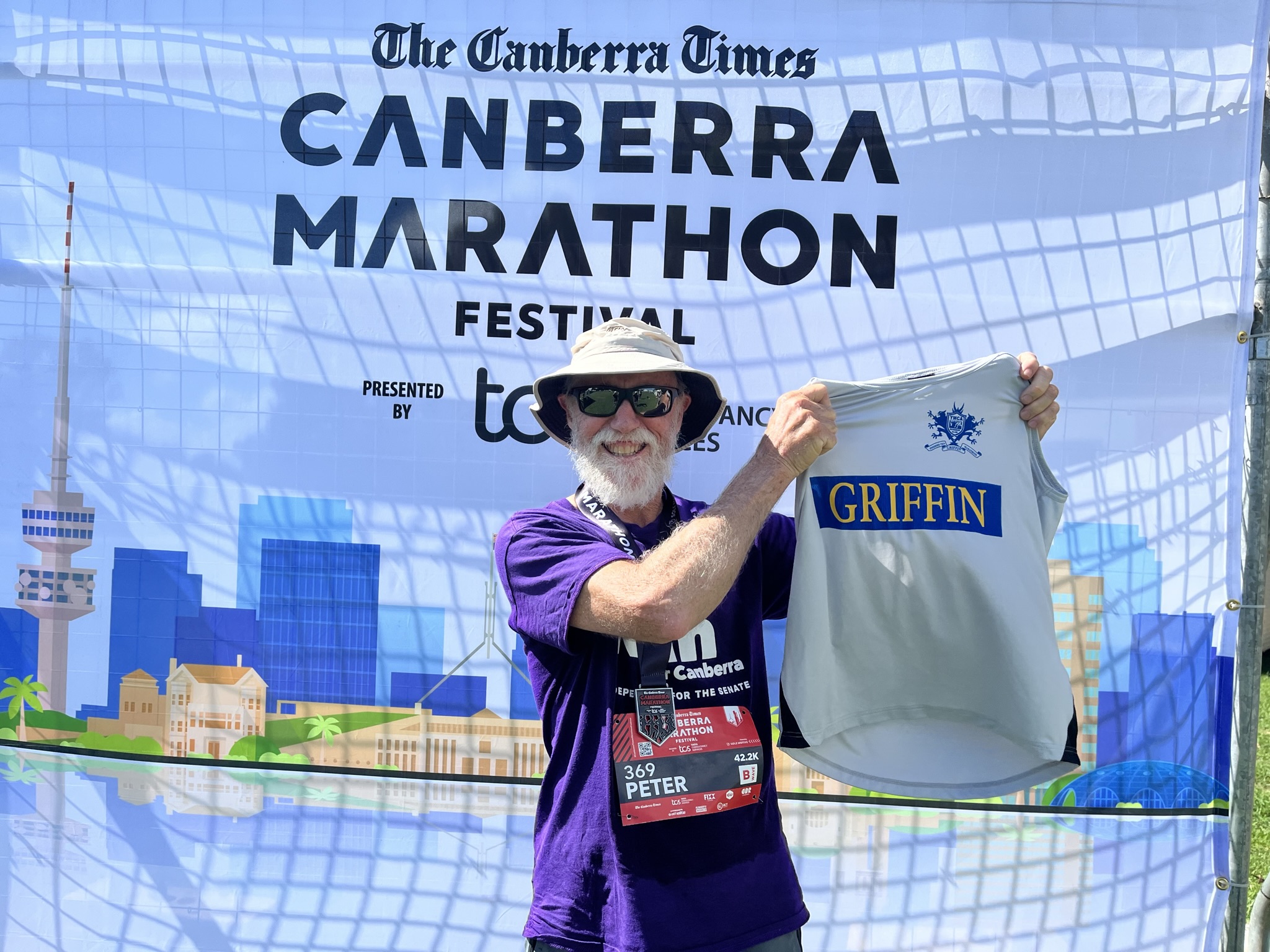
“It’s a Beautiful Day” – U2, as I crossed the finish line as planned, and had hoped for over the past year.

BLINDED BY THE LIGHT – 2022 a few months after the Marathon

Body clocks and biorhythms vary between people and over time. For decades I had run in the mornings but after easing out of regular time committed work my preferred hours moved to the afternoon and the later hours of the day. Occasionally in winter that stretched into the dusk and early evening.

A mixed trail and road route took me undulating round the base of Tuggeranong Hill. From the southern side the sunset blazed back into the Brindabellas shafting the last light from behind a rounded peak.  The gloaming drew me into darkness up through the local suburban streets. As I crested a rise on a narrow path through grassland a full moon rose, silhouetting tall eucalypts. Gently downhill. Easy. Fast pace. Like flying. Endorphins. Breathing matched paces and it felt like heartbeats keeping time. Manfred Mann burst forth “Blinded by the Light”. The world ran with me all in synch. I sang along, my whole body singing. Running like the wind.  Through the cosmos.

FITNESS TEST

Building towards two long awaited and anticipated mountaineering trips to New Zealand, north island volcanoes in September and Southern Alps peaks in November, my fitness and strength was coming along well. For the duration of Covid I had tried to book a high powered University of Canberra Sports Science fitness test including VO2 Max and Max heart rate so I could use the data to make sure my training was maxing out in conjunction with the data from my Garmin watch. On a routine visit to the doctor for some updated travel vaccinations I discussed with him the idea of the fitness test as a double check and he reassured me that it should be fine seeing I was really healthy and fit but if I really wanted to be safe, considering there were some heart issues in my family, I could have a heart scan to be absolutely certain all was ok for me to go ahead. I decided to be super safe and go ahead with the test after returning from overseas.

NEW YORK – June 2022

Bushwick, Brooklyn, is deemed one of the coolest hoods in the world. Visited my son, Matt, after 2 1/2 years of Covid separation. He’d taken me on walks through his Brooklyn, the Jewish quarter, honking streets, quiet brownstones, parks pumping with African American muscle exercise, pampered dogs walking people, Mexican dinners, music. I’d slept in the basement cool for too long and the heat was already building. I jogged the main street towards the water, map and phone and credit card in a pocket. The train tracks raised above the road just amplified and added to the soundscape. A little lost around Dumbo but enjoyed the waterside park. Round and up onto Brooklyn Bridge, walkers, traffic, those famous views 360 degrees. Past halfway across it slopes slightly downhill. I was inside Springsteen’s “Born to Run” underneath the Stars and Stripes hanging from the towers.

Down into the city humidity. Saturated with sweat. Starbucks water, bad coffee and a snack on a park bench with others less fortunate nearby. Steel glass concrete skyscraper homages to the dollar all around.

Wound my way through downtown back towards the river. Doubled back a little lost at times. Slow progress. Kept the fluids up. A long detour past roadworks and foreshore developments to get onto the Williamsburg Bridge. Images from all those past training runs – this could have been my own long imagined international big city New York marathon, helping to get fitness ready for the big ones – those two mountaineering trips to New Zealand. This bridge seemed much longer. A grind. Along the streets and eventually back to the Bushwick apartment. A tiring 20 km. But Big Apple spectacular.

TURKEY             June, July 2022

Istanbul. Bustling, alive, vibrant but with quiet places. Glorious mosques. History at every turn. Where the Oriental east meets European west. Russia just up the Bosphorus and Ukraine nearby. Tacked onto the end of Cath’s work in southern Turkey.
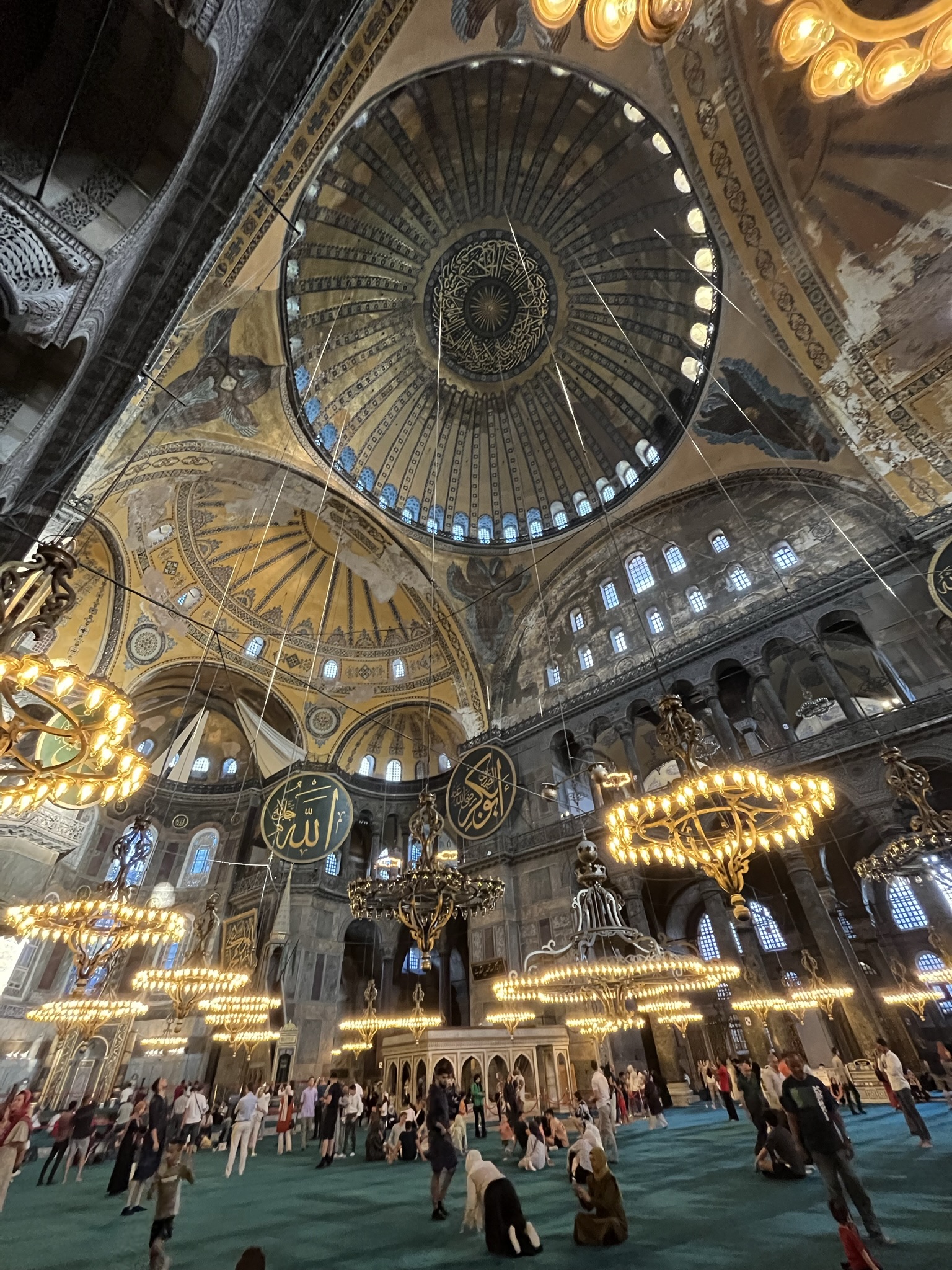
The Blue Mosque

We visited the “Museum of Innocence” which was made by Orhan Pamuk to illustrate his book of the same name – dozens of small boxes (vitrines) were filled with items and special momentos that connected to elements of the story. I was flabbergasted to see this embodiment of an artistic idea that had been percolating in my own head for a decade or so and for which I had been collecting.

Mediterranean. Antalya, Kas, Fetiyhe. Roman and Lycian ruins in the forests, by the ocean, in the fields and right in town.

Lycian pillar burial tomb 479BC

Summer heat too hot to run. Beaches. Crystal clear water iridescent blue like it’s lit up from within. Cath and I swam and snorkelled and stroked our way through the gorgeous warm ocean. It all felt a little like a long second honeymoon.  Through various beaches and bays along our coastal journey I strung together 10km of freestyling shallows and deeps, feeling free and smooth and strong.

TEST     July 2022

Back home after New York and Turkey I followed up my doctor’s recommendation. Like a large MRI machine. Lying on a board you are slid into a large tube. The coronary CT angiogram makes a series of weird noises around your body during a series of breath holds. I felt good, confident. Didn’t even need the drugs to slow my heart beat (my resting rate was averaging about 43 to 45, supposedly superior endurance athlete level!).

Dad had died at age 65 at his third heart attack in three years. Mum, who had been a nurse in an earlier stage of life, CPRed him back from the first two while waiting for the ambulance but couldn’t manage it for the third one. He worked an incredibly stressful job being responsible for the transport and deployment of munitions through Sydney to naval ships at Garden Island among other major tasks as head of naval supply. He had been a smoker prior to marriage, did not exercise much in later life and probably had some form of PTSD from war service experience. At his first heart attack he retired with 18 months of long service leave owing (foregone holidays). His passing had a big impact on my life choices going forward. From about age 30 I determined to live an active life, eat a heart healthy diet and retire in time to enjoy years of life not working. My job was stressful in bursts and I had a high level of duty of care for those in my responsibility – running was a wonderful release from this. Work and interest in adventure activities kept me quite active, running became a passion, I took care with what I ate and retired at 58 in good health and fitness. My cholesterol was mostly on the borderline between normal and high but never high enough for my doctors to be concerned especially considering my fitness and general health levels.

Back at home after the test Cath teased me about seeking over servicing in the medical profession – obviously she thought it was unnecessary, “Stupid Garmin watch, waste of $400 for the scan” she said.

CCA (Canberra Climbers Association) PRESENTATION            July 2022

I’d been asked to do a presentation for CCA about my journey into climbing that led eventually to New Zealand mountaineering at an older age and to share tips for entrée to this endeavour. Through a series of photos I summarized a long history of rockclimbing and adventure through my adult years and how I had suppressed a deep interest in the bigger mountains. I just was not able to fit in mountaineering between family, work and other things. Then I related how in early retirement on a hiking trip in Switzerland where I was immersed in the most beautiful peaks of The Alps and connected with the history of climbing at the base of the Eiger – all the things I had spent so much time reading about over decades – I was overcome with emotion for the mountains. A short time later time became available which I grabbed at the age of 59 to do a technical mountaineering course in the Mt Cook area. There followed month long trips to NZ each summer for 3 years.

After the broken ankle on Ozzy I had undertaken a detailed nutrition and strength training plan that had worked for me as an ageing climber. In the presentation I tried to share this in a way that might encourage others with similar ageing bodies to realise that improvement was still possible.

I had quickly developed a list of 100 great achievable NZ peaks to climb over the next decades and cast my net wide for partners. The depth of the upwelling emotion in the mountains was a constant surprise and delight. Perhaps its source was in the decades of interest that had percolated inside me which finally had the chance to unfold into reality. I passed on all the tips and insights I could synthesize about moving from rockclimbing to mountaineering in New Zealand and my unbridled enthusiasm for the year ahead that included two trips to NZ (North Island Volcanoes in winter, Tasman area peaks in November), climbing a couple more of my “7 Australian Alpine Mainland Winter Summits”, Blade Ridge on Federation Peak in February and another Yosemite big wall the following September. What a year I was looking into! I hoped that my deep love for climbing and mountains shone through.
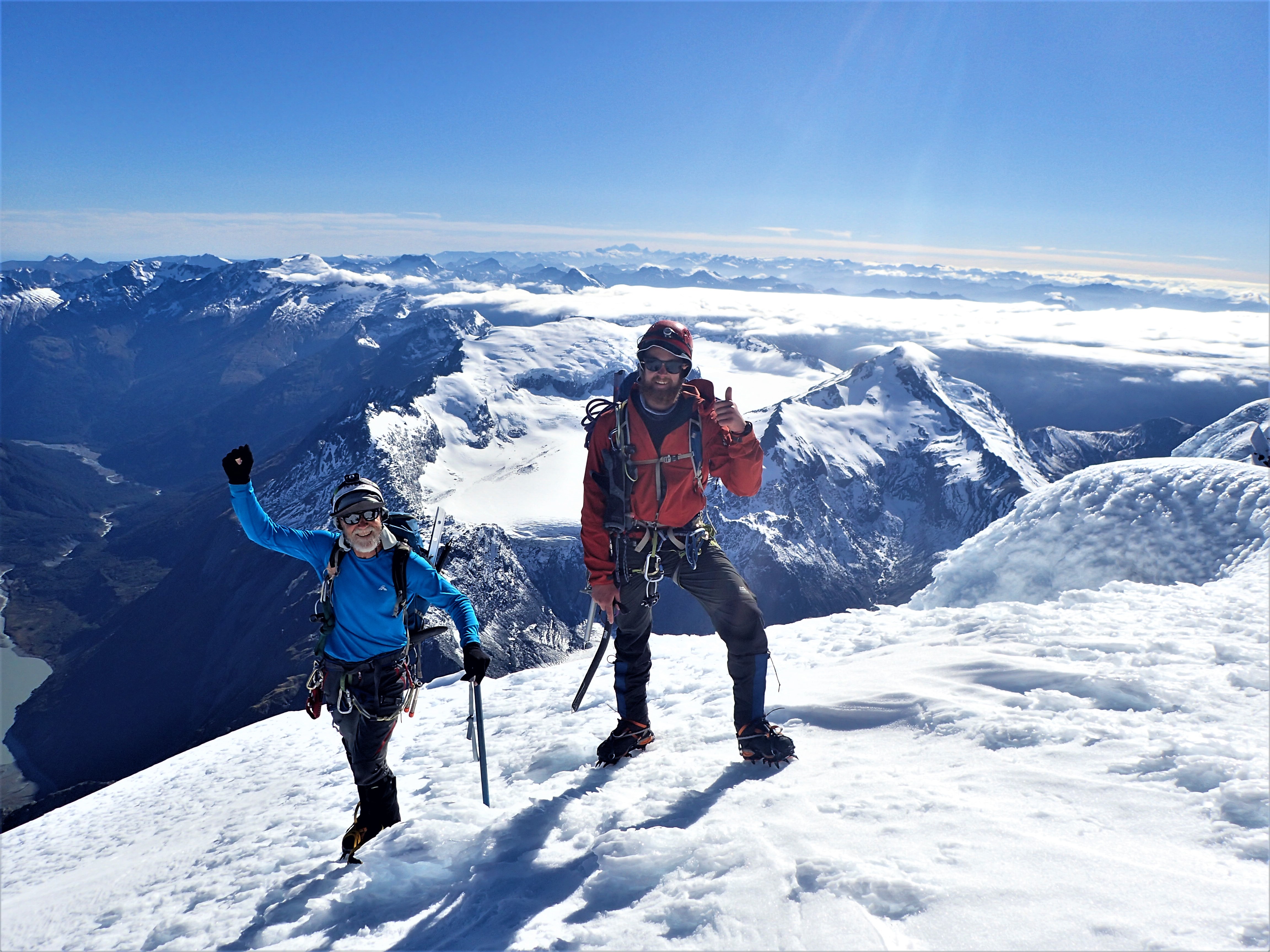
Mt Aspiring summit

OUTDOOR LEADERSHIP MENTORING PROGRAM – SKI TOURING GUIDES COURSE           July 2022

Following retirement from full time work I’d kept up involvement in leading a series of outdoor activity leadership courses for teachers – vertical rescue, bushwalking, rock climbing, caving, canoeing and kayaking, snorkelling, etc. No-one else was really in a position to be able to do this while working full time jobs and having young families. I really enjoyed the work and being in amongst it all with fabulous, super keen, vibrant young adult outdoor education teachers.

During the early part of the pandemic the support structure for this program was threatened. I had been running it for about 10 years while teaching and was reluctant to see it fall apart so I took on the opportunity to strengthen it by developing an upgraded full course during the following lockdowns and restrictions in 2020, then led the whole thing during 2021. A continuous rolling series of big deadlines and commitments meant almost full time work again for long periods of time. By training, assessing and qualifying a large cohort of teachers I was able to ensure the ongoing sustainability of the program as others would have the skills and knowledge and experience to be the future trainers in the course. Towards the end of 2021, having led the whole first program, I looked forward to a low key involvement just leading a sprinkling of occasional courses in an ongoing fashion. However I felt a push to move on from mainstream involvement so decided to run just two more courses that no-one else was qualified to do. At the end of summer 2022 the south coast surf was marginal but we managed enough rescue, surfing and surf leadership sessions at various beaches to get the teachers through.

A ski touring guide course was my very last one. This was one of my favourite adventure activities to instruct – typically students enjoyed it immensely and picked it up fast, the environment was harsh but most often exquisite. Following on from snow skills experience the season before a group 15 of us headed out from Perisher with heavy winter packs in improving weather and good snow conditions.  Uphill. Over Wheatley saddle and down into Betts Creek, navigation, leadership scenarios, teamwork. We set up a base camp in deep snow in a sheltered site below perfect ski slopes – it felt remote and isolated. We built a snow kitchen with shovel sculpted couches of snow. Still, colourful sunset. Everything froze up overnight. Next day skiing, leading, more navigating, avalanche practice, and typical guiding and instructing scenarios, exploring, embracing the fluidity, soaking up the stunning beauty, laughing and sharing. Immersed in a white crystalline world. Moonrise coincided with the sun setting on day two – the fragile round earth rolls through space.
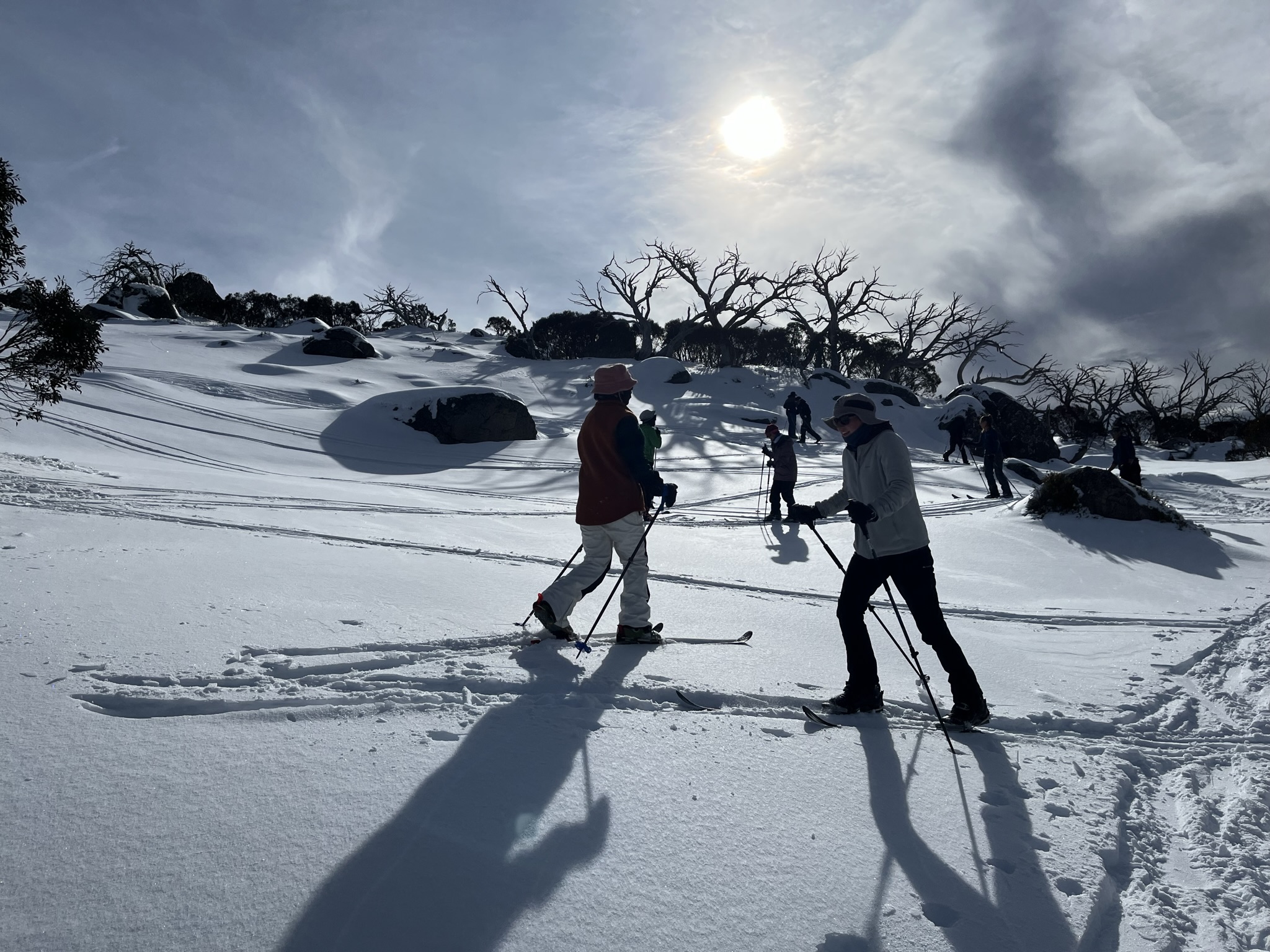
Blizzard conditions were forecast for late on day three. Some more advanced skills and terrain. Packed up. The weather started to deteriorate. We practiced navigating and moving through simulated whiteout conditions then the wind picked up to gale force as we made our way across an exposed saddle – brilliant training conditions that eased in the shelter of the next valley.
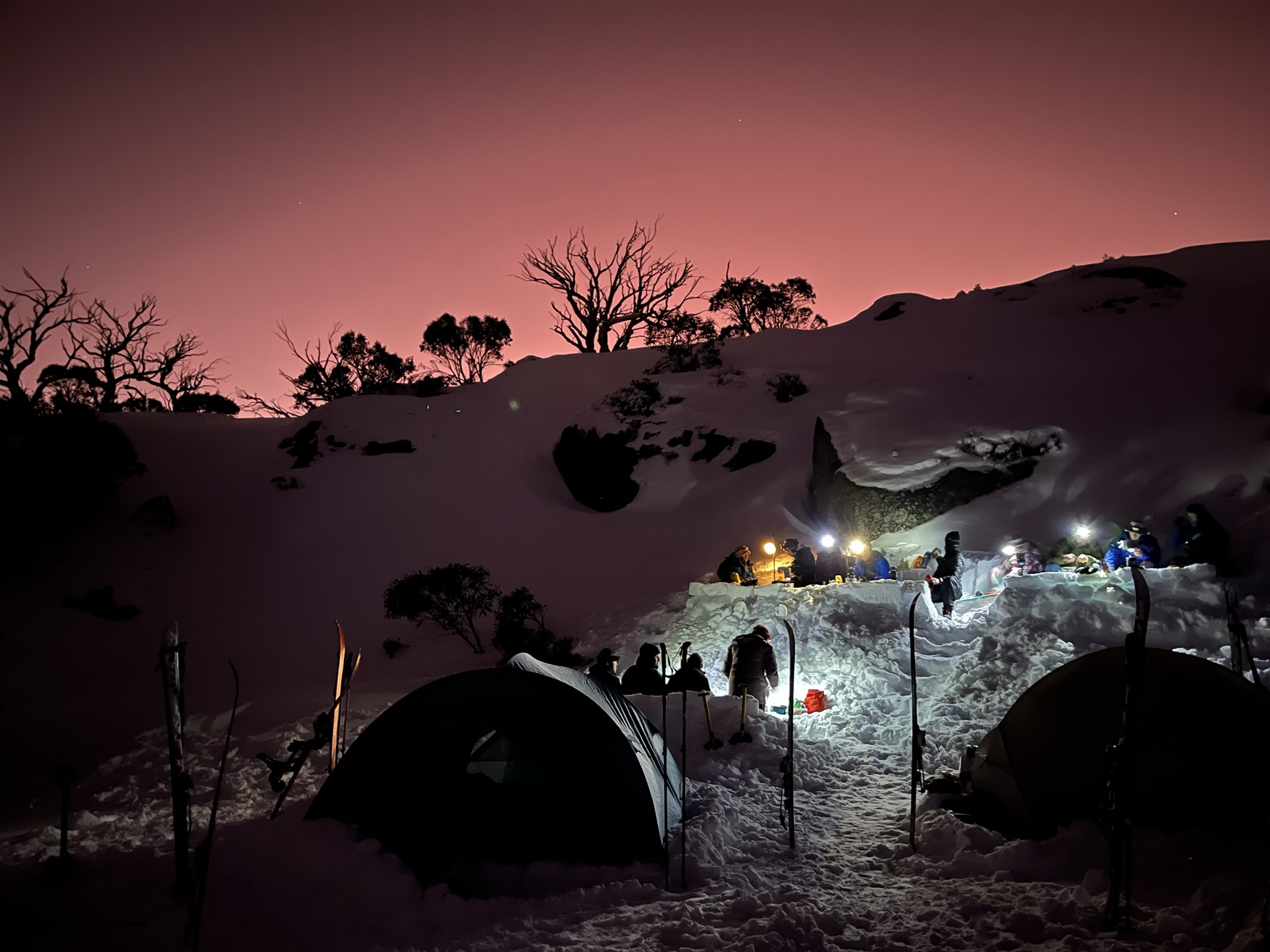
Fabulous trip, which was pretty much par for each of the courses. A bittersweet ending to my professional involvement. I would really miss the instructing, facilitating people’s learning in the wilds of nature, making this meaningful contribution to enabling thousands more students participation in deep outdoor adventure experiences and especially sharing the energised camaraderie of a group of young shining teacher stars. It would take a little while yet to appreciate fully the dissipation of 40 years of duty of care at the cutting edge of adventure education and 17 years of responsibility for the program.

Personally the physicality had been a good benchmark for my fitness – heavy backpack, uphill, long strenuous days, constant vigilance of the team, alpine environment – I felt strong and fit – pretty much ready for my first mountaineering escapade into the frozen volcanoes of North Island New Zealand, only a month away!

Part 2                 Falling

RESULTS            Later July 2022

A week after the CT Angiogram and the day after I returned from the ski course my doctor, normally a chatty, friendly bloke, just picked up my report and started reading it, no eye contact. Stenosis, LAD, right main descending, potential flow limiting, CAC… Between the complex medical jargon was enough for me to start to piece together the notion that something was not quite right. He seemed embarrassed, not comfortable. Gradual realization, OMG! What the hell!!! my heart was in shit condition!!! Three arteries with potentially catastrophic blockages including (I found out later) the LAD which was the most serious (commonly known as the widow maker due to its ability to inflict life ending heart attacks). Build up of plaque inside the arteries. And a calcification (hardening) score that was through the roof. Shock. Disbelief. Anger. Bewilderment. Damnit! I’d spent the last 35 years living a life crafted to prevent just this outcome! *@#!?§&! Unbelievable. Tears. I’d only ever had 2 doctors in my adult life and they had both known my family history. My cholesterol levels were always on the borderline of normal and high – “Nothing to worry about there, all your exercise, fitness, diet and weight mean you are safe”, they both said consistently. Blaming now was pointless but hard to prevent. This would have taken years and years to develop.

The doctor gave me a medical certificate for New Zealand so I could cancel both trips and claim back the costs. It was too risky. I was the marathon runner who dropped dead near the end of the race with an unexpected heart attack except I had dodged the end by a streak of darstedly luck. I could have come home from NZ in a wooden box. Would I have to leave behind my beloved big mountains forever? This was a cruel blow – I had only had a few years to properly tangle with the icey peaks, rocky ridges and glaciers of my no longer suppressed dreams. Statins prescription – to keep lipids under control – a little late maybe?

I walked out gutted, dazed. Went in one person and came out another. Genetics. Bugger.

At home Cath took a while to believe what I was saying. It made no sense. How could I run and ski just days and weeks ago with no symptoms? Shared tears in a loving embrace.

SELF INFLICTED?

Three days of furious googling later. Lots of questions and a diagram of the heart and arteries with the report details labeled so I could check my understanding of the “lie of the land”. The cardiologist explained possible interventions – stenting seemed the most applicable, one day in hospital, short recovery time, limited invasiveness. And how did this all come about? In a second brutal twist he espoused his strong view that the calcification and associated blockages were likely caused by damage and subsequent cumulative repair patching of the arteries and veins of the heart due to extensive and long term exertion and high heart rates maintained for long periods during endurance athletic activity – like marathon running and training, carrying big packs uphill for hours on end in the mountains. He added that whenever he goes for a walk around the lake and he sees a runner he thinks that he will maybe see that person at some stage later as a cardiac patient. This notion was almost too much to bear – the idea that something I chose to do because I loved it so much and did it for long term health to prevent ending up like my Dad could contribute to my own heart disease. I became pretty distrusting at this point. I had run marathons with lots of older people who had done way more than me (one fellow had been 70 and was in his 70th marathon and going faster than me).

Completely gutted again. Smashed.

WAITING 1

Time seemed to slow right down. Talked with Matt in New York and Elspeth in Melbourne, tried to reassure them that it would all be ok, that I was fixable. Tried to believe it myself. The chances fate had dealt – shocking bad luck to have had this build unknown over possibly decades, and the golden ticket of good luck to have discovered it now and not ended up alone and cold inside a wooden box in NZ. Yin and Yang. Struggled with remaining positive.

Cancelled out of New Zealand – North Island volcanoes in winter and November on the Upper Tasman and Grand Plateau. Damn. Pulled out of Blade Ridge on Federation Peak in February. Confirmed that I wasn’t going on the Yosemite El Capitan trip (was this the end of my big walling?). A whole brilliant year of big adventures in the mountains switched off in a single swoop down down into the abyss. Just when all seemed to be crecendoing across the crest of the wave. Wipeout. Salty spray leaked down my face.

Swam slowly, jogged very slowly, walked, all the time limiting my heart rate. Tried to stay active. Rested. Read. Googled extensively. Stared vacantly out the window. Contemplated the unknown. Waited in a shadow zone. Elspeth questioned whether I was afraid. Wanted the intervention ASAP. Kept warm through the Canberra cold.

VITRINE 1

Over the last 8 – 10 years a creative project had percolated in my mind and “heart”. Slowly I assembled the bits and pieces in a final collection that coincided with this time. A very old segmented window offered the opportunity to look out and also in. Within each segment would sit a music LP cover of a favourite album from the key adolescent/young adult period of my life. Between the album cover and the glass I would be place a collection of objects that linked with songs from the album and other key life periods. The overall construction of the artwork presented multiple technical challenges and then each segment became a separate puzzle of complexities for me to solve.

While I worked away in a sort of deep personal introspective engrossment on the fine details I played my all time best tracks from these albums that had carried me through as the soundtrack to my life. Springsteen’s Born To Run segment included an old matchbox toy car from my childhood that also resembled the LC Torana that Cath and I really had a blast driving around as young lovers while we played that song loud through the stereo in the early 80’s. That same song has been part of nearly every longer training run for my marathons so there is one of the finisher medals in the corner. Led Zeppelin IV has a Stairway made out of coloured cuisinaire rods from early primary school, two small round Rock and Roll stones, a small plastic Black Dog and Four Sticks attached to the poor firewood collector on the cover. Morning Of The Earth features beach sand and seaweed from the south coast where we spent family holidays and a fin from an old surfboard similar to one I used in my early high school years during the beginning of my life-long love affair with the ocean. The single from the album “Open Up Your Heart” triggered me to develop a playlist of “heart” songs.

IT GETS WORSE

Cardiac ward. Fasting. Gowned up. Mid afternoon on the operating table under lights. Surrounded by med tech and large screens. I tried to monitor what was going on but couldn’t see really – too awkward so I gave up and relaxed into it. Anaesthetic round the wrist catheter site. I could feel the wire going up my arm and into my heart arteries. Eek. The interventionist cardiologist explored and pressure tested the piping and hydraulics. Again I could feel the wire being removed.

“It’s more complicated than we thought and more constricted. There’s a T junction in a main artery that needs work and we can’t put stents in there. I recommend you consult with a surgeon.”

Back in the ward I enjoyed some food. As darkness fell the implications slowly sank in. Heart surgery. This was just like a big black snowball picking up power as it barreled downhill, unstoppable now. The quick, low impact options had melted away into the shadows. La Niña drizzled down the window.

TRIPPLE BYPASS CABG HEART SURGERY (Coronary artery bypass graft). FUCK

WAITING 2

“In the next few weeks we will call you to let you know a few days ahead when you are in”.

But each day passed and no call. The wait and the unknown were excruciating. I just wanted to have it done and then crack on with rehab and recovery. Excruciating.

VITRINE 2

Back in the workspace the vitrine was taking shape. A now rainbow painted model Thomas the Tank Engine from the kids’ train collection was now the Peacetrain in Teaser And The Firecat. There’s also a fabric peace sign badge from an old pair of jeans similar to all the badges and colourful bits I had sewn onto my white flares that I’d worn to pop concerts and festivals in England in my hippyish youth in the mid 70’s. Cath and I had collected notes and coins from a range of countries which became the Money in Dark Side Of The Moon. Next to the famous light refracting triangle I placed my old watch that had stopped “ticking away the moments that make up a dull day”. John Martyn’s Inside Out sort of focussed the whole thing. People experiencing the vitrine could look inside a small compact makeup mirror and see themselves as the young children who had earned the silver and gold stars that were in each corner and also maybe as adults who had lived and grooved through up to 70 years of musical history with a vinyl record, a cassette homemade mix tape, a compact discs and an iPod. They could also listen to the vitrine playlist streaming through the wifi.

A few years earlier I’d orchestrated a “Springsteen” tour of Canberra for friends where we visited places together through the city that linked to their favourite songs, which we blasted out on a car stereo, and rode our motorbikes through the sunset to a friend’s house where we watched the Springsteen On Broadway film and drank Born to Rums. For the tour I gave each person a red The Boss bandanna. The whole thing was a hoot.

After the vitrine was fixed to the wall just inside the entrance to our home I hung my red bandanna from an old nail on the side of the window frame and drizzled on some patchouli so the smell could transport you back to the seventies.

The vitrine, the artwork, the project – perhaps it’s most special value had been the deeply meaningful, fun, beautiful, delight I had in immersing myself in both an introspective and shared reflective review of a selection of some of the essentials of my life. The synchronicity of time and events was surreal.

SIGN IN              Sept 2022

Eventually my day arrived. A small bag with a few clothes, phone, headphones, book and not much else (I had already signed off that I understood the risks of heart surgery – stroke, heart attack, infection, death and lots of other possible outcomes) – not much to accompany me “into the mystic”.

Tom. “Hi. My name’s Peter”. Turned out he was having the same surgeon, same CABG, liked progressive rock. He had a suitcase like he was going overseas.

THE LAST EVENING

After Cath left I spent a while looking out the window, like an onlooker on life – people walking up the footpath below and cars on the street.

I read some of “Phosphorescence” by Julia Baird. A chapter on bioluminescence in the ocean and another on awe. A mind massage that cut away to the essence of life.

Into a long term extended family conflict I attempted to make a small bridge through a heartfelt and honestly vulnerable text message explaining where I was and that life was short.

Unexpectedly I felt a deep sense of peace. Like if my life was going to finish the next day or soon then it was all ok, my life had been good, I had had a positive place in the world, I had made a small difference. The negativity that normally comes to the fore for many of us had dissipated and been outweighed in the overall balance for me in those moments.

I found some beautiful music and played it on repeat, “Spiral” by Olafur Arnolds.

Thought about life, cosmic consciousness, my Mum and Dad looking down from their campfire among the stars by the river of the Milky Way, and of dying.

WAITING IN THE ANTE ROOM

The anaesthetist set me up with various catheters and tubes in both wrists and another in my neck. Minutes slowly ticked by as I waited. Turns out he had been mountaineering in New Zealand and elsewhere in the world. More minutes. We chattered and smiled about climbs we had both done. Tom was taking a long time – I hoped he wasn’t having complications.

OPERATION

Didn’t really grasp that I would lie on the table with tubes into my neck and that my heart would be turned off. Sort of kept alive but at the same time no heartbeat for some hours. Impossible to comprehend. How does a body react to that? What were the effects on my psyche, my brain, my spirit, my self? I was totally unconscious of all of this, in another realm, a dark, timeless void, an in-between world, from where I could have just faded quietly away. While the modern world’s best medical technology and specialist, at the pinnacle of surgery skills, “harvested” veins from my inner thigh, forearm and mammary, split open my sternum to reveal the heart, rerouted my blood out of my carotid artery into a heart lung machine that reoxygenated it and returned it to my circulatory system. The veins were sewn onto the heart arteries to become bypass channels around the blockages. The sternum was wired back together and all the incisions were sewn back together. Electric wires into my heart were fired to restart it again.

WAKE-UP          ICU

From nothingness a hazy consciousness seeped in. My eyes opened on a shadow land.  Lying in bed. Unable to move. Dulled lights. I must have moved a little as a nurse approached and smiled. I tried to smile back but couldn’t move my neck. And I couldn’t talk because something blocked my throat (a breathing tube I found out later). I could lift an arm so I waved weakly. Then slept. I woke and he was nearby, checking, nodding, smiling, asked if I was ok. I managed a small nod. He checked things again and then sat at a monitor nearby. I was in a dream filled with golden light and infused with loving feelings towards the world. The nurse looked at me again. I couldn’t speak. So in a sign of gratitude for his care and concern I put my hands together and nodded a little and smiled. He looked confused. I love using sign language developed in scuba diving – like communicating underwater.

I woke later. Still unable to move or talk. The nurse studied the monitor. Sounds came in from the next room. A light went on outside the curtain screen. There were muted voices. They sounded worried. The nurse went out for a short time. Alone. They were talking about me, I knew it. Panic. Something had gone wrong. They would have to open me up again. Muted voices again and sounds next door. I was sinking. It hadn’t gone well. Fear. I was terrified. Darkness.

Sometime later the breathing tube was removed and I could croak a little. Sleep.

Lights. Brightness. Reclined. The nurse was there. And Cath. I couldn’t move my neck. Tears to see her. It had all gone to plan. All good. In ICU. Tears again at hearing this. The nurse told me he didn’t know what to do in the night when I made a praying signal to him. He thought I wanted a priest. I’m an atheist.  We laughed but it hurt. I asked him about the night terror and he explained it was most likely the morphine. I wondered where the drugs and the golden light and the terror start and end and merge.

Tom told me later that he rose out of his body and looked down to see himself lying perfectly still on a cold, hard, black stone slab. A woman on the ward related how she had seen members of her family past and present standing mute at the end of her bed.

My fingers explored the tubes that had been fixed into my neck. All my movements were restricted. I felt like, and must have looked like, Frankenstein. Cath took a photo which confirmed it.

“Frankenstein” in ICU

Elspeth arrived and I cried again and drifted into a sort of sleep.

ON THE WARD

Vulnerable, weak, dependent on others for everything. The nurses were wonderful. Any act of their kindness set me off into tears of thanks.

At some point I could get out of bed and shuffle into the hallway supported by Cath and Elspeth. We sent a video to Matt in New York. While I was narrating the waterworks started again. My “heart” was raw and flowing, uncontrollable, with being alive, with making slow progress, with relief.

On an early walk down the corridor I met Tom and like best buddies with the deepest shared experience we nattered away.

It felt like a truck had smashed into me head on. Everything was sore. So much discomfort. Like a series of small mercies there was a very gradual removal of tubes, drains, catheters and canulas. I cheered when the main line was removed from my neck. The worst and best part was the removal by gentle yanking out of the wires that had been inserted into my heart muscle.
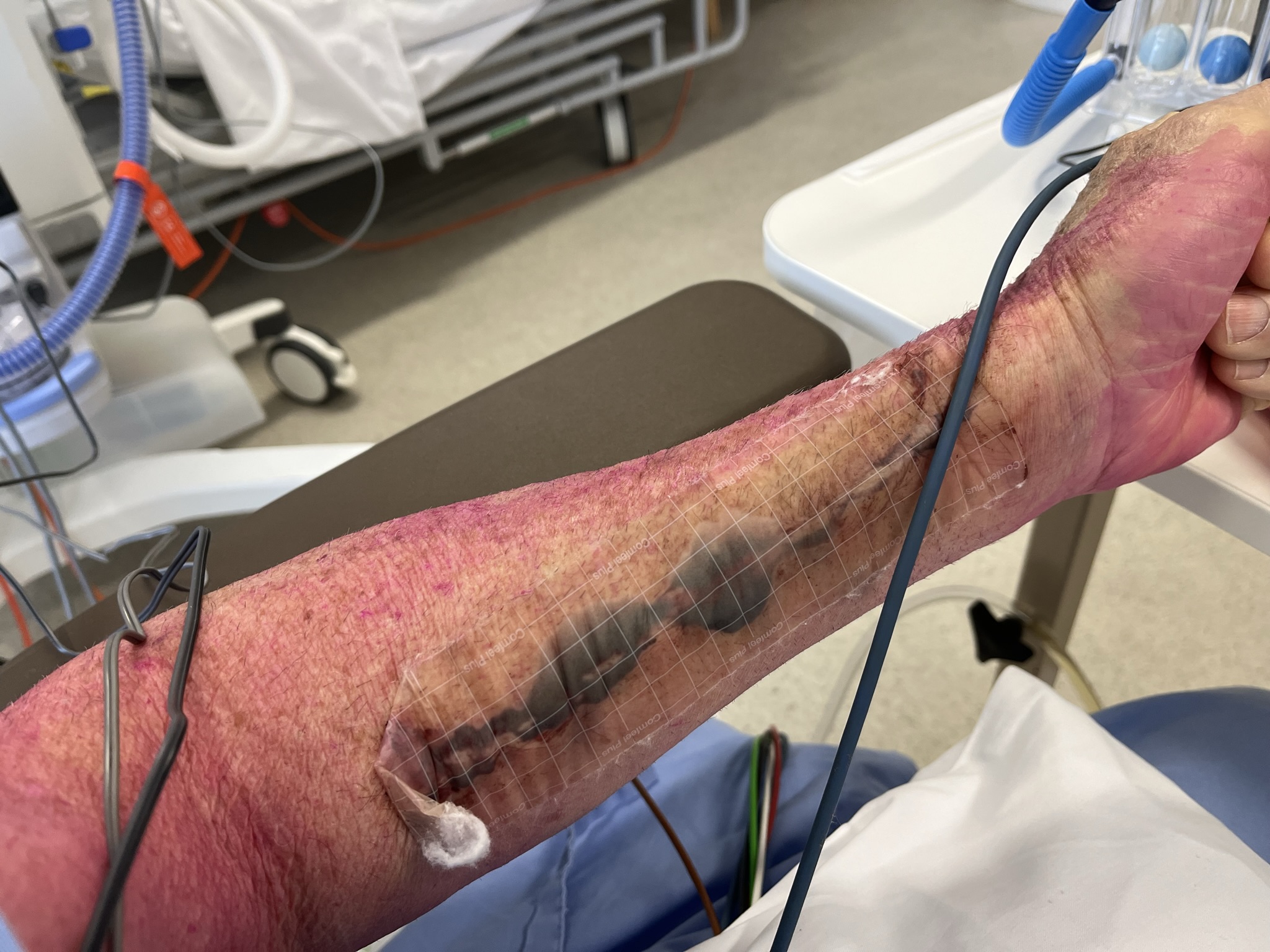
On day 5 I went home. Slept on my back for 6 weeks. Ever so slow easing of discomfort. Slow easing off of the bandages stuck fast like second skin over the harvest sites and up the sternum – aaaarghhhhh. Walked to the other end of the house, then around the yard, hobbled up the street and later eventually round the block.

EMOTE

Small acts of kindness – nurses, Cath being with me through it all and her every little act of love, and Elspeth and Matt being full of support and love and so deeply concerned, friends calling and calling by, random nice things on tv, a favourite song – they all set me off with smiling tears.

PUMPHEAD

Searching the internet I found a group based in Canada for support of athletes with cardiac problems – the Ironheart Foundation I think it was – but you had to live in Canada to access their online program. Now I am no athlete but I did have a decades long history of high level physical activity including marathon running, climbing, hiking, mountaineering etc. I wanted more than the cardiologist seemed to be offering. The rehab program was very basic. I had had no symptoms!

Then I found in my own town a support group for all types of people with cardiac issues. While perusing their website for anything useful I happened upon a film about a syndrome colloquially called “Pumphead”. This syndrome (postperfusion syndrome) was little talked about in the cardiac medical profession. Research is showing that people who have undergone heart surgery using a heart lung machine to provide oxygenated blood to keep them alive can later undergo psychological and emotional changes that can have a physiological origin. Reactions include depression, anxiety, feelings of hopelessness, neurocognitive impairment etc. It seems that when the blood passes through small membranes in the machine (pump) there is much turbulence necessary for the oxygenation process to take place. During this turbulence tiny debris and air bubbles (microemboli) are carried through the heart and brain and these cause pumphead. Sometimes these reactions in people are long lasting, severe and life limiting beyond what could be expected of their surgery and new life/health situation. Now people who have recently had heart surgery could normally be expected to suffer from some depression and anxiety due to lifestyle changes necessary, ongoing discomfort, fatigue and general decrease in capabilities. I wondered whether my emotional fragility/rawness and underlying positivity was a different expression of this Pumphead syndrome. Whatever it was I welcomed it and didn’t try to hide it away. I wanted to hold onto it, perhaps with a few less public tears. Of course there were times when I was grumpy (sorry Cath) and felt frustrated, angry and depressed but the underlying feel was positive.

HEART PLAYLIST

To lighten the mood and dive deeper into the emotion of the journey I was on I made a heart playlist.

“Hearts on fire, Put a little love in your heart, Heartbreaker, Shape of my heart, Two strong hearts, Head and heart, Total eclipse of the heart, Achy breaky heart, Heart of gold …..”

A lot of the songs were cheesy but there was an occasional arrow straight into the zone of emote. I questioned the whole history, media and mythology associating the physical heart with emotion and love. Where does emotion sit in the psycho cognitive sphere? Surely it’s centred somewhere in a part of the brain – the amygdala, the precuneus, the hypothalamus, and the hippocampus working together in some complex combination? But my love emoji is a little pink heart! Is it because when we are falling in love our heart beat speeds up? The heart is a muscle that pumps oxygenated blood to our vital organs.

“Hungry heart, Half of my heart, Piece of my heart, Heartbreak hotel, This old heart of mine, Heart of stone, Don’t go breaking my heart, Fortress around your heart ………”

FRIENDS

In contrast to times in the past where I had been “too busy”, in more recent times I had made significant efforts to call on, support, be interested in and stay in touch with friends who were sick or had recently had surgery or who struggled with life. I felt deeply the love and concern of those friends that took time to generously reach out. Each contact was like a warm embrace that carried me along the path towards recovery. I cherished every moment and it made a great difference. I renewed my own commitment to reach out when life’s waves broke over others and dumped them on the sand.

TOM

My hospital heart buddy and I talked and texted every couple of days, providing support to each other. Talked music, how our symptoms were going, panics we went through when it looked like things might be problematic, sharing tips on how to move correctly and comfortably, diets, exercises, life changes. Later on we met up for coffees. Someone who shares parts of the same journey into darkness provides wonderful reassurance and camaraderie.

SURGEON CONSULT

Of all of the post surgery consultations this was the one I had highest hopes for. Questions tumbled about in my head – how did my heart look, did the op go exactly to plan, etc etc?? This guy was the person who had sliced me open, sawed my sternum in half, exposed my heart, ordered my heart to stop, scalpelled my forearm from wrist to elbow and my inner thigh and “harvested” my veins. Then sewed these new veins as shortcuts onto my heart arteries, ordered my heart to start up again, inserted the wretched drains, wired my sternum back together then sewed up my chest.

Massive disappointment.

All he did was ask if I was going ok and told me the surgery was successful. Then within 5 minutes he shuffled me out. My mind was stuttering with all the insights into what he had exactly found in there and not told me about. Obviously he was a very busy man and had many other patients to see and “save”. I very much appreciated his skill and experience and tearfully expressed my gratitude. BUT I had felt that the massive onslaught he had brought to me would have earned a little more attention. He probably didn’t even remember who I was in spite of playing god over me for a few hours.

CENTENARY TRAIL

Step by step, one foot in front of the other, slowly, like in a marathon after you hit the wall, just make it to the next lamppost. With a friend who was trying to come back from deep long Covid we walked a small part of a section of the Centenary trail which is a 145 km hiking route around Canberra. A week later we linked up another part then set ourselves the long term goal to do the whole lot. Other things have got in the way but when we get a chance we will tackle more of the trail. It felt good to be stepping into, for us, a bigger adventure together. Planning each part and fitting in coffee shops, he’s a coffee aficionado, along the way put smiles on our faces and a sometimes spring in our step. I have always liked to have a long term goal to work towards, I just needed to make them attuned to my new level of physical capability and recovery.

PLANNING A COMEBACK

Springboarding from the Centenary Trail idea I spent many hours devising a structured plan to climb what I think are the best easy and middle grade climbs in south eastern Australia from Grade 8 to about 19 if I could manage it. I could slowly build up strength and would try to link up with as many people from my past and present as possible along the way. Thought I had enough when I counted up about 60 routes. I started back slowly into a weights and strength building program.

Part 3                 Into the light

TWELVE WEEKS            Dec 2022

This is a milestone. By this point my sternum would be fully healed. The surgeon said it would be safe to do everything again and the cardiologist agreed with the proviso of not going too hard. So I did everything! In the 12th week. I ran, more of a slow jog really, but instead of singing in my head with my running playlist I sang out loud, popped in a few pirouetting dance moves and even busted out a couple of my signature flying runner actions.

Cath swam with me at the pool – slow and steady but covered a few hundred meters in the cool clear blue liquid bliss. Next day we cycled to the Lake for a coffee.

My mate and I hiked the harder Mt Ainslie section of the Trail.

And with heart in mouth I tackled some problems at the bouldering gym. Towards the end I pulled into a few overhangs to test out the wired up breastbone – it didn’t explode apart, and there was no pain or awkwardness.

Rest, protein, fruit and vegetables were going to be the easy part. The discipline of slow and steady was always going to be my biggest challenge. The dilemma of how much is too much and what sort of exercise was ok concerned me deeply. I wanted to live long but also do as much as I could without clogging myself up. Reservations about the advice from the cardiologist and my own research and intuition niggled and ate away at my confidence and world view.

FAMILY

Matt came home from NYC for the first time since the beginning of Covid. He seemed very much at ease with the world and himself, full of life, empathetic and caring. I just sort of melted around him.

Elspeth and Julian had a love party in the Grampians which was just a delight, friends and families all out bush, swimming, camping, sharing, dancing in the moonlight and witnessing their setting off into a loving future together. I speeched from my heart how thrilled I was to be there, to still be there (while gesturing to my chest). Emotion and tears flowed but it felt fine and something very deep connected our short lives together for me in those moments.

ON ROCK

First time back on rock, invited by Cait and Greg. At the Goldmines near Nowra. Sport climbing. I led two climbs then really struggled on two harder ones. Did better than expected – the little bits of strength work I had managed must have done some good.  I loved the moves, loved climbing, loved Caitlin and Greg, loved the world. Life was good. Endurance was down later in the day but I maintained energy.

Tired the next day. The reality of where I was (and wasn’t) and the long journey back kicked in.

CARDIOLOGIST – ONE TAKES AWAY   Jan 2023

Cholesterol was tenaciously high – another medication on top of the statin.

Strict recommendations on exercise – max up to 85% of Max HR = 132. Can run 10 mins up to that, walk and get it down to below 100, then repeat up to 5 lots. Up to 4 – 5 times per week. Translating this to adventure ruled out mountaineering for sure and probably backpack carrying up hills for any length of time. This was pretty much as expected as he attributed my exercise as a likely cause – like I had brought this on myself. Rockclimbing would need more investigation and monitoring. He’d see me again in a year.

The light faded and darkness closed in.

Yes the last thing I want to do is clog up again.

For my own psychology and state of being going forward I needed a second opinion on this – to examine the technicalities of heart rates, attribute causes and most importantly sort out what I could and shouldn’t do into the future.

The additional cholesterol reduction drug was an indicator that my body is specially resistant to a reduction.

I tried “running” at his suggested level and it was so constrained it was dispiriting and depressing – just the opposite of what I usually get from running.

CANYONING    27-29 Jan 2023

I took the nephews abseiling and canyoning as a strategy to rekindle and build relationships between them and meet their desire to do adventurous things. Between times of bad weather we fluked a rare good day into Grand Canyon where the conditions and the shafting light turned the already spectacular landscape into a majestic drama. Laughter, smiles, and  chatterboxing accompanied the swimming, scrambling, awestrucknesses of our journey into the depths and cold on a hot summer day. I felt privileged to be able to facilitate and share the experience with them – for each of us we entered into a deeply happy place away from our “other” worlds above in comradeship. And I glimpsed the edges of a subtle shift in my own possibilities to focus more on the sharing with friends and family at a lower level of adventure rather than pursue my own more self focussed harder goals and dreams. I well know the richness in this from half a lifetime dedicated to outdoor education – and the need is strong. But the lucky circumstances that delivered me to peak fitness and strength with an overflowing love of the mountains would be achingly difficult to turn away from with a broken heart.

I hadn’t used the old and beaten up red Olympus “TG Tough” camera for over a year – after finishing Ozy we had descended back down into the Gorge and miraculously located the camera in the scrub at the base, undamaged. I tucked it down the top of my wetsuit to keep it handy and in a vain hope to try to minimise water ingress. As we proceeded along the creek bed several times I noticed the battery charging sealed door had sprung open. Condensation and water droplets were all over it. Amazingly the images I’d snapped in a flurry of exuberant activity while the sunlight had ray-blazed into the canyon darkness portrayed a scene where we seemed to walk, dwarfed and humble yet exultant, somewhere in the zone where the natural, psychic and metaphysical realms occasionally connect in beautiful synergy.

Photo editing by Ian Charles

MELBOURNE – AND THE OTHER GIVES BACK               1 Feb 2023

Trust is massive in the medical world. Someone you’ve only met for 15 minutes stops and restarts your heart, carves you up and puts you back together like Frankenstein, like a hundred others just like you in the last few months. You submit to their skills, knowledge and experience. I had had reservations about my cardiologist in Canberra. Though skilled and experienced he seemed to me to have an extreme view of exercise, assuming that my exercise had been critical in clogging me up. He had then prescribed a very limited, for me, exercise regime and limits following recovery from the surgery. Intuitively I found his ideas didn’t sit right with my own research and very limited but targeted knowledge. Within 5 minutes of my first consultation he had told Cath and I that when he walks round the local lake and sees a young person out running at a decent pace he sees them as a probable future patient. It would have been easy to follow his guidelines, and maybe I would eventually embrace them, and live limited. BUT my love of the mountains and running and adventure encouraged me to seek a second opinion. I sought out the best sports cardiology unit I could find – St Vincent’s Hospital in Melbourne.

Armed with all my reports and test results, with great trepidation, having waited 5 months I fronted up. Dr Maria Brosnan seemed amazingly well credentialed having published more than 20 research papers and meta analyses on exercise and cardiology. In the full 45 minute in depth consultation she looked me straight in the eye and told me that my clogging had been due to genetic family history and how my body deals with cholesterol, that it had nothing to do with the level of exercise I had been doing and that perhaps if I had been her patient initially she may not have suggested the surgery route (depending on other test results). I cried. In passing she said I had likely been led up the garden path. And that I should have a stress echocardiogram if they could hustle me in while I was in Melbourne (and did I know why I had not had one done prior to surgery? No). Also, again giving it to me straight, if the echoC came back good, which she predicted, I SHOULD BE ABLE TO EXERCISE JUST AS I HAD BEFORE SAFELY AND LIVE A HEALTHY LIFE. She had just given me my life back. I floated outside and rang Matt from the park down the road tumbling about with words of relief – from across the planet in New York he held my hand as I danced down the street.

Three people, Maria, the ultrasound and tech nurse and the testing supervisor, all came in an hour early to enable my testing. I let it rip on the running treadmill like I hadn’t done for 8 months, relishing the freedom of full blown exercise in the safe confines of one of Australia’s best cardiac clinics with the most qualified and skilled people. All the results were terrific. WOW. Jubilation.

All for free. All bulk billed. What a marvel of a country we live in. Lucky us who win the birthright lottery to be born in Australia.

CANYONING 2               3-5 Feb 2023

Two weeks of intensive action between the Blue Mountains, Canberra and Melbourne raced along while Cath was away. Serendipity Canyon near Mt Wilson. Nephews H, J and I were like a canyon team by then. We hiked down, abseiled in water falls, into deep pools between the high, smooth sandstone walls. 5 times we abseiled, swam, hiked, marveled at the scenes, checked each others safety. Laughed, chatted about music, reminisced about old times on camping trips. And the lads showed they knew what they were doing mostly. And at the end we lunched on a big rock above the Wollangambee River with large lizards. Nature and people and good times spent in precious company.

ON THE RIVER               7 – 8 Feb 2023

My brother had mentioned that whitewater kayaking was something that he had always wanted to do and had signed up for a course at the stadium at Penrith. As a prelim for this I suggested he spend a couple of days in Canberra on the Murrumbidgee. The first day we did some skills training at Pine Island – the water was warm. In the afternoon we toured the short trip from Point Hut to Pine Island which took a few hours of running rapids, reading the river and dealing with bail outs – we both swam and in the end successfully ran the bigger grade 2 final adrenaline pumping rapid below the car park. Brilliant fun.

Second day we paddled the longer section from Casuarina Sands to Uriarra Crossing. This took most of the day – long pools separated by interested rapids and rocky races. Over thermos coffee as the beautiful river flowed by we chattered about a couple of deep family issues. It’s easier to just let things slide but I gulped and dove in. The sharing felt good. Yep life is short. Again we finished on the most engaging long rapid. Success (no swims). It had been a rare time for us to spend together.

ZEN AND THE ART DREAMS    10 Feb 2023

For the last 8 years I have been part of a group of six friends who are super keen on motorcycle touring, especially on dirt roads – adventure motorcycling – where you carry all your camping gear, food, water, tools etc on the bike. We’d done several desert and other trips together. In my early twenties I read “Zen and the Art of Motorcycle Maintenance” and was captivated by the whole concept as well as the psychology of independence and quality. In a lifetime of motorcycling I had always dreamed of riding and looking after one of the same type of bikes from the book – one with a low center of gravity, boxer motor and smooth shaft drive. Lots of part time work following “retirement” had generated a little bit of pocket money so I started searching. As a crescendo finish to the two weeks while Cath was away I found one and was lucky enough to be able to secure it by a lucky chance. Only trouble was it was bigger and heavier than I was used to.

This was a lifetime bucket list thing. I would try to make it work. Having cancelled out of so many BIG things because of the heart I accepted the invite onto my mates’ trip to Tassie.

CATH RETURNS FROM AFRICA              13 Feb 2023

Her two weeks of work away in Sudan and Malawi seemed much longer for both of us. Much had been packed in. She had been to some of the harshest places for refugees to survive in Sudan but discovered depths of dignity and in Malawi some projects that were leading the world in ethical education and advocacy. Our global timings had been marginal so we had much to share and home was the best place for a while.

JERVIS BAY       Late Feb 2023

Teeming rain as we set up camp for the week. Like getting washed clean was a prerequisite for tuning in to the ebb and flow of the natural world in this special place.

Ocean swimming – patterns of sunlight through the water’s surface rippling in the breeze onto the white sand sea floor and we stroked in the liquid otherworld between. Arms with smooth rhythm, breathing easy, along the beach, movement, grace, freedom, wellness, back home in the sea.

Walked barefoot along the beach after nightfall, the Milky Way arced right across the sky, hand in hand, warm heart. Soft wash on the shore.

Sea kayaked Illuka to Murray’s Beach. Underwater sea grass, sand patches, rocky reefs, kelp beds. A different perspective on the land and sea scape from on the water. I ride the edge of small swells close to shore. Cath smiling, confident and fluid, two weeks of stress ebbing away. Murray’s Beach stunning as ever. I wonder again, as I have many times here, about my Dad’s naval supply role in not moving the navy base from Sydney to Jervis Bay in the seventies. I felt close to him here, paddling on the ocean, to his sailing and time on the sea. In a different generation I get to continue my love of activities like this whereas he gave up his sailing as a young man as he could not fit it in amongst work and raising a family. And then he died at the beginning of his retirement.

Groupers green and blue, morwong, whiting, bullseyes under a ledge. Snorkelled in the warm water. Shared discoveries. We cruised around the rocky point. A school of hyperactive small silvers vibrated and danced around us reflecting flashes of sunlight. Further on I became entranced by a small school of the tiniest fish that pirouetted and snaked and balled as if in a joy of active togetherness. We covered some distance then headed back. Right at the point where the water deepens into a darker blue another school hovered and swayed around me as light streamed – I was with them, conscious of being fully alive in this moment – life is good.

Another evening walk to the beach. Billowing clouds pink, glowing in the after sunset. Sliver of moon, evening star above the western horizon.

Kayak on the bay, on a swell rolling through. Cath – “The ocean feels like it’s breathing”.

I swam long at Cave Beach while Cath bodyboarded. Nice waves, crystal clear water.

Very much full of life – I felt these things with more intensity, more attention. It had been a really special week. I wanted to hold on to this new way of being. Dad seemed to have a very dramatic change of being after his first heart attack – he became much warmer, eye twinkling, happier, more at ease, the big teddy bear inside him let loose more often. I don’t claim all of that but I know I have changed and there is much I would like to keep fresh.

TASSIE                Mar 2023

I took on the challenge of riding the big, heavy, fully loaded machine. The trip would be a make or break for the bike. A couple of hours in we stopped for fuel at Holbrook. The riding had been brilliant and the nerve wracking part had been the stopping and manoeuvring at low speed. “Do you guys realise we are on a two week ride through Tassie? Do you know how special it is to do something like this with a group of best mates? Do you realise how good it is to be alive?” I said this while pulling open my jacket, pulling down my tshirt and pointing to my scarred chest.

I dropped the bike while going very slowly down and round a very tight corner loading onto the ship. In front of hundreds of other travellers, bikers and drivers. EMBARRASSING. My mates jumped in and helped lift it up. And then again at a campsite at about 2 kmph. Apart from that the riding and touring and camaraderie was fab. Twisties thru the east coast hills. Looking out for the aurora borealis which was visible on the southern coast but eluded us behind clouds and rain https://www.theguardian.com/world/gallery/2023/apr/25/aurora-australis-borealis-northern-southern-lights-auroras-across-the-world-after-solar-storm-pictures- . Driving rain on gravel roads up the Wild West coast. Forest walks. Great campsites. And then over two days riding alone from Melbourne back to Canberra I finally felt comfortable and in tune with the bike. Even some odd moments of zen.

Some weeks later I successfully disassembled and reassembled the whole shaft drive unit to fix a minor issue. Sometimes dreams, like zen and the art of motorcycle maintenance, take half a lifetime (or more) to bring to fruition (43 years).

KILIMANJARO

Txt msg on facebook messenger – from a former student who was in a year 6 class in Tanga, Tanzania while I was teaching there as an Australian Volunteer Abroad in 1982/83.

(Inna – name changed). “Hey Mr Blunt! As I was planning a Kili climb with the family I suddenly remembered we had an excursion with you there!! Did we make it to the first hut or is that my memory?! We are taking our two adult boys on a Tanzania trip and super excited to be going back! Hope you are both well!”

My response; “Oh lucky you and your family. Yes indeed we did trek up to the first hut. That would have been in 1983 and I’m thinking that it would have been in the first part of the year. So that makes it exactly 40 years ago. Amazing. I hope you have a wonderful trip. Perhaps you could share a photo for the class. Lovely to hear from you.”

(Inna). “Your memory is better than mine!!! 40 years to the year that’s crazy, I had no idea!! Will def take a photo.”

Note – this had been my first BIG excursion for students. 15 of them aged 11 – 13 and some parents. Overnight train from Tanga to Moshi then a two day trek onto the mountain and return. 5 days. It all showed me that with a wonderful bunch of motivated young people the sky is the limit. The whole rest of my career became a quest to recreate this for as many young people as possible.

And a summit photo of them turned up 6 weeks later.

Part 4   In flight on rock

WARRUMBUNGLES – Flight of the Phoenix  300m Bluff Mtn   April 2023

Most rock climbers spend many many many hours reading guidebooks, talking to other climbers and dreaming about famous venues and climbs that they’d like to visit/attempt. Over many years some climbs take on a personal, psychoemotive, almost mythical place in our hearts. For me “Flight of the Phoenix“ was one of those very special routes that had been in the handful of climbs that I had most cherished for more than 40 years. Although I had climbed another route on Bluff Mountain and done several trips to the Bungles over the years this one had eluded me. With each passing year it seemed to get a little more out of reach and now with my cardiac situation even more so. When Cait mentioned she wanted to try to be part of the first female team to do the Bungles Triple Treat (Lieben on Crater Bluff, Caucusus Corner on Belougerys Spire and Flight of the Phoenix on Bluff Mountain in a single push) and wanted to do a recce I jumped in and offered to accompany her on the familiarisation trip as a person with local knowledge. Waking dreams of leading pitch 4, one of the most widely recognised pitches of climbing in Australia, with its rising traverse below the beautiful orange wing of the phoenix into space high on the wall, set my broken heart a-flutter. And with Greg on the team our El Cap crew was back together again.

To view a stunning photo of this part of the climb go to Simon Carter’s website  onsight.com.au    https://www.onsight.com.au/product/flight-of-the-phoenix-v/ and try to spot the climbers.

Hiking up the hill with a heavy backpack was always going to be a tester. I was quite daunted and not a little worried about how I might handle the physicality. Backpacking with a load was the basis of many of my most loved adventure activities – bushwalking, back country skiing, climbing in remote areas and especially mountaineering. Surprisingly the 6km and 300m ascent with 20kg, which a year earlier would have been just a warm up, went well. Glancing at the heart rate data on my watch reassured me that I wasn’t pushing too hard. PHEW. Such a relief.

Day 1   Up at 5.00am, out the door by 6.00 and at the base of “Lieben”, grade 17, 6 pitches, 200m. We each led 2 pitches – mine were straightforward, Greg’s involved some scarey slab climbing and tricky route finding. Cait led the crux up high which she did with style and confidence and which I found strenuous, exclaiming loudly and forcefully like a tennis player when I was on the brink of falling but managed to pull through. I was climbing reasonably well, considering … With a long descent finishing back at the base just on dark we made it back to the hut by about 6.00pm. A long day but all had gone smoothly. We were a terrific team.

Cait “How about a rest day tomorrow?” Reassured again. Both the young hotshots were fatigued as well. Our best chance of ongoing success lay in taking a rest day.

Day 2   Sleep in, leisurely breakfast. We hiked up and around to the base of Belougery’s Spire and checked the access to “Caucusus Corner”. Back for a quick lunch. Hiked out and found rough tracks through the scrubby bush to the base of Bluff Mountain. We compared the info details and a photo with the cliff base and located the start of the climb. Then retraced our steps back to the hut late into the afternoon. This would all make our trek to the start the following morning really efficient – we would be saved from thrashing round in the bush in the dark trying to find our way across.

Evening             Conversation 1. A soliloquy really. On top of the small peak above the hut as the sun went down. Rocky spires and peaks all around. Forested valleys and high ridges catching the orange then pinking afterglow. On video I reflected on the deep meaning of the climb next day. Emotion bubbled up, not unexpectedly. A possible life moment if we pulled it off together and a precious moment of life 7 months after lying in darkness on the table, switched off. Humbled. Savoured the fading of the day. So grateful.

Day 3                  Up at 4.45am, departed the hut at 5.30. In the darkness we hiked up towards Bluff Mountain, one of Australia’s big cliffs, 330m high.         

Conversation 2. Headtorches lit up our footsteps. Sometimes we walk with our friends with insights into their lives from which we build stories and occasionally add snippets to fill in gaps. Rarely we get to plumb the depths and realise that we are walking in the footsteps of heroes. Stripped of distractions by the darkness and focussed by the narrow beams of light Greg questioned Cait about her coaching of Canberra’s climbing youth. It emerged that she had started coaching in the local climbing gym (Mitchell IRC) at age 17. By 18 she had a group ready to compete on the international circuit and took a team single-handedly to Scotland, Oceania, later to China and across the world for world cups and other international competitions over the next 20 years. With amazing enthusiasm, a bold vision and new and innovative coaching techniques derived from her own athletic youth and deep research her understudies became equal to the elite of the world. Her Canberra crew broke into new dimensions of capability, performance and achievement in. She facilitated a group culture where, unlike many other individual athletes that compete just for themselves, they celebrated each other and thrilled at one another’s breakthroughs. This team feel has contributed to their longevity in climbing. Her groups that grew and changed became some of Australia’s leading young climbers, Ben, Daniel and Zac Fisher, Joe Horan, Angie Scarf Johnson, Esther Packard Hill, Emma Horan, and many others. All this she did while teaching full time. 20 of these athletes made Australian teams. Starting with 60 younguns the program now has more than 300. And through this massive contribution she has managed to significantly shift forward the state of sport climbing and competition climbing in this country. Dan has put up the hardest trad climb in Australia and several of the hardest sports climbs, Emma Horan is the only Australian setting world cup routes, Angie is one of the leading climbers in the world, Rose has just done an ascent of Attack Mode 32.

Predawn light filtered into the forest as we entered the scrub and twisted our way on the trails we had scoped out on our “rest day”. At the base at 7.30am and climbing. Greg led up a crack through a strenuous bulge then threaded the rest of the first crux pitch, grade 18, out left, then up, then back right through varied climbing. Eventually he found the belay next to an old piton hidden behind a bush. This climb had been established in 1974 when protection gear was of an “earlier” age. The sense of history was palpable. 49 years previously Keith Bell and Ray Lassman had pioneered the route – a groundbreaking achievement at the time. Cait cruised up the hard sections and then I followed at the limit of my strength – carrying a pack with water etc made it that little bit harder – at least I didn’t have to pull on any gear and didn’t fall off. The second crux pitch was a repeat. Cait found a route up, linking crack systems of strenuosity to reach a large ledge system. At this point we had succeeded on the hardest part of the climb – route finding and climbing to the ledge. At the right end of the ledge is a block with a fixed anchor from which Greg abseiled down a corner into yellow rock and made a semi-hanging belay. I rapped down the rope and joined him below the inner end of the wing.

In mythology the phoenix is a bird that keeps rising from the ashes, regenerating itself from the ashes of its predecessor in association with the sun. On Bluff Mountain the giant orange stone wing of the phoenix is the dominant feature of the whole enormous cliff. It sweeps across and upwards, above dark black rock, for 50 meters high above the ground. For a climber the terrain is daunting, a black wall of downsloping blocks below the impossibly steep and blank orange of the underwing. Greg used the abseil rope as a backup for his belay anchor system. Cait waited on the ledge above, with a “bird’s eye” view of the action, very safely anchored. The complexity and awkwardness and, according to hearsay, the dodgy nature of Greg’s anchor just added more drama to the situation. For some while I studied the rock trying to work out the somewhat unprotected start to the pitch. Then gulped and stepped out right and into the “zone”, the “flow’. Concentrate, focus, move slowly, look for protection, place a small wire, repeat. Until a few moves later I could get in a solid small cam, then another wire. Surprisingly holds for hands and feet kept appearing that were not visible until I moved onwards and upwards. The sun was warm. I was climbing well. Greg was encouraging. The climbing moves were continuous but not hard. I was miles up on the cliff. The rock was solid. I was here. I was fully alive. It all just kept on going. Greg became a small figure a long way down left. Totally hyped, psyched. But at ease with the whole world around me. I followed a line below the orange wing. On reaching the end of the wing a small ledge appeared where I fixed a solid anchor and arranged a semi-hanging belay. “Safe Greg!” I yelled down. He’d held my rope, my life in his hands if I had fallen, while I soared across the wall. Whoops from Cait and Greg.

We still had a long way to go. Cait abseiled down to Greg’s belay then he headed upwards and across the rising traverse. As he climbed I took in the rope and draped it big wall style in loops below. Hi 5 as he reached the anchor and a big smile.

Conversation 3              I perched the tiny camera on a small jutting rock that would show Greg in the foreground and Cait climbing the pitch below. While belaying I asked Greg how he had found the climbing compared to his favourite upside down roof sport climbing at Nowra where he had been ticking off most of the hard roofs for some years now. He told me about his reading of Dave McLeod’s coaching and improvement strategies. One of these had been to lose the fear of falling – I had witnessed Greg’s success in this to a terrifying extent. Another was to not just stick to what you like and are good at but to try and stretch out into unfamiliar styles and techniques – this had been part of his reasoning for joining this trip – intricate tricky route finding, rock that is not 100% solid – real, remote, “out there” adventure climbing. Also for him our previous climb up The Nose of El Cap, big wall climbing, had shown him how deep he could go in pushing himself which lifted his sport climbing through a threshold and up 2 – 3 grades. We all have ups and downs. I asked him how he was going at the moment and how climbing fitted into that. He revealed that things had been difficult ….. but that climbing really helped – the focus where all your thoughts are directed at just one totally absorbing thing, concentrating on doing one move at a time step by step moving upwards, the companionship and close bonds formed by the shared rope and experience, being with really good friends, having an objective (for Greg his objective would be a project climb that might takes lots of shots and months to complete) to work towards, sharing climbing with his children ….. Listening to him speak from his heart I could just feel how much climbing was helping him hold on.

Cait took her time coming up and across the wing, taking out the protection as she climbed. The downsloping stacked blocks that looked like a huge sweeping lizard skin was freakish to climb on while you came to terms with the idea that maybe they were all cemented and forced securely together. I was bopping around with Joi de Vivre, thrilled with what I had just done, where we were, literally living the dream, and confident we were headed to the top.

The day was still and hot. We drank steadily through our water supplies and snacked when we could. The hours ticked by.

Greg led off on the next pitch. The topo diagrams of the big climbs in the Bungles and the route descriptions for each pitch were often difficult to make sense of. I’d spent weeks putting together the best info I could find from multiple sources – guidebook, thecrag.com, blogs and talking to people who had done these routes. The complexity of the rock and the lack of major features to navigate by meant that there was still lots of guesswork in route finding decision making. Greg disappeared up and out of sight. According to the information we had it was important here from the end of the wing not to head too far up to the right as this would lead to steeper hostile terrain – the way through to the easier pitches higher up was up a steep corner system on the left. Greg appeared intermittently in view and seemed to be heading right then disappeared again. At times like this on a big adventure climb making mistakes can have dire consequences, like getting benighted (having to spend an unplanned cold night really uncomfortably semi-hanging perched on a sloping ledge) or in a very complex multiple abseil descent where you have to leave expensive gear behind. At times like this you have to have complete trust in your buddy up above that s/he is doing the absolute best they can and that they are making decisions based on their wealth of experience. He was taking a long time. Eventually “Safe.” Greg had committed us to his route finding. Cait went up with smooth grace. I followed up a long pitch which wound right then up a hard corner slightly left. We were in exactly the right place. “Greg you’re a legend”. Cait took us out left and into the exit groove. Then I led a scrambling easy pitch a long way towards the top and Cait scrambled the last laid back section to the summit rocks.

Embraced. Photos. Rolled the ropes. Changed out of tight climbing boots!!! An unexpected bitterly cold blasting wind swept the plateau and like a flag hoisted in a storm I could feel the negativity, doubts and struggles of the recent months being torn to ragged ribbons and blowing away like chaff in the tempest as the sun set. We raced through heath and boulders and found the descent track as the light faded. High spirits. I was flying, gliding, soaring, warm inside, rising from the ashes. My heart sang me back through the darkness to the hut.

I want to fly like an eagle

To the sea

Fly like an eagle

Let my spirit carry me

Fly like an eagle

Till I’m free

“Fly Like an Eagle” Steve Miller Band
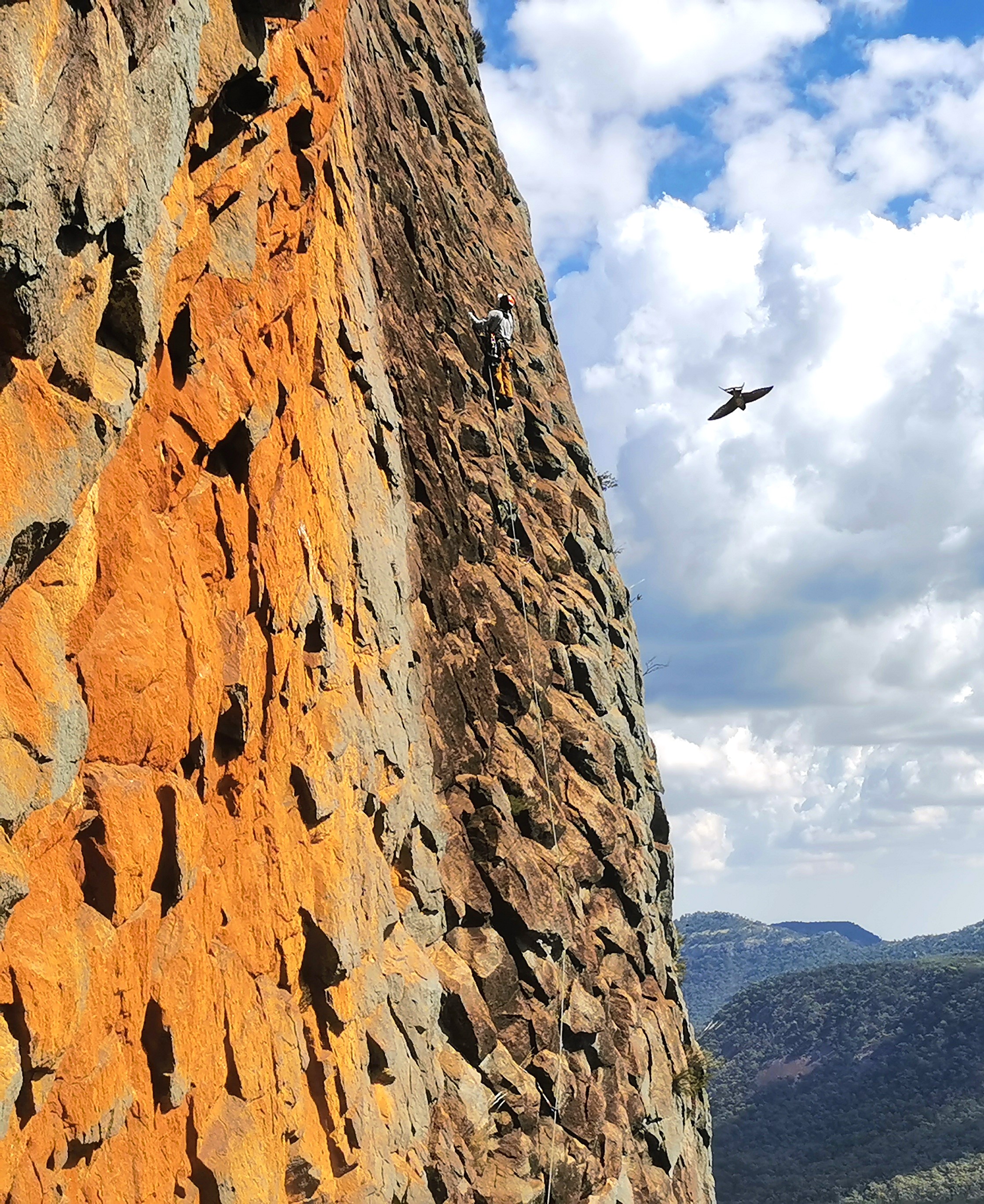
Photo Cait Horan

I can hear the phoenix sing

Touch the rock and feel the sky

Let my soul and spirit fly

Into the golden light                               

Adapted from “Into the Mystic” Van Morrison

LINKS

“Pumphead” documentary film by Andrew Pike 2020  https://www.roninfilms.com.au/feature/13773/pumphead.html

Ozymandias    

https://www.thecrag.com/en/climbing/australia/buffalo/the-gorge-north-side/route/142342560

Flight of the Phoenix https://www.thecrag.com/en/climbing/australia/warrumbungles/route/12107227

Common Climber (Facebook group) – Flight of the Phoenix

Heart support Australia            https://www.heartsupport.org.au/

St Vincent’s Heart Unit – Melbourne               https://www.stvheart.com/

Simon Carter website.   https://www.onsight.com.au/product/flight-of-the-phoenix-v/

Songs

“Viva la Vida”                Coldplay

“Into the Mystic”          Van Morrison

“Fly like and Eagle”      Steve Miller Band

”Born to Run”               Bruce Springsteen

“Beautiful Day”             U2

Climbing Beta

Ozymandias Direct intel/beta – for aid climbers

Pitch and gear suggestions Original below is from thecrag.com 2022. Our comments in bold.

  1. 25m (M2) Slime Corner. Two bolts off the deck (Deck potential, often stick-clipped1st bolt at 4m – stick clip, climb up and across to good holds and stance, stick clip 2nd bolt) to L-trending slab with slime-filled corner (might have to dig out some placements!) then up the crack. To DBB on a flake. Good stance. It’s possible to link 1 and 2. Nuts, offsets, cams to 3. After clipping 2nd bolt haul up the rack.
  2. 3530m (M4) Big Corner part 1. Sustained aiding on thin pin scars up the corner to a hanging belay 2 bolts with mailons and 2 carrots on the R wall. If you’re struggling, imagine freeing it! Camhooks, wires, offset nuts and cams to 2, micro cams
  3. 4020m (M4) Big Corner part 2. Shorter pitch to free anchor out right on sloping stance – 2 good carrots. More pin scars up the same corner, using a mixture of thin and fixed gear. Overlaps and bulges. Camhooks, wires, offset nuts and cams to 2, micro cams
  4. 28m (10M4) Big Corner part 3. Fixed piton then more thin gear and pin scars to 2 bolts. Swing or skyhook left to small tree and ledge. to trad belay in Climb corner on the left and tricky flop onto Big Grassy. Gear as above and cams to 3.

Big Grassy – lots of bolts, space for hammocks and portaledge. Ok position for one in between rocks on ledge. Extra space for 2 on flat ledge 8m below.

  • 3530m (M3) More thin gear up the corner above Big Grassy. Carrot below small roof. Take the left corner line after the roof at 25m to hanging DBB for the “Ozymandias Variant M2″/”Ozymandias direct(free version) or the less popular right line which is part of the original Ozymandias Direct line.
  • Option A 30m (M2) “Ozymandias Variant M2″/”Ozymandias direct(free version)” Up the beautiful corner (finger crack layback goes free at 22), at double carrots head right past two3 fixed hangers (2 long reaches – extender draw and skyhook maybe useful for shorter people) to a hanging triple bolt belay on the arete under the Great Big Roof.

Option B. 25m (M4) Ozymandias Direct – follow corner on RPs, wires, tie offs to hanging triple bolt belay. Unpopular and vegetated.

  • 37m (M4) The Roof. New and old carrots lead to the roof (good nut and cam in roof) and then using small gear up the pretty orange corner, which gets thinner as you go up. Hanging belay. (the Gledhill Bivvy).
  • 30m (M3) The Fang. Head R on decaying carrots then up steep crack past the Fang (some fixed gear) and beyond. Lots of steep awkward caving up to a final hand and fist crack. Take the big gear (cams – two #3s, #4,  #5) and watch out for the sharp edge at the start. Rope drag can be problematic.
  • 4035m (10 M2) Continue up crack to an ugly carrot and a slab move leading right to the base of an easy chimney (optional DBB) make sure to move the haul line left of the trees before entering the chimney. Then head up to big terrace with plaque. DBB is way around left.
  • 15m (M3) Steep offwidth (BD C4 #4 and #5s) with an initial seam on the left wall and a few dodgy carrots higher up. Finish on lookout.

Gear suggestions

  • 12 draws, 4 alpine draws, 15 spare snaplink biners
  • Slings med and long
  • 3 – 4 anchor kits including 8 large locking biners
  • Camhooks – 2 mall, 2 large, 2 skyhooks
  • Haul kit – See “Nose of El Capitan” at 52adventuresblog.com for 2 to 1 setup with protraxion for group of 3 sized haul bag
  • 8 bolt brackets, hero loops
  • Camelots or equivalents – 2 each 0.5 – 3, 1 #3.5, 2 #4s, 1 #5 (Totems are brilliant)
  • 1 set aliens
  • 1 set alien offsets
  • 1 set TCUs or DMM micro cams
  • 1 blue totem, 1 BD #4
  • 1 set RPs, 2 sets offset nuts, 2 sets nuts 1-7, 1 set 8-12

General

  • Strategy – Day 1 – drive to Buffalo, sort gear, hike down southside track, cross creek and hike up to base of climb. Climb and fix pitches 1 and 2, sort out water from creek. Bivvy at base – comfy for 3. Day 2 – Ascend and haul to anchor 2, climb pitches 3 and 4 to Big grassy. Climb and fix pitches 5 and 6. Bivvy on Big Grassy. Day 3 – Ascend and haul to anchor 6, climb pitches 7 to 10. This worked well with our team of 3.
  • Water – 3 ½ litres per day (December). Climb is shady from about 11.00am.
  • Communication can be difficult round roofs and with noise from the stream, waterfall and wind. Consider radios.

Flight of the Phoenix

Balor Hut is an excellent base camp – can be booked through NPWS website, has a combination lock, mostly ? has water, bunks for 8 with wooden bases, only one group can be booked at any one time, some camping outside also needs to be booked, rats/mice will eat anything, 2 hours hike from Camp Pinchum carpark.

Start – 1 ½ hours from Balor hut via Dows Camp and a network of footpads from Dows Camp to the climb which would be hard to follow in the dark. There is a great photo looking up Pitch 1 from the start on thecrag.com. In a V groove with seat boulder on the ground.

Gear – doubles of cams up to #2 and a single #3, lots of wires, lots of slings, some micro cams are good.

P2          Good gear, a bit harder than P1, zig zag a little

Anchor on the ledge at end of P2 – has been replaced 4/2023 with double static inside inch tape with 2 mailons to abseil from.
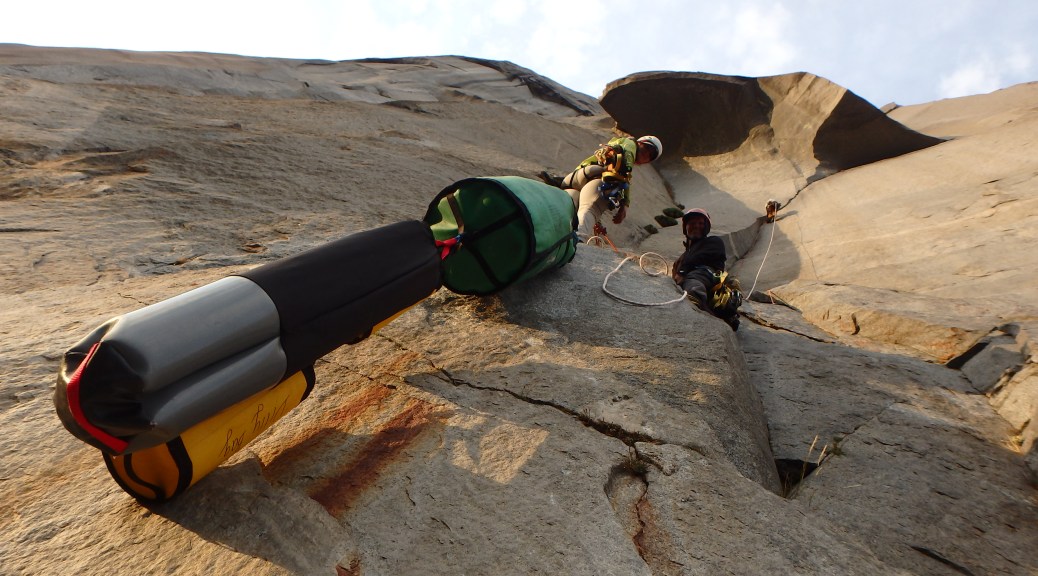
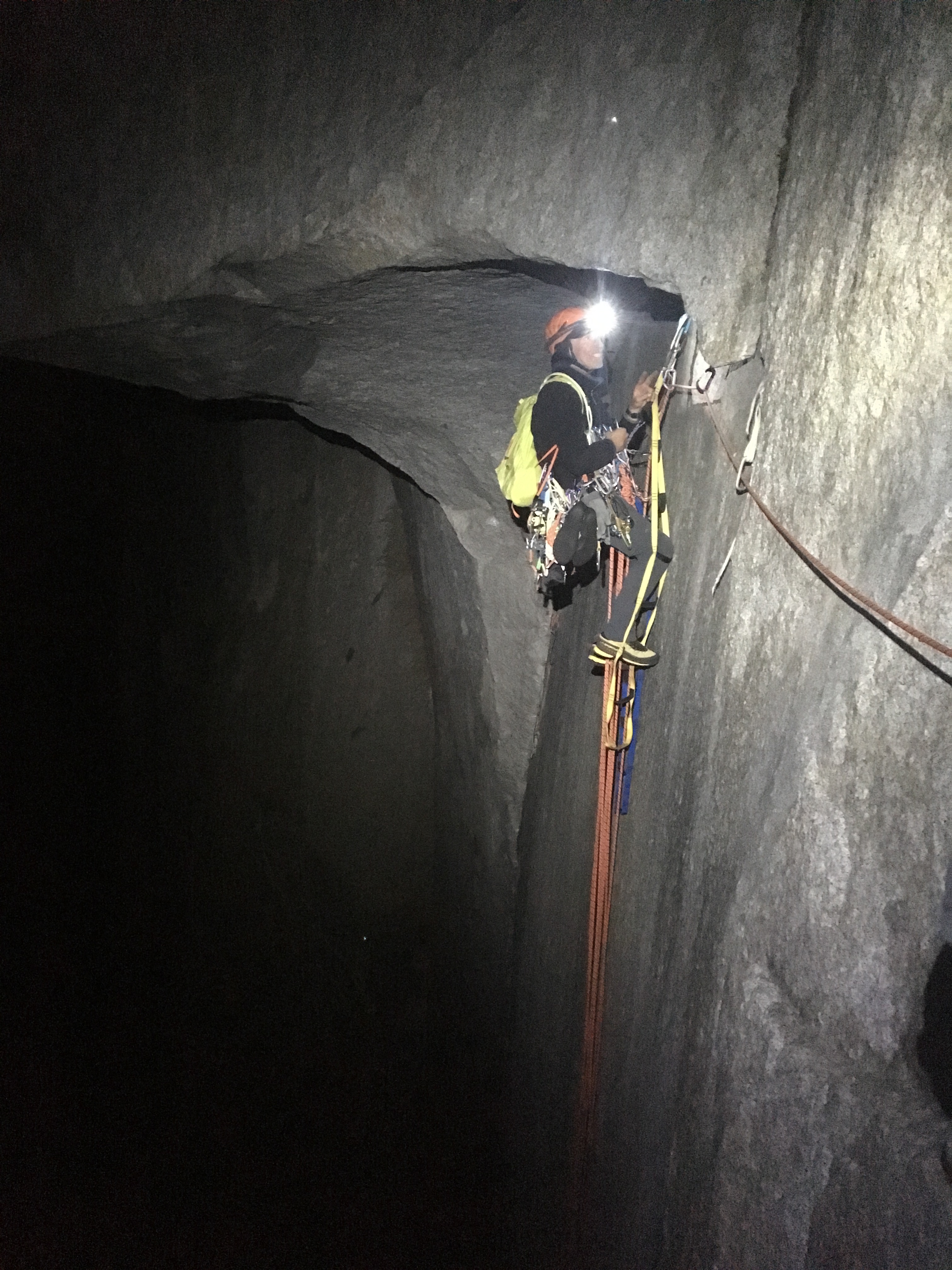
The Nose of El Capitan

The Nose of El Capitan

For climbers who want info and beta on the route skip to Part 4 – it’s at the end.

Part 4 – Route Beta and Info for interested Nose climbers

  • Party of 3 system
  • Equipment tips
  • Pitch by pitch useful info
  • Hauling with a 2:1
  • Crowds, queues and traffic
  • Sources of info, super high res photo link, topo sources

Featured image above – Heading up to the Great Roof. Photo by Wolf Friedmann

The Climb – Part 1

The Days After – Part 2

Greg’s Poem – Part 3

Greg cleaning the Great Roof

The Climb – Part 1

It was dark. 8.00 pm ish. Three sets of feet on the 2 inch wide sliver of a ledge. Three good bolts on a sheerness of vertical granite that disappeared 2000 feet below into the gloom. Shifting from foot to foot, trying to relieve the pressure of harnesses and sore toes. “So we either hang the portaledge right here and the 3 of us sit up through the night … look plenty of people before us have done much worse in the past … or we push on to Camp V?”. This was a critical point. Together we had decided to keep going late in the afternoon. I had just led The Great Roof. Sensational. Cait and Greg had been on belay way below.

Peter heading up to the Great Roof

The best pitch I had ever led in my life, tricky, wildly exposed, thin small gear, each aid move tenuous but workable, through the Valley sunset into a blaze of glory.

The hardest section


In my head I was thinking “This is it, this is what The Nose and big walling is all about. This encapsulates what makes The Nose the best rock climb in the world.”


I had hooted and danced high among the sky full of stars across the final moves onto the foot ledge.

Just before dark

Cait jugged up, we hugged then we hauled. Greg cleaned the pitch by torchlight. 2/3 of the way up The Nose.

Day 4, had started at 4.00 am. We had packed up our bivvy on the comfy El Cap Tower ledge and started jugging up the fixed line to the top of Texas Flake at 5.00, a prearranged hour ahead of the German team we had been held up by 2 days prior. Greg had led the notorious unprotected chimney up behind the Flake in the afternoon of Day 3 – a gutsy brave effort, lonely and completely isolated, hidden in the chimney while Cait and I willed him on in silent trepidation from below – until he poked his head thankfully mischievously over the lip. I’d offered to take the risk of the chimney fall from him but months before we had divided up the key pitches and this was one of his, and he was determined. We jugged and hauled again to the top of Boot Flake. That had been one of mine and the last pitch from the day before – a bolt ladder then a cam hook and micro nuts that led into a good crack up the edge of the Boot – brilliant aid climbing. The latest research shows that only 7% of the boot is in contact with the cliff, but reassuringly (?!) it needs another 4% to give way to send the whole thing plunging. I had contemplated this as we fixed our anchor system to the bolts on the actual cliff above the top of the Boot on which we had stood.
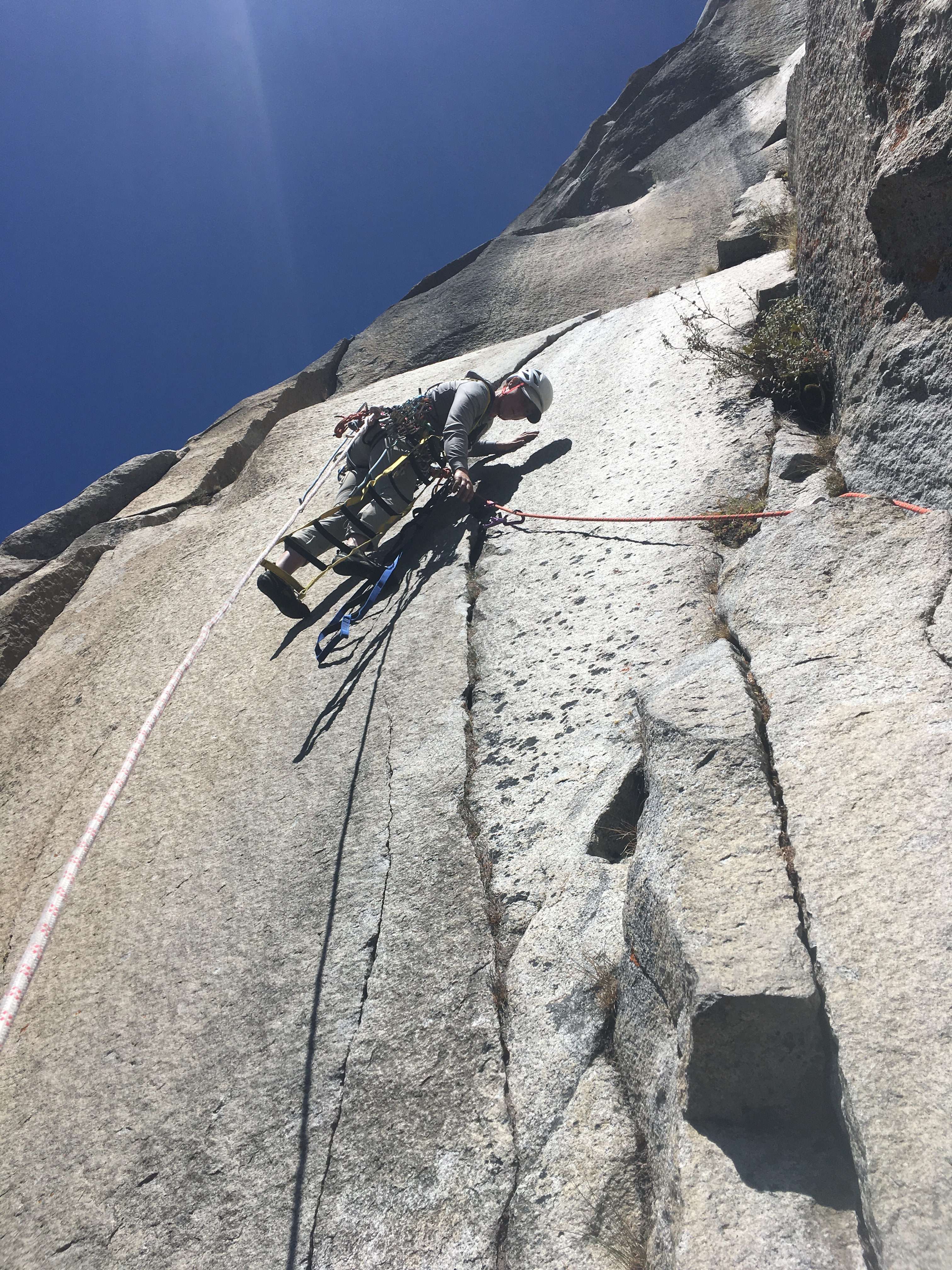
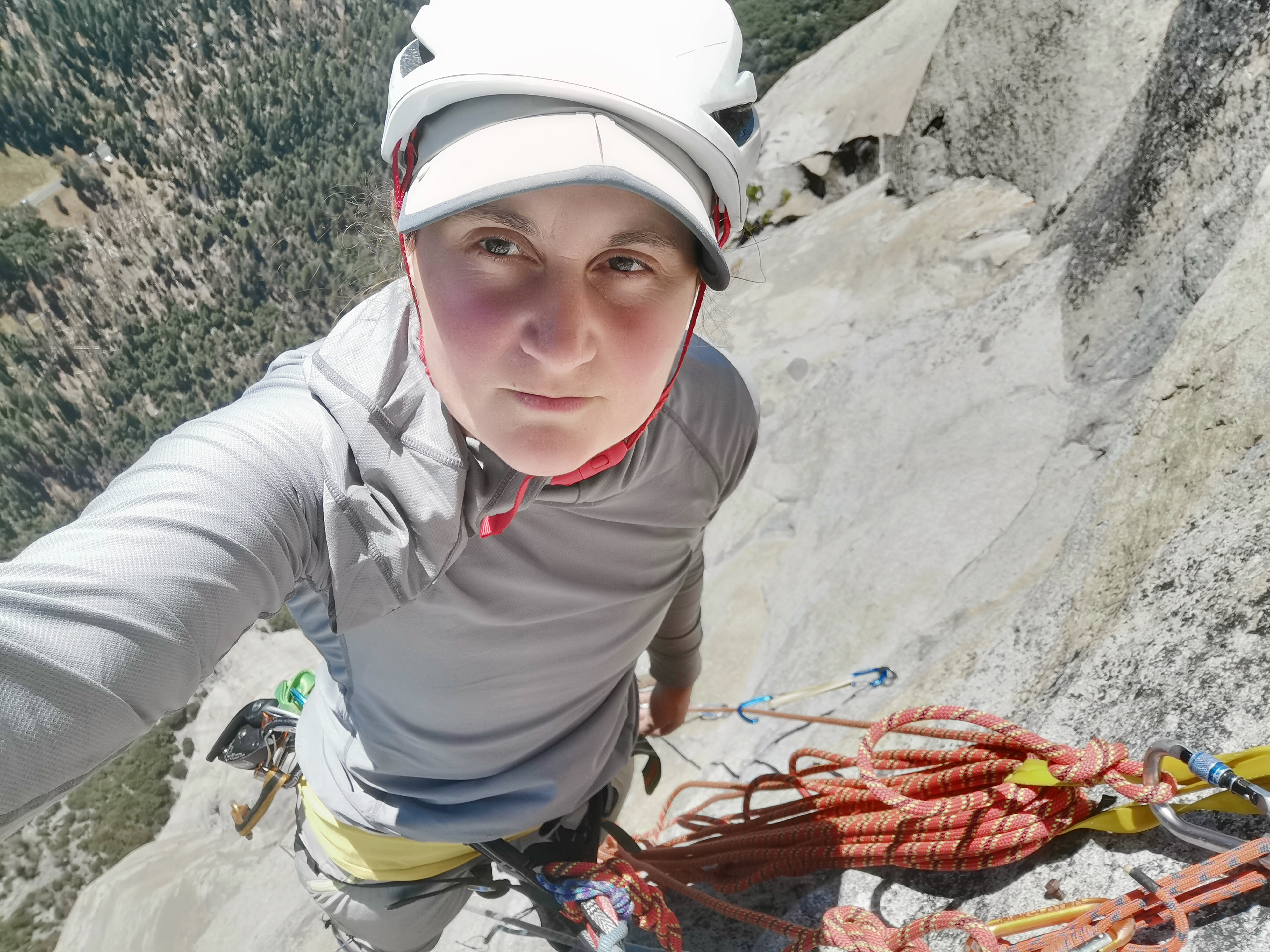
At the top of the Boot the crack system and climbable features end in blank smooth granite. This necessitates switching to a crack system about 20 m to the left. I lowered Greg down vertically to a point at which his feet were level with the third from top bolt in the bolt ladder I had climbed to reach the Boot – invaluable detailed intel/beta like this we had been collecting over previous months through research and talking with people. This King Swing was a deal breaker and a legendary pitch. We had met a group retreating from the climb who had spent hours on it and then one of their climbers had become injured attempting the swinging pendulum. Feeling totally amped and confident, hanging by his thread Greg strode back across the face then while he hung horizontally he jogged with large paces towards the protruding edge. First warm up shot he nearly made it. On his return swing he sprinted to build up momentum and as he swung back wildly he took giant athletic slow motion strides thru space, hit the ground running, launched with arms outstretched and grabbed the rib. We cheered, not quite believing he had done it so fast, and the crowd of spectators 1500 feet below in the Meadow cheered as well, along with other climbers on the mountain. It was as if time had slowed right down. Like all his youth of developing diverse sporting prowess and 25 years of PE teaching had led him to that brief moment of athletic mastery in the most hostile and dramatic arena.

For a full screen view search   Youtube King Swing Greg Fisher

It was exhilarating for our team as a whole. “He’s our secret weapon”, Cait said with great confidence. She knew him better than me. I was just grinning, shaking my head and thankful to be in his team. It blew his mind. He had found it easier than expected. He balanced carefully across and up to a safe anchor then started up a difficult section after we had lowered him down all the gear. The hardest moves were just above Eagle Ledge which is where he was pretty much on a top rope from the side. He climbed slowly up the crack system but as Cait and I had to lower down from about 20 m to the side he had to place protection then climb up a little before going back down to retrieve the lowest gear. It was like yoyoing bit by bit upwards balancing the risk of a long sideways fall with having enough protection in and minimising rope drag. We cheered and whooped again when he reached the belay bolts at almost the same level as us.

Cait lowering out across the King Swing


Cait lowered out and rope wrangled her way efficiently down then up.


The Germans on the boot hauling. Peter lowering out across the King Swing. Photo Tom Evans

I thought I had it figured out but managed to tie myself up from both anchors at the mid-point spread eagled in deep space and somehow extricated myself in what would be the first of two key skills that I should have practised more thoroughly back at home.

A good pitch of aiding up cracks took me to a belay at the edge of a steep grey wall. A few well spaced bolts led out left across this almost blank wall while the crack system continued up. If we could climb across the rising traverse we would save at least an hour. Cait was our gun free crimpy face climber and was keen to give it a try. Failure would mean significant wasted time. Below the Germans were across the Swing and looking upwards. Tentatively at first Cait delicately placed her feet on tiny sloping footers and pinched even smaller finger holds and side pulls outwards away from safety. This Lynn Hill Traverse wasn’t sport climbing with bolts every meter. Rather it was bold and hard. She clipped through a couple of bolts at full stretch then the wall blanked out to a subtle arête further up. Climbing wise this was Cait’s forte, her world. Hard, fine, balancy moves. Technique. Smooth. Bold. Control. Strength. But here, so far up that the thousands of feet just turn to huge sucking exposure, she was being tested. Just like the boulderer, Kevin Jorgenson, up on his Dawn Wall. Run out. In the space where “real climbers” do their dance. I held my breath as time once more seemed to bend around us, to focus our inner worlds and our skill into an intense relationship with this stone.

Cait leading the Lynn Hill Traverse, Peter belaying. Photo Tom Evans

A small nest of microcams protected her final choreography to the end of the pitch. Following her long battle with cancer Cait had determined “not to waste another moment ….. I could be dead or taken into hospital at any time”. As I belayed and she shimmered across the wall the moment was etched into our hearts and into the spirit of the granite that seemed to shine in grey and brilliant yellow bands of colour. Her relentless positivity was infectious.

Cait Horan high on The Nose

(Haul bag quote)         Cait, you have always been my role model, my biggest inspiration and the person I still hope to grow up to be like. There is not a haul bag big enough to write all the ways you motivated, inspired and shaped the person I have become.                                                                                                                           Emma Horan

Into the Grey Bands. Cait was on a roll. The day was going well. We were making steady progress. In the ebb and flow of my confidence and feeling that we should consider bailing I felt optimistic. We left Greg with “Kevin” the haul bag, and the now catching up Germans. Cait led a long traversing weird pitch across the Grey and up to Camp IV. She then wove her way, gracefully free climbing, following seams up a huge concave hanging wall below the Great Roof. When all three of us considered our position we made that first decision to keep going, knowing that whenever we needed to stop we could pull out the portaledge if need be. Without a nearby rock ledge for one of us it would be a challenging, uncomfortable and long night. But it would be ok. It would be safe. We were 2/3 of the way up. Still a long way to go. 10 more pitches. None of them easy. Some of them difficult, more difficult than we knew.

Everywhere the outlook was stupendous. The Valley. Half Dome. The forest way below. The Nose of El Capitan, we were there, we were doing it. So amazing and hard and spectacular and fun and stonkingly huge in all dimensions. In our 90 years of shared climbing experience no other climb ranked or loomed larger, more grand, more beautiful, more full of history, more daunting. More wonderful in its surrounding landscape.

And so to the top of the Great Roof pitch. We discussed our options. The promise of a good ledge at Camp V offered some comfort and the possibility of laying down sleep. “As long as you’re ok to lead we are happy to keep going”. With a big rack of gear and under head torch light I set off up Pancake Flake. This would have been classical in daylight. It passed through the narrow beam slowly bit by bit. I was switched on. Didn’t feel tired. Not conscious of time. Just going step by step – place a piece, test it, walk up the aider as high as possible, repeat. A long pitch. Occasional call to the others met with encouragement. Belay anchors, 3rd person jugs, lower out the haul bag, haul, cleaner does their job, eat, drink never enough.

I set off again for the next and last pitch of the day/night. The pitch had no name known to us. Nondescript. The topo just said “awk” and listed the gear needed. “Awk” it proved to be. After midnight. And strenuous. And painful. It was a deep flaring groove. I had to reach far in to place each piece then struggle to fit the aider and detangle then step up with toes squeezed deeply into the narrow fissure with all my weight on them then struggle to place a piece just a little higher. It became a horror. Not unsafe. Just low down awful and strenuous and more painful and more and more “awk”.

(Haul bag quote)         “You have to want it more than it hurts.” Tommy Caldwell

Like a too big worm with too short arms I had to struggle in between the walls of the flare. It took an age. The others could hear my struggle and never once exorted me to move faster or try to do other than I was doing. For a too short time there was a blessed crack on the left wall that eased my passage. Then more struggle. I held it together. Just. They must have been drifting in a cold haze of discomfort below. A nightmare awake. In the end I reached a slab and exhausted hauled my way to its top and a couple of bolts. Totally smashed.

Cait on the way up the Butt Crack pitch.

The easy 15 feet of 5.6 unprotected slabby wall I just could not face so I called up Cait who flew up the fixed rope then waltzed across to Camp V.

At last. The ledge. Relief 4.00am. Between Greg below, with the haul bag, and me on the ledge and a miscommunication we nearly had a problem hauling into which Cait switched into safety mode and brought us all back into line and onto the Camp V ledge. Hot chocolate and food never tasted so good. Portaledge erected. We drifted off to sleep at about 6.00 am in the first glow of dawn. 26 hours. 10 pitches. Our teamwork had been pushed into another zone – patience, support and assistance for each other, generosity, giving our all and trusting that each of us were doing the best we possibly could do, for each other.

___________________________________________________________________________

The lead up

 Alpine rock. Endless “thousands of feet” of climber’s granite spired, walled and domed skywards across the spine of the “Range of Light”. Over four weeks Ian and I had threaded our way from peak to peak through the High Sierra and brought to fabulous fruition our dream of forty years. Perfect weather, warm rock – Tuolumne, Fairview Dome and Cathedral Peak, Mts Whitney and Russell, Temple Crag and Charlotte Dome. Stunningly beautiful. The routes made up our own “Classic Climbs of North America” list. Then for a final week we pilgrimaged to Yosemite. Like an addendum to the main game. The Valley. Legendary. Even chanced a spot in Camp 4. I’d spent a lifetime reading about the big walls and climbs which over the years had settled back into a nice comfortable place of reverie, like a favourite book lying dusty on the bottom shelf. On another perfect day we climbed the easy “Snake Dike” up the side of Half Dome – a wonderful romp up runout slabs to the glorious summit where we soaked up the grand scenery as the sun set over Yosemite. Then it rained. For four days. We hiked trails through forest and beside streams.

One evening high up at Glacier Point at minutes before  sundown shafts of blazing light finally broke through a gap in clouds and lit the summit of Half Dome gold then pink.

Next day we walked down to El Cap Meadow in drizzle and mist. Again the sunlight streamed up through the valley in the last of the day and lit the top section of El Capitan. I hardly dared breathe for wanting not to break the spell and wonder of the scene. I had fallen in love with the place. Our last day slowly cleared. With binoculars I traced the line the setting sunlight had taken the evening before as it had risen up the wall. The bottom section was less than vertical. There were crack systems that linked nearly all the way. The Stovelegs and the Great Roof – names etched in memory. Totally unexpectedly it looked even possibly climbable. For me. On a maybe good day. The realm of possibility arose from a long buried precious place within. The Nose. Of El Capitan.

Back at home a plan hatched. Two years, two trips, two routes, The Nose and the Regular Route on Half Dome. And the Tip of Lost Arrow Spire. Heart and psyche set a course for the big adventure – the outcome unknown. A new lightweight portaledge arrived eventually.

My partner from the Sierras, Ian, wasn’t interested and another dropped out. From a solo mountain summit in New Zealand I messaged a climber back home, strong and skilled and tough, a teacher friend – Greg. During my pitch to him about the concept a few weeks later at the climbing gym he mentioned another person who would possibly be interested. Cait joined our discussion outside. She jumped head first straight in while Greg needed more time to let the idea percolate.

(Haul bag quote)         Aim and dream big you guys.                      John Fantini

We did some practice and made a plan to climb Australia’s biggest aid climb (Ozymandias at Mt Buffalo) to see if we were ready and willing to commit. Snowy storms got in the way so in the Blue Mountains we did Australia’s longest sport climb (Hotel California) with two of us doing a bunch of jumaring. Then at Piddington and Mt York some technical aid climbing and hauling, a night on the portaledge for two of us and a day of crack climbing (Eternity led by Greg with a few concerned grunts as he had not trad climbed for a fair while) at Piddington. Over the three days we shared some successes and a few rude awakenings. A lot to learn and practice and research. Results were inconclusive on our readiness. There and then Cait was in. I was happy to go with the two trips over two years process. Greg was keen but only wanted to give it one shot with a high probability of success. We could spend 18 months slowly preparing or throw ourselves in with five months intensive work. With something of a casting vote I plunged us right in. Later, in the darkness, on the journey home, after chatter of climbing eventually subsided I listened from the back seat to their close sharing of deep personal traumas and life struggles. I hoped the undertaking might give them some respite and renewal. And that we could meld ourselves into a cracker team.

(Haul bag quote)         Greg, you’ve been an incredible, selfless role model. I’m so glad to see you making time to pursue your own dreams after helping so many others achieve theirs.       Emma Horan

Cait used her myriad of contacts in the climbing industry, derived through many years of being SuperCoach to up and coming youth climbing teams, to order a stack of gear. The hugest haul bag we could find arrived. We practiced on Greg’s school climbing wall. Hauling 70 kg. That was the weight we had calculated that we needed to start up El Cap with. 7 ten litre water jerry cans just fitted in the bag, could NOT be carried by one person and made up just the right haul weight to practice with. Early on we settled on a strategy for 3 people that involved 2 climbing ropes, a static haul rope and a skinny tag line. It was complicated and several times we ended up badly tangled up and cluster f…ed with all the ropes and the very heavy bag. The big green haul bag became “Kevin”, through an iteration of the common term for such bags by big wall climbers being “The Pig”, which led to bacon, then Kevin Bacon and then just to Kevin. Cait’s “people” had been in touch with Tommy Caldwell’s people who were trying to get us together with him and “Kevin” Jorgenson who would be presenting in our home town Canberra about their epic Dawn Wall climb (just to the right of our Nose route) before our trip. So it was with fondness that the bag became “Kevin”.

Offset nuts and the latest and best Totem cams were obtained. A microtraxion was upgraded to a protraxion for the haul device. I was soon convinced we needed a 2:1 haul system to enable us to more easily haul the big load with the aid of some mechanical advantage. Endless research, “homework”, led to improved pulleys and a workable system. Cait, the gun sport climber, taught me how to correctly use a grigri. Our main concerns were hauling the big load, efficiency in a group of three and the queue for the world’s best rockclimb. There were lots of other things to find out about in amongst watching YouTube videos of big wall skills and climbing the Nose films.

The haul bag started doing the rounds. Our friends and some renowned climbers wrote messages of support on it for us. We had a sense of taking these others along with us to give us strength and inspiration.

(Haul bag quote)         Thanks to all 3 of you for teaching and inspiring multiple generations of outdoor enthusiasts. I would have had a completely different path in life without the encouragement and the opportunities you guys offered me. May your protection be bomber and your hauling system be efficient. Stay safe.                  Matt Cools

Cait went to USA for a climbing trip in her school holidays, she’s Deputy Principal of a Canberra secondary school. She cut her high end sport climbing short and did a few days climbing and familiarising at Yosemite. She returned scared and extremely highly motivated to train, learn, practice and research harder. About this time we started emailing and messaging each other regularly. It didn’t seem to me that Yosemite was the ONLY thing I was thinking about – at least every week or two I thought about something, or someone!, else. Greg was in the zone as well having put his other climbing goals on hold. To augment her amazing climbing training walls in her garage Cait and her Dad built an adjustable crack system to work out on while she watched more YouTube videos.

(Haul bag quote)         Climb hard. Stay safe.             Brandon Maggs

Early on the time arrived for camping bookings in The Valley. At the stroke of midnight (which was 10.00 am USA time 5 months in advance) on the appropriate day the three of us feverishly typed our requests into the recreation.gov website that contains hundreds of campsites. For our planned three weeks the best we could manage was bookings for about 80% of our nights but pretty much every night in a different site in a different campground. Trying to manage this would have been an absolute nightmare. I’d envisaged this from previous experience and don’t know what the solution is. Camping arrangements for Camp 4 are changing but may still be almost impossible for international travellers. So I booked us in to a permanent tented glamping place “Housekeeping Camp” which had vacancies for all our nights! Except the weekends! This situation is an indicator of the popularity and crowding on the Valley floor. The previous year Ian and I had found that once you are on the trails and up near the crags the crowds melted away. Stories of queuing for 2 – 3 days to get on The Nose and clusters of climbers higher up the climb were daunting. Hopefully patience, a positive approach and solid skills would see us through. I did wonder on the flight over the Pacific how many others were flying or driving a similar path, with similar objectives, to Yosemite.

The day before Tommy and Kevin arrived in town Cait’s people arranged for the local newspaper to do an inspirational full front page story about her near death experience with cancer, her incredible recovery and dedication through a slow build up back to her former climbing performance levels. During her illness the Dawn Wall saga had played out on El Cap and in her psyche. Climbing El Cap went onto her bucket list. She was now inspired herself by Kevin Jorgensen’s own exploits and dedication in transitioning from sports climbing to completing one of the most amazing trad climbs in the world today. With Tommy and Kevin she also did radio and TV slots on the day. And two of us did meet them later before their show. They signed and wrote messages on our haul bag and posed with Cait in CAC (Climbers Against Cancer) tshirts.

Cait Tommy and Kevin

Cait also had them sign a special CAC shirt which she had already got Chris Sharma, another world leading climber, to sign and which she was going to auction for the charity at a later date. Next day, unsolicited, Tommy sent her a photo of himself and Kevin climbing in the Blue Mountains wearing their CAC shirts. The photo was great publicity for the charity.

Greg and I did several training days on local granite crags. We aided popular free climbs where we had to be single minded and resist climbing free. We practised with cam hooks and peckers. Surprisingly the cam hooks worked very well and felt secure. On a solo day, while backed up on a top rope, I levered out a block which grazed my helmet, took a chunk out of the stiff brim of my cap and shaved my cheek bone. It seems that aid climbing puts different forces on rocks in free climbing areas. I immediately thought of Tommy’s comment on our haul bag. I went straight up and finished the climb before I went home to clean myself up. Later Greg did a great lead across under a tricky roof then up an overhanging crack line.

Greg aiding Sipple at Booroomba Rocks

(Haul bag quote)         Enjoy the process.                   Kale

It may have been a case of overtraining that led to Cait getting the flu.

Greg and Cait flew up to Frog Buttress near Brisbane for a long weekend to hone and consolidate their crack climbing skills.

(Haul bag quote)         You’ve worked hard for this. Enjoy the type 2 fun. Rob H

At another Canberra school we used their climbing wall for simulated multi pitch climbing, hauling and anchoring training. We all had strong connections to Lake Ginninderra College. I had been Outdoor Education teacher there for 14 years and had taken Cait and her brother and sister on numerous climbing, and countless other, trips as part of their year 11 and 12 studies. Both Cait and Joe later became teachers themselves. As a student in year 12 Joe became probably one of the youngest qualified climbing guides in the country.  Greg’s five sons had all spent two years at the college with several of them being outstanding Outdoor Ed students and elite level climbers. Greg led one of the best high school Outdoor Education courses in the city at one of the feeder high schools. He has organised and run the state school climbing competition for decades. He accompanied several college trips to Arapiles on which his son Ben led Kachoong 21 and later Daniel led India 28 – amazing. Together the two families have been the throbbing heart of a vibrant youth climbing scene in Canberra. I felt privileged to be teamed up and connected, literally, with the two key players of local climbing royalty.

“Yosemite Erik” Sloan, who authored the Yosemite Big Walls guidebook, talked to us for over an hour. He introduced us to a much simplified strategy for our group of three. Two people is the most common team size and can be very efficient. Efficiency is a major aspect of success. The retreat/failure rate is about 50% on The Nose. If you are inefficient then you take much longer, have to carry more water and food, overflow your poop container, run out of water etc and so you are likely to bail out. Three can be good because there are more people to spread the load – physically, socially, psychologically – and you have more fun. We were committed to our team of three which would automatically take longer and require carrying more food, water and gear. We could hopefully haul well with the 2:1 early on when our bag would be heavy. Erik gave us a simplified system with only two ropes – less chance of getting things tangled up. We still brought over all our ropes so that if we changed back to our earlier system we would have that option. Many groups also do not take a portaledge and camp on the available ledges where possible. With our lightweight double portaledge we intended to sleep two on that and only one on a ledge nearby. Hopefully this would provide some good flexibility, but it would be another substantial extra bit of kit to cart up.

At a dinner with partners and family within the first couple of minutes the two wives shared perspectives on how we had been extremely focussed on our climbing and research and training. In retrospect now I would probably agree but feel also that all the time spent had been necessary. Even with our combined extensive climbing experience we all had tons to learn and sort out and practice. In the end we still might have been underdone and alternatively if we were successful then maybe our level of prep was just right. All three of us had become swept away with it all. Just as I had been captivated by The Valley and the possibility of tangling with the Capitan. Intellectually our wives supported us but they struggled with our unavailability and preoccupation at times. The support of loved ones was an enabler for each of us. I hoped we could return refreshed emotionally with a deep sense of gratitude. Our best selves.

In the lead up I had wavered in my assessment of our chances. From strong confidence to doubt. Sometimes it was related to how our skills practices had gone – Cait and I did some smooth hauling of a bag full of stones and each other, a breakthrough in our systems – or how my puny muscles and ageing joints had stiffened up after a session at the gym.

“I think I understand and can work the systems now and concentrate on being faster”. Cait at our final practice the week before leaving. “In the nick of time”, I replied as we high fived.

Friends were full of the generic questions. “How do you go to the toilet up there? What do you eat? Where do you sleep? What happens if you roll over at night? What do you do if it rains? Have you updated your will?”

(Haul bag quote)         The bigger the dream, the more important the team. You have done the work now enjoy the success. Stay safe, look after each other and enjoy the view from the top.       Cait’s Mum and Dad

During the first part of the flight from Sydney to LA I listened for the hundredth time to some tracks from our Yosemite playlist. And I reflected that it was similar to the start of a marathon. You have to be thrilled that you have reached that starting point – completed enough training to be in the ballpark to finish in reasonable shape, to be healthy. And different to a marathon – to be part of a cracker team.

__________________________________________________________________________

Day 1

Our efforts telescoped right up to the point where we stood at the bottom of Pine Line. The initial access pitch. 6 months of training, planning, research at home. Long haul flight to SFO Saturday. Food shopped then drove to Yosemite Sunday and checked out El Cap. Monday we multi pitch free climbed. Tuesday and Wednesday we worked with a guide, Greg Coit, to tune our systems and obtain last minute beta on the route. Greg suggested we start the next day and get straight into action. The weather forecast was excellent and our Greg had an important commitment a week later. An evening packing. Early morning start.

(Haul bag quote)         Peter, I will never forget the confidence and trust you gave me on Danielle. Now it’s time for me to return that confidence and trust. I have no doubt you will achieve your dreams.     Mike Law-Smith

Pine Line went well. I led, we hauled, Cait cleaned. As the most experienced aid climber I led the first two main pitches which were fabulous. To get us going as smoothly as we could. It was a fantastic feeling to be actually climbing on the big stone. Tried to just focus on the pitch, the placement at hand, the systems, being careful and efficient. Not on the huge distance and steepenings in the corners far above. Just the job at hand. I dropped an offset alien. Bugger. Pin scars, totems, offset cams, micro cams, micro nuts. Bolted belays. Quad anchors. 2:1 haul system. Everything went pretty much to plan.

(Haul bag quote)         All three of you, Pete, Greg and Cait, are people who have touched my life in only positive ways! Enjoy the climb up that wall.                Chris Webb-Parsons

That left Greg with the two hardest pitches. Two of the hardest of the climb. Thin aid. Pin scars. Slippery smooth rock.

Greg leading

One fall when his gear pulled out unexpectedly. A big pecker the only thing he could find to get through one section of pin scars. Lower outs. He did well. The practice back on home crags paid big. Then a big complex lower out and traverse right and he was on Sickle Ledge.


Greg on the way to Sickle Ledge with the Great Roof looming 1500 feet higher


 A smooth day. In anticipation we enjoyed spying out the route ahead up high.

On Sickle in high spirits

We met up with a German pair who we had spied during the day jugging their fixed ropes up to Sickle and hauling quite slowly. We secured our haul bag and portaledge onto the ledge then fixed and repelled our own ropes 150m down to the ground in the late afternoon.

The lost alien was replaced at the mountain shop. We packed up our stuff and sorted all our food.

Day 2

4.00am start. At that stage we didn’t know this would become the norm. Everything in the car. All the leftover food and other scented stuff went into a bear box at the Meadow.  By 5.00am we were jugging the fixed lines with our sleeping bags, some snacks for the day and extra water. Hard work. The third rope we dropped to join others at the base (we had arranged for it to be picked up).

Getting stuck in amongst other groups on the Nose is a major problem and almost inevitable. We had spent time on previous days scoping out the traffic on the route. There seemed to be a pretty good gap ahead of us, maybe due to some cold weather that had just passed. And miraculously no one else had climbed up to Sickle on the same day as us. Things looked good until we arrived at Sickle 5 minutes after the German pair, who had bivvied there overnight, were ready to go. They seemed to have a lot of stuff. We waited. And waited. While one of them led the next pitch and then tried to haul their large load.

Waiting on Sickle

A pair of Nose In A Day (NIAD) speed climbers passed through quickly. An American pair jugged up with their haul bag. And another pair who were doing a run to Dolt Tower. Eventually Cait led off, only to have to wait while the Germans struggled first with a pendulum across to the Stoveleg Crack system then with their big load and inefficient hauling system. This was really frustrating and required all our reserves of patience.

Us and the Americans still waiting on Sickle. Photo Tom Evans

Getting gridlocked with other groups is one of the primary reasons for the high bail rate on the Nose. Greg Coit, Erik Sloan and Tommy and Kevin had told us that early on we would be looking for excuses to go down, that the secret to success is just to never give up. We were a group of three which is slower than a regular group of two. And we weren’t experts, but we had practised and for a group of three were travelling light. We had proved the previous day that we were in the ballpark to be successful. Our water supply was calculated to last a little short of 4 full days, now we were getting behind schedule, maybe critically. The Dolt runners bailed and rapped back down.

Cait waiting, hanging in the middle of the Germans and Americans

The Americans looked fast and needed to get high up as they had no portaledge and only 3 days water. We let them take a higher route through the Dolt Hole but then they caught themselves out by running the pitch too far. They lost communication with each other and got tangled trying to make sure they didn’t lower out their haul bag onto us to the side and below them. Clusterfuck. More hold up for us. The wind picked up.

Cait eventually pendulumed across and we got set up in the bottom of the Stoveleg Cracks mid afternoon. She had been training and practicing trad crack climbing intensively for 6 months – building a crack machine in her home climbing garage, spending multiple weekends at local crack climbing venues and flying up to Frog Buttress for a 4 day weekend. She set off with a big rack. Made slow progress. The hours of “hanging around” had taken their toll. She fought the wind. Communication was difficult. I gave out slack and held the belay tight at the wrong times. She inched upwards then stopped for a time. Alone. Strung out.

(Haul bag quote)         Very important – DON’T FALL! Stay strong. Will be thinking of you crushing!!             Peta

Then she moved on again. Not much free. Eventually reached the belay. We made our way up and joined her. Her face was tear stained, her jaw set rock solid. Silent.

http://https://www.youtube.com/watch?v=5f8RdMwafJI&feature=youtu.be

She gave me the rack and I aided up as the light faded. A piece pulled and I took a long fall scraping my shin in the darkness. Set my own jaw and continued up two pitches. Three of the most famous pitches we’d got smashed on due to the traffic, out of our control – the Stovelegs.

At 2.00 am on Dolt Tower the Germans were in bed. While we set up our ‘ledge and had some dinner. Tried to regather ourselves. Respect. Mutual support. Dig deep. We decided to negotiate with the Germans to go first in the morning. This was one of those critical points where it would have been so easy to bail but almost without speaking our plan was hatched through this very low point – Cait had really lost it for a bit, I’d led for hours through the dark, Greg was psyching out from spending the day hanging, hauling and cleaning but isolated from the leading. We started a nightly round of ibuprofen with the best hot chocolate on the planet. The wind had dropped. 20 years earlier Cait had been a student in my outdoor ed. class. I had introduced her to climbing and then she passed that on to her brother and sister. At my retirement they had given me a small clock with an engraved quote from Ed. Hillary, “It’s not the mountain that we conquer but ourselves”.  The night was velvet and star studded – I did notice this for a second as I zipped my sleeping bag shut. Up was the plan. Bed at 4.00 am.

Day 3

We were woken early by a NIAD (Nose In A Day) group climbing past. Up at 6.00 am.

Air B n B at Dolt

We then chatted with the Germans, Wolf and Herbert, “Your climbing is great but your hauling takes a long time. Could we leave first today and see if we can stay in front?” They agreed. We were off by 7.00 am. I led down into a bottomless gap then up a steep crack system. Great to be in front. The Americans were a long way ahead. Our combined teams strategy was working. Maybe we were settling into our groove with a team above and another below.

Cait leading, Greg and Peter on belay between Dolt and El Cap Tower. Photo Tom Evans

Cait took over the lead and really enjoyed two mixed free and aid pitches. We cracked along nicely.

On one of the belay ledges Greg confided to me that although this type of climbing was not really his thing he had wanted to be part of the undertaking to assist Cait and I who were so deeply passionate about it and that we were two people who he respected so much. We hugged and cried.

In the early afternoon we reached the palatial El Cap Tower ledge – “a good bivvy for 4”.

On El Cap Tower ledge.
Photo Tom Evans

After a short rest and food and precious water Greg led into the Texas Flake Chimney. He was super psyched, extremely well informed, very nervous and his heart was pumping. When we had first met local big wall guide, Greg Coit, he had straight away asked who was going to lead the Texas Flake Chimney – unprotectable, dangerous and scarey. A hard part was actually getting in to the bottom of the chimney. There were some gear placements there and a bolt higher up but if Greg clipped these he would not be able to swing the rope out of the chimney to make the going easier for the second climber. Also the bolt in the chimney was where the harder climbing was. Further to the west in the chimney there were more flake holds on the wall. Greg had set off into the chimney but had to retreat to the bottom to reset his shirt and the gear on his harness.  It was digging into his back as he chimneyed up so he went back down and switched it to the front of his harness. He had also left the rack at the front of the Flake for me to collect as I jugged up.

Greg at the top of Texas Flake, Peter jumaring up. Photo Tom Evans

When I joined Greg at the top of the Flake we considered the time of day and the shortage of good bivvy sites ahead (and the strong pull of the fabulous El Cap Tower ledge) and decided to fix the Boot then rap down and stay the night on El Cap Tower.

Peter leading the Boot Flake pitch in the last of the daylight.

Cait set up camp and had the dinner ready as we arrived back down. The Germans had arrived. We shared chocolate, yarns and good times together. Respect. Patience. Support.


Cooked dinner!!!

Just before dark a wacky, fun motormouth, Pass The Pitons Pete, and his mate passed through our camp on their way to set up a camp higher up and out right on their New Dawn route. In a party atmosphere they regaled us with tales of haul bags full of beer and margaritas. Total wall rats completely at home up there.

Pass The Pitons Pete dropped by.

(Haul bag quote)        

Shut up and climb!                        Pass the Pitons Pete


The ledge was like a small horizontal oasis in an ocean of verticality. We savoured the delightful evening, the shadows, changing colours – John Muir’s Range of Light. Warm sleeping bag, harness still on, tethered to the wall.

Greg’s spot on the ledge was a little too close to the German waste case, we would get to retaliate later.

Day 4

We jumared through the dawn to the top of the Boot. Then the King Swing, Lynn Hill Traverse, Great Roof, Pancake Flake and on to Camp V. Each of us digging deep, being our very best selves with each other and in our own private journeys across and up the mountain. Endurance. Support. Care. Trust.

“Even if we’re breaking down, we can find a way to break through
Even if we can’t find heaven, I’ll walk through hell with you
Love, you’re not alone, ’cause I’m gonna stand by you”        Rachel Platten

Through the longest and hardest day that any of us had maybe ever encountered. Time stretched to allow us to fit it all into one exquisite day of struggle and joy and awe in the grandest place and quest of our lives.

At some stage Cait said, “I’ve never done anything as gruelling as The Nose.” I could only agree.

Day 5

Camp V

The sun opened up across the wall. Heat pulled us out of slumber at 8.00. “I’m starting to poop my pants,” Greg. It was his way of telling us he was getting scared, struggling. We needed to get going. Breakfast and packed up.

Camp V. In the lower right the top of the Butt Crack is visible. Above right the thin crack and the big corner lead to the Glowering Spot. Photo Tom Evans

Big walling is an intimate pastime. The portaledge is small. On belay you hang off the same anchor bolts for long periods of time together. Your daily issues are closely shared. Space anywhere is limited. One of our waste cases was full. A wag bag is a clever invention that mostly does the job. You poop into the large plastic bag which contains some crystals that absorb moisture and some of the smell. Then you squeeze the air out and tie a knot to seal it up. This is stowed in a heavy duty zip lock bag which again you squeeze the air out of to reduce the storage volume. The wag bag also comes with a small supply of toilet paper and hand sanitiser. And in the logistics of cramped space you often have one person that pushes them down into the waste case that hangs below the haul bag. In a moment of brilliance back home I had bought a second waste case. “Look the other way guys”. I shuffled round the not quite corner of the Camp V ledge. While Greg and Cait busied themselves. Every morning was the same, for each of us. “There’s something not right with my system”, Cait said as we stowed her wag bag in the waste case. Change of diet, lack of food, not enough water, too many Cliff Bars, dehydrated dinners, physical and psychological stress, too much of the energy drink additive. Any of the above. Life on the wall? Concerned I asked her if we needed to go down. This would have been a dreaded prospect of 20 abseils. But we would do it if necessary. “Absolutely No Way”. Fierce determination.

I led through a section of thin aid above small ledges that would not have been nice to fall onto. Then up to cool shade in the Glowering Spot, a comfy but slightly sloping ledge big enough for two people to sit down on. While Cait belayed Greg into the next pitch I dozed as the sun arrived in the alcove. I rested while Greg pushed thru an awkward wide section then up the higher part of the long and taxing pitch. I’d suggested he just take it slow and carefully, one small step at a time.

(Haul bag quote)         As long as you’re going up you’re sending.                Kevin Jorgenson

In the heat of the day Greg made it up to Camp VI. A nice triangular gently sloping ledge, big enough for us to spread out and arrange our stuff, all clipped in to safety ropes. It had been a short day. Welcome relief from the day before. Occasionally we caught faint noises from the Germans down below. One more pitch to fix and that would set us up for the summit next day. Changing Corners. Another game breaker and the higher crux for us. Famous for aid and the few free climbers able to give it a shot. Another key pitch for Greg. He was psyched for it but fatigued. I really hoped he could push himself into it. I was wasted. I made him a sun shelter so he could cool down a little and some lunch wraps. There was a 1 foot wide crack at the rear of the ledge that dropped down about 15 m and then into the bowels of the mountain. Cait handed Greg the stove bag with the instruction, “Don’t drop this down the crack”. Immediate tinkling sounded our disappointment as it fell down out of sight. Greg! Oh No! Hot dinner gone, hot chocolate, coffee gone. Oh No. He wanted to abseil down in a forlorn hope of finding it. I pretty much vetoed that idea as I wanted him to have every last bit of energy for the pitch above.

In the cool of later afternoon Greg geared up bravely and headed up. Things got steadily harder. Another long pitch. At some bolts he had to move right from one corner system to another. It was all very steep. These were the corners way up high in the top, over vertical section of the route we had tried to avoid looking at from the Meadow. He reached a lower set of bolts but then headed up to a higher set that were strung with old climbing tape and cord. He clipped a couple then teetered round into the next corner, placed an offset alien and a micro cam, moved up slowly. “Yaaaaaaaaaaaaaah!!!!!!” Both pieces popped up there and he took a decent fall, slamming back into the corner. He had just missed reaching a fixed wire.

(Haul bag quote)         We tend not to remember the easy days out adventuring. Make this trip one to remember. It’s going to bring with it suffering and anxiety. But for some reason it will all be worth it. Savour both the moments when one is riding the metaphorical suffer bus, and when you are filled with wonder, joy and happiness, because it’s a mixture of these two that drive us up the walls, across the continents and has us training tirelessly for months on end. Enjoy the good and bad moments because there will be plenty of both.                                              Daniel Fisher

Straight back up, delicately round the edge, cam hook, micro gear then the wire. Slowly upwards. Cait and I held our breaths, again. The rope stopped inching upwards. He was out of sight. Up there alone. 2,500 feet up. Time stood still. He’d been studying this for months. Visualising. We willed him on. “Safe. Yeah!” Met by whoops from us. We were going to the top for sure now. Four pitches to go. Tomorrow. Nothing could stop us now. Cait and I hugged. Golden light. Greg fixed the rope and abseiled back down, cleaning the protection as he descended. In the highest spirits we hi fived and chattered. Jubilation. Tension relieved. (Apparently if the leader top steps on the third bolt and tensions right it may be possible to reach the fixed wire at a stretch.)

Greg. At the end of Day 5 after success on Changing Corners.

Just before dark we hung the portaledge just over the lip and had muesli for dinner which we ate with our nut tools from our now one shared remaining cup. Our sporks had gone down with the stove. Herbert, one of the Germans, appeared below and called up. We tried to convince him to make his camp at a nice small ledge about 10 m below ours. He preferred to come up and check out any spare space on ours. Cait and Greg collapsed into their sleeping bags. I rearranged all our gear and our anchor system to make space for Wolf and Herbert. My climbing ethics demanded that we share whatever space we could with another party in need. Herbert ascended through our waste cases then anchored his ropes carefully underneath ours to limit tangles the following morning. By then we were good friends with them and this was more a meeting up than a cluster. We had been clustered and held up by them low down on the route but had been clear of each other since then and worked together so that both of our parties could move at their own pace. He then descended to the smaller ledge below where they set up in comfort. Cait, Greg and I had traded hours of sleep for a clear run. (In the following week, from the Meadow, we had noticed a major cluster of parties high on the route. This would have been much more problematic as climbers would have been strung out, dehydrated and fatigued and slowed up within sight of the summit.)

(Haul bag quote)         Have the best adventure sufferfest ever.       Tracey

Greg and I slept on the ledge, Greg with his shoulders over the crack, and me, at regular intervals through the night shuffling back inwards, at the edge.

“I’ve battled demons that won’t let me sleep
Called to the sea but she abandoned me

But I won’t never give up, no, never give up, no, no
No, I won’t never give up, no, never give up, no, no”                        Sia

Cait on the portaledge

Cait slept fitfully on the portaledge – alternating gazing up at the stars and peering over the edge to watch tiny car lights snaking down the valley way below.


A plane passed high overhead – its flashing red light reminded her of her flashing monitor lights during her year in hospital.

Day 6

No tea or coffee. “What peanut dropped the stove?” It would take a lifetime to live that one down. I took the haul rope and the huge rack and I began jumaring up the fixed rope. For about 25m the rope hung out away from the wall, which showed that Greg’s Changing Corners pitch had overhung, and made my ascent of the rope exhausting. Maybe my arms were already tired from all the jugging and climbing and hauling. I had to break it down into small sections, each with its own end point objective, just like marathon running when you’ve hit the wall.

(Haul bag quote)               “Swing on some jugs for me Pete. I’ll be willing you on”.                Ian Brown.

Ian’s message echoed in my head. Eventually I was able to reach the wall with my feet and the going got a bit easier. Greg came up and we got ready to haul the bag. By this time we had drunk most of the water and eaten a fair amount of our food so we could body haul instead of using the 2 to 1 system with pulleys. We took the weight of the bag. Cait then lowered it out of the anchor below. Greg and I pulled it up a little so she could get started ascending the fixed rope. Unbeknown to us this meant that our two waste cases, which hung below our haul bag and were by now pretty full and ripe, hung right next to Wolf’s head. He had re ascended to our Camp VI ledge and lashed himself to the anchor. In her sensitive and interpersonally aware way Cait noticed his discomfort and yelled up to ask us if we could haul up the bag some more. As the bag ascended slowly Herbert thanked Cait for asking the question.

From the belay at the top of Changing Corners the action picked up. I led up a nice pitch of easy aid, shuffling red cams up a curving cracked corner.

Cait jugging up Changing Corners in the early morning of Day 6. The toe of The Nose is lit up way below.

The view back down the pitch funnelled down the Corners, past Camp VI, then down past the Great Roof, the Grey Bands, eventually to the sloping section of white stone glistening in the morning sun around Sickle, eventually to the base, the Meadow and then to the forest of tiny trees. Over a lip of rock above a rope snaked down followed by an abseiler. “Hi. I’m Brad” “Yeah Hi. I’m Peter.”

Brad Gobright working on the Changing Corners.

He continued down some more then started doing free practice on the hardest section of the Corners, falling and grunting. “Hey that’s Brad Gobright”, whispered Cait to Greg, “He’s the Alex Honnold you’ve never heard of.” So he had hiked up and ascended fixed ropes from the base of El Cap to the top (1000m+), abseiled down 150m, to do 30 minutes practice on the Corners then reversed the whole approach – very impressive motivation and effort. Since Lynn Hill’s first free ascent of The Nose only about 5 – 6 other people had managed the feat. The Changing Corners pitch is the hardest free pitch on the climb. Perhaps Brad was working on trying to be the next. Two groups are also competing with each other for the fastest ascent of The Nose. Tommy Caldwell and Alex Honnold currently have the fastest time of 1 hour and 58 minutes. Brad Gobright and Jim Reynolds hold the second fastest time of 2 hours 2 minutes. As impressive as these speed ascents are they are also incredibly dangerous. Many of the recent accidents on El Cap have been on the faster ascents where aspects of safety are compromised while climbers are simul climbing. Tommy, Alex and Brad, the elite of world rockclimbing with athletic capabilities equivalent to Olympic gold medal level are pushing the envelope of possibility. To witness Brad training on the hardest pitch on The Nose between us and the Germans was almost as good as his offer that we could jug his rope that was anchored nearby.

Greg jumaring Pitch 25

All’s fair in aid climbing and he totally unexpectedly sped us up a pitch to The Wild Stance before he jugged out and pulled his rope up.


We found the megadeath loose spike beside the Wild Stance that we had been warned about. The thought of anything falling off the climb was horrendous. Even a dropped water bottle or carabiner could cause a major injury 1000’s of feet below.

We could see the summit overhangs but not the well known pine tree. 2 pitches to go. Cait showed off her latest and best aid climbing skills lacing up a curving crack that led to a bolt ladder. High stepping, back cleaning like a big wall pro she was taking us to the top in style.

Meanwhile Greg and I guffawed and laughed as we likened the sound of our regular farts to various makes and models of motor bikes. Must have been the change of diet or too many cliff bars.

Cait with that “nothings gonna stop us now” look at the final, and worst, belay stance below pitch 28.

The bolts led Cait, with her trusty extender draw, through an overhanging section to a very uncomfortable stance. Greg lowered out on the haul rope and swung out over 3000 feet of space on the single 10.4 mm of nylon life line. I know that if I did what Brad had done and gone to the top and abseiled over the edge I would have found it terrifying. When I start at the bottom however and slowly ascend step by step increasing the height I get used to it and as long as I am connected to the rope and cliff correctly the exposure doesn’t really concern me. It certainly focuses the attention and adds massively to the experience and perception of the landscape but it’s not like when I stand unroped near a cliff edge and feel the fearful sucking pull of vertigo. After Greg left I had an alone overcome with emotion weeping moment – deep dreams only occasionally reach fruition in life.

“Don’t stop believin’

Hold on to that feeling”          Journey

I found following the bolt ladder really strenuous. I tangled, thrashed and graunched ungainly up to the stance completely devoid of style or finesse. The others were in a state of uncomfortable distress on the very poor stance. For some reason our toes were squashed into the wall. (Cait and I have ongoing big wall nerve damaged big toes that should heal eventually) Cait then free walzed off across a wall then up and round out of sight and then to the top where we heard a very faint “Safe” call. Greg once again floated in wild space up and out of sight. “Oh My Gosh,” Greg. I was out of sorts, out of style, totally blown emotionally and deeply satisfied. Following the bolts up I made a mistake and found myself stuck in tight on a quickdraw. In haste I took out my knife and sliced it free of the rope. This climb never broke down or got easy even to the final moves. Greg was at the final bolted anchor. He had jugged and then hauled. And was now hot and dry and wrecked.

We struggled up to the famous pine tree with a bit of the gear and collapsed. Sipped some of our little remaining water, sat or lay down, let the focus and being switched on drain away. We smiled and cried and hugged. One of the best experiences of our lives. 6 days. Massive in every way. Together. It was like everything had fallen into place. Sipped some more precious liquid. After a while we carried the rest of our gear from the bolts up to the tree. Called home, reported in safely to our supporters. Then we took summit photos in soft golden light in our Climbers Against Cancer t shirts.

Deeply fatigued as we were we couldn’t face the daunting task of switching on again and carting our heavy load down the unknown East Ledges abseil descent. So we stashed all our climbing gear under a rock then packed up all the stuff that bears might tear to bits – left over food, rubbish, flattened drink bottles, full waste cases and other essentials. Just prior to leaving we discovered a stash of water under a rock and took some glorious big gulps like nectar from the gods. “Light and Fast” we set off on the long hike down the back at about 6.00 pm. Tired, sore, slow. But elated. We would make it down that night. In the darkness with head torches we trudged. Greg muscled the haul bag. I carried both waste cases in a smaller backpack. Every time I stopped the smell enveloped me. The others always walked in front. Through the forest. Across rock slabs. Up and down. For hours. Then to the steep descent which went on forever. 12 km never seemed so far. In a quiet moment of rest, “I feel like a real climber now,” Cait. Down. Switchbacks. Down. At about 9.15 we realised the last transit bus that could return one of us to the car would be at 10.00 pm. From somewhere deeper than I knew existed I summoned the ability to run downhill. For 45 minutes then I saw the bus disappear. In desperation I flagged down a passing car after I had ditched the stinking waste case backpack into the scrub beside the road.

(Haul bag quote)         Get after it and take the whip! I always thought you were a bit on the nose.  Joe Horan

An English couple who never mentioned my smell and showed great interest in the climb thankfully gave me a lift. In my fatigue I walked up and down the road looking for our car. After an age I located the car and picked up the others. We collected our stashed food and stuff from a bear box.

Shower. Hot chocolate. Bed. Horizontal. Sleep.


The Days After – Part 2

Rest day. Bruised legs. Swollen hands. Greg had sausage fingers. Numb big toes – nerve damage. (Tommy’s haul bag message kept repeating)

“We climbed The Nose”. Greg said about every 10 minutes. Coffee. Deep satisfaction. We felt surprisingly ok. Walked round just smiling. Savouring. Pizza for lunch.

In The Meadow later in the afternoon we spent a long time just drinking in the scene. Tracing the route on the mountain. Checking out the other climbers. Beautiful. Grand. Powerful. “Yes I know Greg. We climbed The Nose.” Smiled a lot more. Cait – “You know. Up there. Here. This is the happiest I have ever been.”

Tom Evans

A fellow in a red shirt with a big camera. Tom Evans! The legend. Turned out he had started his daily photo record of El Cap climbs for the season the day we started from Sickle!!!!! And he could give us copies of photos of our climb later that night!!!! When he asked how we found it I mentioned the pitch above Pancake Flake that I had led in the depths of the night and found so hard. “Oh that pitch is notorious. Lots of people have had accidents on that pitch. It’s called the ButtCrack.” I’m glad I didn’t know that beforehand.

Erik was there too. “I’ve only got one thing to say to you Erik”. And I just gave him a big hug. His info and encouragement had been instrumental. He offered to help us retrieve our gear from the top the next day, especially as he was going up anyway.

Cait, Brad and Greg – legends!

Later that evening we met up with Tom and picked up a USB full of his great photos. Brad just happened to be there as well.


Even though Cait had climbed across the world for 20 years and coached the Australian team it wasn’t until she had completed The Nose that she felt “like a real climber”. It struck me that being in the spiritual home of rockclimbing and mixing it with the world’s best was perhaps a fitting place to come to that realisation.

Next day Cait dropped me off at 5.00 am on her way to take Greg towards San Francisco to catch a bus to the airport for an engagement in Canada. I hiked back up the 1000 m and 12 km to the top of The Nose. True to his word Erik was there assembling our gear. He took the haul bag  and I a large rucksack. A program to clean up Yosemite, The Facelift, was on and Erik had set himself the task to update the abseil ropes on the East Ledges descent route. We donated our static rope. We spent the rest of the day replacing the ropes that were worn and abseiling down with our gear. Erik was a trooper. I was very fatigued. We paid him well. At the bottom I met Kevin Jorgensen and reminded him of our meeting in Canberra and the message he had written on our haul bag. He said he wanted to catch up with Cait and congratulate her.

Tommy just happened to be in the Valley


She met up with Tommy Caldwell and Kevin that evening in one of the many circularities and synchronicities associated with our climb.

Kevin – boulderer to big wall climber, Cait – sport climber to big wall climber!


We arranged to meet up with Greg Coit. We had heard his prearranged stuttered horn honking encouragement each morning as he drove past El Cap on his way to guiding work in The Valley. He was generously interested in our climb. He told us that when he saw our slow early progress he doubted we would make it up. I also sensed that Erik might have doubted we would be successful. We were an unusual team for The Nose. A group of 3. Two males and a female. An old trad climber with some aid climbing experience in Australia from decades previous, an experienced traddy who was now a committed sport climber (also an all round strong athlete) and a younger gun sport climber. Different ages with at least 12 years between each person. And we each had our fears. Greg was worried about dropping stuff and the height and exposure during his down time. Cait became very anxious during the lead up – failure, not being able to do it, fear of dying, worried about the media hype, what if something goes wrong, anchor failure, ropes getting cut, falling rock, falling on trad gear. She had a major crisis of confidence in her own climbing ability and got sick three weeks before we departed Australia. I was mainly concerned about my body breaking down. We were all scared of being the weakest link. The bail out rate was high – over 50%. Greg Coit told us he had bailed on his first two attempts though I wasn’t sure whether he was just telling us this to soften us up for our own possible failure. We had met teams from UK and Australia who were going home without making it. The Germans too had failed on The Nose and Half Dome in previous years.

In the aftermath we considered at length what may have been critical factors in our success. We had an unusual combination of experience and skills. 90 years of combined climbing experience. 75 years of combined outdoor education leadership. Being in a team of 3 where there is always someone to share things with on the wall and more fun to be had. Very serious research “homework” in the 6 months prior. Substantial training in the lead up. Good gear. Diverse and complimentary skills. The depth of our shared dream. The public nature of our climb, encapsulated by the messages we carried up on our haul bag, added a sense of wider support. Cait wanted to make her family and Greg’s wife proud. We had the ability to cover for each other. Our life experiences that gave us the endurance, the will and and the wherewithal to be able to dig very, very deep. Our emotional commitment to each other borne of appreciation of each other’s struggles. Friendship.

(Haul bag quote)         To the team. The fellowship of the rope is one of the most powerful bonds. Climb hard, climb strong, live life and come back as mates.                  Zac Zaharias

Our journey up the mountain together was a massive test of each of these. Throughout, our underlying respect for each other and mutual support prevailed. What more could I have asked for when I shared a dream and an interpersonal hunch.

“All fired up (now I believe there comes a time)
All fired up (when everything just falls in line)”                    Pat Benatar

Sometimes things do fall into line. Sometimes things go your way. And sometimes when you do good things in the world with good intentions things around you conspire to make things happen. Fate and karma intertwined.

On our last night in The Valley we went down to the Meadow. A string of twinkling lights hung down the Nose and marked the bivvys of climbers on other routes across the Cap. And possibly of others like us climbing into the night. Stars blanketed the deep blue sky above. Huge black pine silhouettes framed the whole magical scene. Once again I was overcome with emotion – the surreal beauty of the place, we had been those starry lights up there, everything had fallen into line for us. The three of us together had climbed the most famous and beautiful route on the best cliff in the world.

Text msg 3 weeks later “Hey. We climbed The Nose.”

Thanks

Especially to our partners and families for their support and forbearance.

Erik Sloan and Greg Coit

Tom Evans for your brilliant photos

Tommy and Kevin for inspiration and generous encouragement

Ian and Dan for loaned gear

Canberra Indoor Rockclimbing, Mont, Climbing Anchors

————————————————————————————-

Greg’s Poem – Part 3

Slack Pete, Cross Cait and Safety 5th vs the Nose             Greg Fisher

It was early in 2019 that Peter made his emotional plea,

Let’s have an awesome adventure, by going over to Yosemite.

The goal was to conquer The Nose on El Cap,

A wall climb, 28 pitches, 1000metrs high, ooh..crap!


This would take much more than some training in the gym,

What was needed, was the Spirit of Adventure, just to follow him.

Increased fitness, new gear, different techniques and a little sacrifice,

Pete’s little adventure was going to change us for the rest of our life.


Three friends, comrades, colleagues and mates,

Would form team awesome combining their special traits.

Peter, Cait and Greg were the three who dared,

They trained, practiced, studied and constantly prepared.


Greg was the comedy relief, grunt and crash dummy,

Caitlin organised everything and her pro deals saved money.

She was the chauffer and all round booking queen,

But it was her free climbing skills that cemented our team.


Pete was our wise leader, full of passion and desire,

With him on our team, he did nothing but inspire.

From YouTube, Erik, Tommy, Kevin and Greg our guide, we drew,

On the wealth of their experience and knowledge to make this dream come true.


We were pumped and excited as Peter led the way,

This was the start of our inspiring first day.

Greg pulled out the Pecker, early on the Sickle Pitch,

But with the haul bag up, the day went without a hitch.


We jugged up early the next morning, and ran into a road block,

The Germans were in front, and so we fell way behind the clock.

Americans too decided to thwart our ascent to Dolt Tower,

Pete was undeterred, head torch on, he forged forward on will power.


Cait found Stovelegs hard, but it only fuelled her fire,

To make certain this achievement on her bucket list, would transpire.

Going down was never an option in the words of Cait,

She was going to drag us all to the top and strive to keep Greg awake.


Who needs sleep? was to be the slogan for this epic wall,

After only 2 hours of sleep, Pete kept climbing to give it his all,

Onto El Cap Tower which is the goal we would reach,

Smashing Texas Flake, The Boot Leg and fixing ropes from each.


Things were working smooth in our team, hauling and ropework understood,

Cait cooked up a storm that night, the hot chocolate and dinner, sooo… good.

At last we got some sleep and our bodies were so thankful and glad,

Greg fell unconscious after laying his head directly under, the Germans poo bag!


We were up again early and jugging to the Boot,

Greg did the King Swing and found it a hoot.

The Lynn Hill Traverse Caitlin left in her wake,

She led us to the roof with skill, make no mistake.


An ominous roof, lay directly in the path of this little group,

Most people would look at it, and it would make them poop!

Pete smashed The Great Roof and enjoyed the challenge and thrill,

He climbed like a demon, and so continued up, on desire and will.


His energy maxed out, after grunting through the Bum Crack Pitch,

He called on Cait to now lead, and so they did a switch.

Greg was struggling with micro sleeps and staying awake was hell,

Cait finished the pitch and used a clear mind, to save the haul bag as well.


Her toilet routine had been affected, and was totally out of whack,

Greg had lost focus and had to get back on the wall to stay on track.

Pete led to the Glowering Spot, then slept as Greg led and Cait was belay,

Greg pushed on and reached Camp VI, pitch 23, hip hip hooray!


Greg felt like a King as food, drink and shade was provided,

His crew was helping motivate him and get him excited.

Up Changing Corners which he had studied for months,

Where’s all my gear, cam hooks to the rescue after falling just once!


A good sleep would help, knowing tomorrow we would top out,

Was crushed as the Germans, messed our sleeping quarters about.

We jugged past the corner and then past Brad Gobright,

He gave us his rope to use, and the end was in sight.


We planned food and water for four days on the wall, but five it would take,

We had all been so determined, no one in our team would give up and break.

Greg dropped the jetboil, no coffee, this could be bad,

It pushed the team to their limit but they weren’t even mad.


Pete and Greg talked of motor bikes, and laughed at sounds that we made,

As Caitlin focussed on the last two pitches, bolt ladders, she would smash that grade.

The team, awesome, incredible, cohesive, formidable, focussed and it shows,

We had arrived at the top the incredible and impressive Monolith, The Nose!


The Nose had taken its toll on our party of three,

There was no major celebration or jumping up and down with glee.

We sat and reflected, we hugged and we cried,

This whole epic adventure had been one incredible ride.


Greg Fisher (Peanut)

Greg – “This climb took our friendship to a whole new level. The Nose changed our lives forever.”

Cait – “El Cap is no match for 90 years of Canberra Climbing.”

Peter –

“In the fellowship of the rope

time shifts and dreams become reality

as we journey upwards together

into the golden light.”

__________________________________________________________________________

Part 4

Notes for other climbers


Did we belong up there? Our ascent was slow – 6 days total (1 to Sickle then 5 days on the wall). We arrived at the top pretty wasted. Chris McNamara, in his “How to Big Wall Climb” book which we had used extensively, exhorts teams heading for the Nose to hone their skills by climbing a series of lead up big walls in Yosemite so they are efficient. For international teams this ideal prep is difficult as it is sometimes not possible to do multiple trips to The Valley due to expense and time shortage and many of us cannot stay for long periods. We did lots of training at home on small crags. We practiced hauling with real loads and doing thin aid climbing. We researched and practiced our system with three people. We gathered good information. On the climb we didn’t hold up any other teams, we arrived at the top with enough water to make our descent, we didn’t endanger ourselves (more than anyone else) or anyone else, we still had space in our second waste case, we didn’t leave any rubbish behind, we could have retreated at any point, we could have bivvied on our portaledge at any point, we patiently and respectfully dealt with being held up ourselves and we could have assisted any other team in difficulty at any time. And we had the most fabulous time!

Getting held up by crowds – In the main big wall season from mid September to late October there will be other teams wanting to attempt The Nose. It is one of the most popular routes in The Valley. Being delayed by other parties is inevitable. There is no formal queuing system at the base from what we could see and Greg Coit and Erik Sloan told us. You just have to get to the base on your preferred approach to the actual start of Pitch 1 and then wait for your turn among whoever else is there at the time. We didn’t have anyone else on our climb up to Sickle day but then the next day when we jugged back up to Sickle the team of Germans who had portaledged up there the night before and started climbing 10 minutes before we were ready, then an American pair arrived having started in the night, then a pair planning to go to Dolt. In amongst all this a NIAD pair cruised past us all. During that day the Germans held us up considerably, we let the Americans overtake and then they too held us up and the Dolt runners bailed from Sickle. By the next day we had all sorted ourselves into a workable order that continued for us to the top. We were clustered for one day which required much patience and made us dig into our water supplies. Later after we had finished our climb we noticed clusters near the top of the route which would have been worse. ADVICE – plan to get held up, prepare to be patient and respectful, be friendly to other groups and take photos of them to share afterwards, bring some extra food to share and bring extra water. Be prepared to climb in the dark. In the lead up to your start spend time in the Meadow and at the actual base of the route tuning in to the ebb and flow of the traffic.

Sickle Ledge – we climbed to Sickle and hauled a third rope and our bag with everything except our sleeping bags and 3 litres of water each. We secured our load on Sickle then rapped down on 3 ropes to the ground and spent the night back in camp. The next day we jugged up pre dawn with our sleeping bags and 3 litres of water each to Sickle having dropped our third rope back to the ground on the way. We had arranged for someone to pick up the third rope but several ropes had just been left at the base for later retrieval. This process worked really well for us. Not having a group behind us up to Sickle meant we could take our time and check all our systems. Not camping on Sickle meant we saved carrying up one extra day of food and water. But maybe it also meant we didn’t start before the Germans. The Germans had climbed without hauling to Sickle, rapped down, had a rest day then jugged and hauled and camped on Sickle.

Aid climbing practice – High stepping, placing and weighting gear, managing ladders, using Fifi hooks. Use of peckers and cam hooks. Use of offset nuts and cams. Multi day multi pitch endurance. Portaledge set up and pack up, sleeping in, hanging vertically and off ledges, using the rain fly and bivvy bags. Hauling with your estimated loads – body, space, 2:1. Get your jumaring nailed using different methods for off vertical, vertical, overhanging – with 2 people you will jumar half the route and with 3 you will jumar 1/3 of the route. Belay and anchor setups and changeovers – quads worked well for us. Rope management on hanging belays – use of rope hooks, rope bags or saddle coils with slings. Bolt ladders including overhanging leading and cleaning. Lower outs and pendulums. Free and French free with a big rack. Climbing in approach shoes. Climbing in the dark. Be very careful practicing aid climbing in areas which are not regularly used for aid – aid placements put unusual forces on rock. Anchor systems, attaching, backing up then releasing the loaded haulbag straight up and on traversing terrain. Hauling straight up, traversing, overhanging and off vertical, releasing from getting stuck.

Pitches – consider dividing up pitches to be led beforehand. That way each person can practise, psyche up for and research their pitches. Share info in case things change on the mountain. Practice each key pitch – King Swing leading and following, top overhanging bolt ladder, Great Roof, ButtCrack flaring awkward groove.

Key bits of equipment

Portaledge is great to give flexibility in timing and placement of camps and fitting in with other groups. Without a Portaledge you get committed to specific objectives each day which adds pressure and may turn hold ups into more stressful situations. We used a lightweight Runout Customs ledge that took several months to arrive from USA.

Cam hooks – we used two wide and one medium.

Pecker – we used one large

Proper belay/climbing gloves – your hands will get worked

Climbing balm and tape for hands

Spare head torch and batteries

Light rain shell jacket (used for wind shell as well) and pants. OR Helium were great and surprisingly durable.

Sun protection hat system and sun shirt.

Clothing – wear bright colours for photos!

Footwear – TC Pros were excellent with TX 4 approach shoes. I led a lot in the TCs and Cait only occasionally – we both ended up with numb big toes with nerve damage. Apparently this is common.

Rack – Totem cams were great with a range of small alien offsets and micro cams, brass micro and larger offset nuts, regular cams. The listing by Erik Sloan in “Yosemite Big Walls” was great.

Topos – we mainly used the one from “Yosemite Big Walls” by Erik Sloan. Have several copies with associated collected beta on each pitch.

Waste cases by Metolius are excellent. Taking 2 for our group of three was a masterstroke.

An extender draw was found very useful for fixed gear and bolts.

Go light!

Descent – sort out options for the descent. Have a map of the hike and detailed topos for the East Ledges. A great idea would be to recce the East Ledges by hiking and jugging up it or climbing the East Buttress then doing the East Ledges descent.

Sources of info

Erik Sloan – “Yosemite Big Walls”. Erik also offers a 1 hour chat over the Internet – his support and encouragement is fabulous. Check his website too. He also has an as yet unpublished guide to climbing The Nose – this has terrific info on each pitch. https://store.yosemitebigwall.com

Chris McNamara – “How to Big Wall Climb” (associated videos on YouTube) and also his guide “Yosemite Big Walls” – both published by Supertopo. Also “The Road to The Nose” supertopo.com

Websites – Supertopo and Mountain Project are great

Guide services

Yosemite Mountain Guides is the only licensed operator in The Valley. Greg Coit is fabulous – as well as instructing he guides various big wall routes on El Cap and other Valley cliffs. He provided lots of good beta on the route.

Yosemite grades – “Remember Yosemite 5.8 is probably 5.10, Yosemite 5.9 is also probably 5.10 and Yosemite 5.10 is about 5.10 as well.”

xRex Studio – extremely high resolution panorama photo of El Capitan. You may be able to zoom in on this image to show a series of about 2,000 individual overlay photos of Erik Sloan and Roger Putnam climbing on every pitch of The Nose route over a seven hour push from bottom to top. I could only zoom on my phone. http://www.xrez.com/blog/el-capitan-gigapixel-climbing-routes/

2:1 hauling system – we used this system from Alpine Savvy. It was excellent and worked extremely well with our Protraxion, Rock Exotica PMP 2 pulley at the top, small Petzl Partner pulley at the bottom. A Rock Exotica Pirate carabiner for the hauler to clove hitch into worked well as it had a round spine. We used this for most of the climb until we were able to do a standard body haul near the top when the load diminished. Our starting load would have been about 75 kg. https://www.alpinesavvy.com/blog/the-2-to-1-z-pull-haul-explained

System for our group of 3 – our team of three was fabulous from a mutual support and fun point of view. We researched widely, tried several systems and sought lots of advice. The system we settled on was recommended by Erik Sloan and checked by Greg Coit. It is simple, straightforward and reduces the potential for complicated tangles (which we had experienced in practice with use of 3 ropes and a tag line). Key bits of equipment – pretied quad anchors, 2:1 hauling system as above, microtraxion, 3 rope hooks (not essential), lead rope, haul rope, 17 m lower out rope for the haul bag, long back up sling for haul bag, anchoring cord for haul bag long enough to anchor and tie munter/mule. The beauty of this system is that there are only 2 ropes to deal with.

  • Leader leads pitch trailing up haul rope.
  • On reaching the anchor leader attaches quad to bolts (on the Nose there are always at least 2 bolts at each anchor) and makes self safe. Leader communicates “Safe”. Leader fixes haul line and communicates “Haul Line Fixed”.
  • 3rd Person connects microtraxion from harness to haul rope (Grigri won’t work due to traversing nature of many pitches on the Nose) and pulls through slack. 3rd Person attaches jumars to haul rope then lowers out from anchor generally by hand over handing from the bottom end of the haul line, which is still attached to the haul bag, which is still anchored to the belay at the bottom of the pitch.
  • 3rd Person jumars up the haul line with the microtraxion as a backup so they don’t have to tie back up knots. She carries a small backpack with the haul kit and some water and food.
  • While the 3rd Person jumars the haul line the leader pulls up 4 m of slack in the lead line and then fixes the lead line. The leader communicates “Lead Line Fixed”.
  • When the 3rd Person reaches the anchor she makes herself safe. The 2:1 hauling system is removed from the 3rd Person’s small backpack, which they have jumared up with, and is attached to the quad and the haul line is set up in the 2:1 system. Excess haul line is coiled on a rope hook and the haul line pulled up tight. 3rd Person communicates “Ready To Haul”.
  • The Cleaner undoes the haulbag back up sling from the anchor at the bottom of the pitch. The Cleaner then undoes the releasable munter/mule knot and lowers out the haul bag. The lower out line is not tied into but is threaded thru a snaplink biner on the Cleaner’s harness (the Cleaner will not be dragged sideways but can access the lower out line while going up near the haul bag in case it gets stuck)
  • The Cleaner starts cleaning the pitch using a grigri as a backup and tying knots in the lead line which are attached to her harness to stop it hanging down too far and getting stuck.
  • The 3rd Person or the Leader or both haul up the haul bag. The person to lead the next pitch eats, drinks and prepares. The haul line is coiled onto a rope hook as the bag comes up.
  • When the haul bag arrives it is attached to the anchor with a munter/mule knot then backed up with the long sling. The haul kit is detached and stowed in the 3rd Person’s small backpack. The haul bag rope coils are rotated as necessary to allow it to feed out smoothly on the next pitch.
  • When the Cleaner arrives she is made safe. The Leader collects the cleaned gear. The lead rope is coiled onto a rope hook. The Leader attaches the haul rope to the back of her harness and sets off up the next pitch.

Communication – needs to be very simple and very consistent. We used a combination of calls, radios (2 very small and rarely used), rope tugs and visual signals.

 Rope coils – pro tip. When using the rope hook or lap coiling into a sling start off with a long coil then make each subsequent coil a little shorter than the last. This stops the coils getting tangled in each other.

Tag line – we did take a 60m 6mm cord tagline in the haul bag but ended up not using it. Sometimes when the leader was less than ½ the rope length out we tagged up gear on the haul line.

Some specific pitch beta – the best pitch by pitch info is on Erik Sloan’s as yet unpublished “Guide to Climbing The Nose” which won’t be reproduced here. (Call or email him). The beta below is based on Erik’s topo (28 pitches) which seems to be preferred to the Supertopo one (31 pitches) – the pitches are slightly different in where they start and finish

  • Pine Line is the best approach if hauling – climb and haul round to the right of the tree and up to the anchors at the start of Pitch 1.
  • Pitch 4 – Greg used a large pecker twice on pin scars. Use the higher anchors on Sickle.
  • If hauling Pitch 4 don’t let the bag go low or it will get stuck in the “man eating flake” – haul and lower out at the same time.
  • Pitch 6 – the lower line with two lower outs worked well.
  • Pitch 9 to Dolt Tower we used larger cams including leapfrogging 2 no. 4s towards the top.
  • Pitches 10 and 11 – do not link
  • Texas Flake – leave the rack at the base of the chimney.
  • Boot Flake Pitch – a cam hook, micro cams and micro offset nuts were used above the bolts, leader to clip bolts across top of Boot for Cleaner.
  • King Swing – For the video with tips and beta look at Section 1 above or search;   Youtube King Swing Greg Fisher.  Leader is lowered down 16 – 20 feet below The Boot to where her feet are level with the 3rd from top bolt on the bolt ladder on the Boot pitch. To get maximum traction on the wall and a good sprint action Greg positioned his body so he was running with his toes pointing towards the direction he was running to get maximum speed. The hardest section of the aiding up to the anchors after the swing is through the wide part of the crack just above Eagle Ledge. It saves time for the leader to back clean as s/he climbs so that no-one has to go down to Eagle Ledge to clean it and also to reduce rope drag. The Germans did an extra pitch by anchoring on Eagle Ledge and lowering their haul bag down.
  • Lynn Hill Traverse – is not sport climbing. It is 5.10 face climbing with bolted protection and a little bold. An extender draw is useful. Cait only found 3 bolts (not the 4 marked on both Erik and Supertopo topos). A few micro/small cams can be used together to protect the section between the 3rd bolt and the anchors.
  • Great Roof – there is usually fixed gear with various tat up the final section into the roof.
  • Pitch 21 up to Camp V – this is a very awkward and strenuous pitch! It’s called The Butt Crack. Take care there have been accidents on this one.
  • Pitch 22 up to the Glowering Spot – On the thin aid section up the crack offset nuts are good. Don’t back clean as there are ledges below to fall onto.
  • Changing Corners – there are two bolts that lead right into the right hand corner – don’t take these. Continue up the 3 bolt ladder above. From the top bolt if you high step in your aid ladder and tension right you may be able to reach into the corner on the right high enough to reach a fixed wire. Cam hooks and micros in this section until bigger gear up to the anchors.
  • Wild Stance – Avoid the MegaDeath Spike on the left of the anchors.
  • Pitch 27 – an extender draw is useful. The anchor placement is uncomfortable.
  • The Top – communication may be very difficult from the top down to the anchor below. Plan for this prior to setting off on the last pitch.


Travel Insurance for Rockclimbing and Mountaineering – an Australian perspective

Title photo – Camp beneath Mts Whitney and Russell USA Sierras

Notes from Dec 2018

For Australian climbers heading overseas

You need to read the PDS (Product Disclosure Statement) for each travel insurance agency of interest. All agencies have this document easily downloadable.

The following has been based on my understanding of what I have researched and may be incorrect.

Communications in the field is often necessary prior to a rescue/assistance to confirm your insurer is going to foot the bill.

Generally rockclimbing and mountaineering requiring ropes and specialist equipment is above and beyond what’s included in most travel insurance policies.

Overlapping, chunking parts of the trip, doubling up – Some people may choose a combination of rescue cover from eg, Global Rescue or Ripcord and general travel insurance from a mainstream agency. The separation of these in a claim may get messy. Mostly you have to specify the whole length of a trip when purchasing a product. Take care to disclose all aspects of a trip.

Generally you require a medical certificate in the country you are claiming for in order for your insurance agency to accept a claim for medical cover.

Differences in altitude require differing levels of trekking cover.

Ian Brown – Regular Route Fairview Dome P 1

International agencies

The following is a link to an excellent overview of international travel insurance and rescue and evacuation services suitable for mountaineering and rockclimbing with a USA perspective.

https://expeditionportal.com/buyers-guide-travel-insurance-rescue-and-medical-evacuation-services/

Based on this intro/review and my own research the following seem valid points.

Global Rescue

  • Recommended/used by – Mountain Madness, American Alpine Club, Adventure Consultants
  • Combined with Signature travel insurance gives a product that includes rescue, evac, medical etc and standard travel insurance
  • For 1 year membership and Travel Insurance for a 5 week climbing trip in USA cost is approx. $650US
  • Preexisting medical conditions do not limit coverage
  • Available to Aussies
  • Some bad reviews
  • Requires two way comms – eg satellite phone

Ripcord Rescue + Travel Insurance with TravelEx

  • Recommended/used by – Adventure Consultants, IMG
  • Preexisting medical conditions not excluded
  • Comprehensive product
  • The only available option for Australians however is medical evacuation and rescue – approx. $312 per year membership – the travel insurance additional option is not available to Australians
  • Great reviews
  • Requires two way comms – eg satellite phone

Medjet Assist

  • Only covers medical transport

World Nomads

  • Activity specific
  • Limited rescue and evac capability
  • Poor reviews

American Alpine Club

  • Membership gives $10,000 cover anywhere in the world for rescue
  • Gives a discount for membership of Global Rescue

Austrian Alpine Club

  • Membership is available to anyone no matter country of citizenship/residence
  • Yearly fee approx. 50Euros
  • Rescue insurance of up to 25,000 Euros included and applies worldwide
  • Also discounts at wide range of European mountain huts
  • Rescue must approved prior to it being undertaken

BMC (British Mountaineering Club)

  • Looks to have a great policy
  • Only for residents/citizens of Britain

Ian Brown – Venusian Blind, Temple Crag, USA Sierras

Agencies with Australian retailers

Following is a good review of standard travel insurance available to Australians

https://www.choice.com.au/travel/money/travel-insurance/review-and-compare/travel-insurance

Most of these don’t cover hiking above 3,000m or rockclimbing. Some will cover hiking above 3,000m and rockclimbing if an additional “Adventure Pack” is purchased for an additional fee. None cover mountaineering using ropes and climbing equipment.

Allianz Travel Insurance available through eg, Teachers Health (available to non-members and members), Virgin Money etc includes with the additional “Adventure Pack”;

  • Hiking, trekking or tramping, peaking at altitudes from 3,000 metres up to 6,000 metres, where specialist climbing equipment is not required;
  • Outdoor rock climbing (with ropes and appropriate safety gear);
  • Abseiling
  • And lots of other adventurous things
  • Cost for 5 week USA rockclimbing trip with Comprehensive TI and Adventure Pack is approx. $720AU
  • Some good reports from Nepal with commercial activities providers.

Zoom

Seems to have a policy similar to Allianz with the Adventure Pack but at about half the price.

Insure4Less

  • Has specific policy additions for rockclimbing and mountaineering
  • Not for USA, Canada, Nepal
  • Formal link to VCC (Victorian Climbing Club)
  • Online only

Ian Brown – Charlotte Dome, USA Sierras

Other

NZAC (New Zealand Alpine Club)

  • Provides insurance for Australian members for mountaineering in NZ only for a fee

Travel Insurance with your Credit Card

If airline tickets are purchased with a credit card some credit card providers include complimentary travel insurance. This insurance is generally underwritten or arranged in conjunction with a mainstream travel insurance agency eg HSBC Platinum complimentary travel insurance is underwritten by Allianz. However policies will most likely not include mountaineering or rockclimbing and additional “Adventure Packs” are probably not available.

For this insurance you need to have available proof of air ticket purchase eg a copy of your credit card statement, to elicit acceptance by the card agency.

Take with you a contact for the insurance aspect of your credit card not just a 1800 number.

Pre-existing conditions
Many policies (read the PDS) include automatic coverage of a number of pre-existing conditions, but most of the listed conditions are useless (eg. acne!). If you have any potentially risky or expensive conditions which are not automatically covered, you should make specific enquiries about them. Many providers are quite helpful with this, and after asking a series of questions will give you a ‘yes’ or ‘no’ as to whether they will cover you. Different providers might come up with different answers, even if they are selling the same base product (eg. Allianz is a common product resold by TI retailers). And subtle distinctions can be important. Case study: A traveller has a blood clotting issue and is on medication that increases bleeding risk (eg. warfarin). No policy could be found that covered for claims arising from a blood clot, or from bleeding. On enquiry, some companies said they would not pay on any claim that had ANY association with these issues. However one company said that as long as the original cause of the claim was NOT those conditions, then they would cover a claim (eg. a broken arm, that was a bit harder to treat because of more bleeding). Although this could be read as at variance with the wording of the PDS, the company would not put the clarification in writing, saying they had recorded the phone call against the quote, and that was enough. Is it? Who knows.

Evening Light, Top section of The Nose of El Capitan, USA Yosemite

Thanks to Ian Brown and Zac Zaharias for input.

Edge – Night Climb

50

Edge Night Climb

4/2/16

Booroomba Rocks

Rock climbing


Canberra summer. Too hot to climb on a north west facing crag, toes burn inside black rubber randed tight boots, any exposed skin prickles and burns, sweat, thirst, hot to touch granite.

The heat is too long a time not to climb.

Other adventurers go mountainbiking, caving, do pre-dawn starts to mountaineering days. All under new bright head torches.

A film fest showed a mini film about Tommy Caldwell and Kevin Jorgeson doing the first free ascent of the Dawn Wall in Yosemite. They found the best friction and temperature of the rock at night. Under lights. Thousands of feet up the face.

Turning around the subconscious that tells us you only climb at night if you are having an epic was a challenge.

I talked about the concept with a few people and Neil was the only one interested to try it out. On the afternoon drive in we chattered about doing different things. Rather than just doing the same trips all the time he thought it was important to try new ways doing things, different locations, new canyons. To keep what he called your “edge”. Your ability to stay sharp, in tune with all the components of adventure – the group, the weather, the activity, the place on the map, the time, the terrain……….

As we got into the climbing, a middle grade warmup as the afternoon stretched towards evening, I discovered we had more in common than our professional outdoor education pasts. We both wore the exact same worn out black running shoes (kayano 18s), our sunscreen for the afternoon came from the same orange and yellow mini refillable cancer council containers. And then he made a comment about the amount of time he had spent away on school trips when his family was young that linked us in our emotional inner depths. On that day and evening though we could be like the singing golden whistlers nearby with independent grown up children and wives at work or travelling overseas.

Neil led the first two pitches. I had climbed and adventured lots over the past year while for him this was a more special treat. Then I took us through the easy ground and on to the top. The view over the imposing North Buttress and down valley to the distant city was filled with contrast and shadow in the late afternoon light.IMG_0893

Just like in the old days we made a small fire and cooked beans and cheese jaffles and drank tea. Except this time it was for dinner rather than lunch.

We scrambled down the central rocks and then skirted under the main cliff to the northern slabs and arrived at the base of our climb just as the sun set. The sun going down over the horizon is a defined moment between day and night but the edge of the day is less well defined. The light continues for a long time. He headtorched up the first pitch. I needed only a small amount of light from mine to make the moves up the familiar ground of the climb and fiddle the nuts and cams out. We swapped leads and I did a rising traverse across a slab and into a corner system. Night had fallen. The rock was almost in black silhouette against a starry sky. Dark clouds slowly passed overhead. The city lights way off in the lowland were beautiful. A gentle breeze cooled. We climbed on. Not quite at ease because this activity was so ingrained in our combined consciousness to be a pursuit of the day. But intrigued with the sensations of the situation and open to a new range of aesthetics. Around 11.00pm we approached the top unexpectedly wide awake. Stimulated by the differences, the drama of the scenes, the small pool of climbing light at hand. Unhurried. With all the time in the world. Until morning if we liked.

We were thankful of the good exit path and track through the scrub. A final take in of the whole nightscape vista from the summit rocks. Then back to the packs and down to the car.

IMG_0896Home in the early hours. The luxury of a sleep in. Strangely at ease in the world. A sense of shared experience beyond the edge.

Big Wall Roped Solo Booroomba

43

Big Wall Roped Solo Booroomba

10-11/12/15

Booroomba Rocks

Rockclimbing

Capture

Yosemite. Tuolumne Meadows. Stunning, beautiful alpine granite. Huge walls. Wonderful climbing. History and stories. Over decades I had read the magazine articles and books, seen the Ansell Adams photos. Inspired by the earlier adventures of John Muir. These are climbers’ dreams. They are/were my dreams. To go there and spend time in the vertical world. Immersed. In the balancing of life’s relationships, family, work, time, money some dreams get prioritised to the periphery. Occasionally creative alternatives pop up that fulfil the ache left behind. My local crag, Booroomba Rocks, has 5 pitch routes up to 200m long with ledges big enough to sleep on. An idea percolated while I waited for the right time.

The crux slab pitch
The crux slab pitch

I hiked up in the early afternoon. I climbed the first two pitches roped soloing before dark then camped on a ledge and climbed the remaining three pitches the next day. The system I had was mostly relatively safe – the end of the rope tied off to a bottom anchor I then led each pitch while feeding out rope lengths attached to my harness with alpine butterfly knots. This was pretty much the same as normal lead climbing except that there was more slack in each new loop without a belayer meaning I would fall further than “normal”. I had done the climb years before and felt pretty confident. The crux second pitch focussed the mind/body/judgement totally as the climbing for me was tenuous slab climbing on slopers and very small holds. Staying in control through this section was challenging when unclipping the next loop and undoing the knot in the rope with one hand and teeth then watching the rope snake further down below my feet making a potential fall longer. There is not much protection on this steep, hanging slab section anyway for the leader but somehow up there with a slack rope I felt very alone and exposed. (Whenever I watch the video of this part I am instantly “gripped”.) Even after this section at the headwall the protection is fiddly and a little questionable. I was totally stoked to reach safe ground at the ledge. I then abseiled down the anchored rope and reclimbed the pitch with the pack using jumars as a self-belay and backup knots as I removed the protection. The water was heavy so I hauled it up next in a smaller backpack. The system worked reasonably well on this climb. It took a lot of time but unlike normal climbing with a partner I was on the go the whole time rather than spending half the time sitting belaying.

IMG_0328The night on the ledge was beautifully cool. The aesthetics were heightened by the situation – being surrounded by rock, sun set, evening glow, breeze, tree silhouettes, stars, dawn. The distant street lights of Canberra shimmered like the embers of a bushfire.

Lights of Canberra
Lights of Canberra

The second day’s climbing was easier but had its own adventure exacerbated by a strong wind which twisted the ropes and tried to blow me off the balancy moves. At the top I felt a great sense of satisfaction. I had experienced much of what I envisaged the big walls overseas to be like. Now I’m thinking about a week up on Tiger Wall and The Bluffs at Arapiles as the next step.

Please note that any solo (roped) rockclimbing activity is dangerous and requires a very high degree of skill and knowledge to apply even an elementary level of safety. The attached video is not intended as instructional material.

Cliffcare

22

Cliffcare

21 June

Honeysuckle Crag – Namadgi

Rockclimbing

½ day doing cliffcare tasks and ½ day climbing.

Many popular climbing areas have groups which take on cliffcare tasks – Arapiles, Blue Mountains etc. Typical tasks are track work, erosion control in descent gullies and rebolting routes with safer technology. Along with a good sized group from Canberra Climbers Association we worked in the morning then climbed in the afternoon. Charles and I climbed the classic of the crag, a 3 pitch route with a nice corner system then a run out slab followed by a steep wall to a final crack system. Deep Space/Sickle link up *** climbing. The crag has a different outlook to the main Booroomba Rocks – only a few distant signs of civilisation in a sea of rolling montaigne forest.

Club Day at the Local

13

Club day at the local

3/5/15

Booroomba Rocks

Rockclimbing


Maybe some people are club people and others aren’t. Macquarie Uni Mountaineering Society, Navy Ski Club, Canberra Canoe Club, Canberra Bushwalking Club, Southern Tablelands Four Wheel Drive Club, had been or are a big part of my life.

We chatted companionably as backpacks of gear were sorted in the carpark. Zac, the current president of the Canberra Climbers Association, filled us in on what he knew of the earthquake situation in Nepal. Climbing groups were allocated and we hiked up the hill.

Over at the northern slabs I spied two new shiny bolts on a climb I had taken many years to psyche up for and develop the skills to do. It was extremely dangerous but if your technique was solid and your mind in lockdown it was fabulous. The bolts now made it much less of an undertaking. Diminished. They stuck out like shiny silver flags in an acre of almost pristine granite.

Charles, an ex Pom, pushed through the first tricky section on lichen damp steeps. Both of us are not monarchists but we still chatted about the new baby princess born the day before. Fourth in line for the throne. Lady Di would have been her Grandmother. She was one of my heroes. I still can’t believe how one of her best mates could sing “Candle in the Wind” at her funeral in Westminster Abbey with such composure. While writing this I stopped and relived it again on youtube……..”we’ll miss the wings of your compassion more than you will ever know”. I hoped that Club Royal and the baby’s despicable grandfather, soon to be our head of state, would treat her better than her departed too soon grandmother. Forty years prior I would like to have been able to be a Pom and stay on in England.

I led the stunning second pitch of Counterbalance. “If this was in the UK you would have to book up a time on the Internet six months in advance” joked Charles. At the belay ledge another party from the club crossed over our route and I could hear another of our groups further across. Later we abseiled to a ledge and did Hurricane Cracks, another classic. I top roped a harder crack system nearby. On the top when questioned Zac explained about his clever rescue knife that he carried on his harness. He’d been caught upside down in a bunch of old ropes descending the second rock step on Everest and nearly died. The knife was a present straight after. Clubs have a huge amount of shared knowledge and experience that can be transferred. My break from work had finally enabled me to have enough time to become involved with this club that I had been on an email list for about eight or ten years. Comeraderie at the crag.

All we needed at day’s end was a local English pub in the village nearby where we could swap yarns about the day together.


Goodbye England’s Rose – Elton John. https://m.youtube.com/watch?v=A8gO0Z818j4

Ethics and Retreat

11

“Ethics and Retreat”

Secret spot #2

14 – 16 April

Rockclimbing – more new routes

What marks do we leave on the world?

What do we leave behind?

What is the evidence of our passing through?

Any published writings. A pile of detail and forgotten emails in the digital cloud. For a time we rest in the hearts of our surviving loved ones. Maybe our stories persist with our friends and family. In Education our legacy is probably fairly short lived, with a possible few students being deeply affected in their own lifetimes if we are lucky. Research. Roads, buildings and inventions in other industries are longer lasting and more tangible. A carbon tonnage in the sky. In other cultures and countries our footprints are much lighter.

Of the whole volume of outdoor rockclimbing activity in Australia probably less than one percent involves the pioneering and establishment of new climbs. The vast majority of activity takes place on existing routes at cliffs that are documented on the web and in guidebooks. Cliffs are the country, mostly exclusively, of climbers. No-one else has the interest and expertise to venture beyond the tracks worn at the base of the crags. Loose rocks are quickly removed from higher up to make the climbing safe. Ethical debate rages in some circles about the placement of bolts which last for aeons. Some climbers don’t use chalk because it can remain in places on the rock protected from rain. Even in national parks cliff care groups do access track maintenance.

Last thing in the afternoon on day 1 I had descended a route and “cleaned” off the loose rock. The process involves carefully threading the abseil rope into a small backpack with the end tied off at the top. This allows you to abseil down the rope as it feeds out of the bag on your back. Any rocks that fall do not hit and damage the rope as it does not hang below. A prussic backup is insurance for any rocks that might fall from above and hit the climber as s/he descends. This turned out to be a sometimes loose cliff with giant columns stacked like huge “pick up sticks”. Parts of it were a climber’s delight – solid with zooming lines. A loose rock made a scar on the talus below as I worked my way downwards. The climbing looked hard but there were several resting spots.

Next morning I launched up. The climbing was superb. Sustained. Hard for me. The protection was excellent. Technical jamming of all types. Thrilled at the top to have been climbing well on steep, difficult, high quality stone. I called the climb “Scar Tissue”, grade 19 or 20. This cliff is on an outlying ridge out the middle of nowhere. Who knows if there will ever be a guidebook or even if anyone will ever climb it again? The climb exists now. A claim to fame? Evidence that I passed through?

Secret crag #2

Late in the day I led up a blocky corner and then out onto a steepening wall. Again the climbing was superb. Long reaches. High step ups. Balance. Thin cracks provided opportunities for protection but fiddling in small wires that wobbled in the parallel sides didn’t inspire confidence. I’d pulled off a hold on another climb and was spooked by the time I reached a hard section that verticalled.

“Did you hear that thunder?” Ian from below.

A wire and tiny cam didn’t feel like enough. Hesitation. Another look at full stretch. Only this section and we’d be on the half way ledge. It was getting late. I lacked confidence in my strength and was afraid of the unknown and psyched out by the questionable protection lower down.

“I’m lowering off”. The decision made. Not to push myself through. We don’t often retreat together. I wasn’t up to it. Not now. Not today. Our plans would have to change for the next day as we would have to return to retrieve the gear and rope or finish the climb. Disappointed.

It wasn’t far back to the top and then to the car. Almost dark under heavy cloud when we arrived and rain started. 10 minutes later it was pelting down. Had I pushed on and made it we would have been on the climb in the heavy rain and fading light. An epic avoided.

The rock was dry in the morning. We both abseiled the route again. I had a close inspection and removed some moss from a key ledge. The climbing was achievable but I still maintained it was too hard for me to lead. Ian set off from the ground. At the vertical he placed a couple more pieces of gear then committed. He did the moves to the small ledge then got tangled up and fell. His top wire pulled. The rope stretched. Eight meters down he came to a stop. Unhurt. A clean fall. He doesn’t fall very often. Rest. Back up to the high point his solution to every climbing problem is to put in some more pro. Next shot he cruised it. Yay. His push through was very impressive. I enjoyed following. The second pitch was a classic. Exposed channel chimney right up the prow. What a climb!

Ian at the steepening

Ian at the steepening

Adventure Climbing

5

Adventure climbing

March 10 – 12

Secret spot in the Blue Mountains – no clues given

Rockclimbing new routes

Ian Brown is one of Australia’s foremost current adventurers having expeditioned across the Antarctic, climbed in Greenland fjords, established major new climbs in the Darran Mountains of New Zealand and hiked criss cross over Cape York among other major undertakings. He has also quietly been one of the most prolific rockclimbing new route pioneers over a thirty year period in Australia. As we trudge through scrub, up and down steep talus slopes and balance along unstable cliff edges in yet another area he has dug out of the encyclopaedic recesses of his archive of new crags, this one from a hike 30 years ago, I contemplate the privilege of being a part of a couple of these exploits. Some have ended badly – the most oft remembered is the so called “fabulous outback rock untouched by modern people” that turned out to be conglomerate rubble miles from the car. We just looked at it and started the long return journey home leaving behind a small pile of large pebbles/handholds that fell off the cliff as we pulled on them. Oh well. Some of the discoveries were good and one had been a cracker. We had shared a gold mine of new climbs at Point Perpendicular over a five year period before rumours got out. Each treasured day was strictly divided depending on whose turn it was to select the line and lead. We both had notebooks of climb names that were added to as fast as they were used up. Ian had persisted, and uncovered the place that has become Australia’s premier sea cliff for climbing, where many others had looked but not appreciated the potential. I’d learned to trust his judgement and knowledge and take the risk.

So here we were saturated with sweat and scratched to buggery by scrub gawking up at the most amazing climbers crag. Every meter a zooming line of superb and mostly hard climbing on rock that looked great where it didn’t balance in precarious spires and worrisome pedestals. Steep, thin, perfectly straight crack lines the full 40 – 60 m height of the cliff. This was another gold mine of classic climbs as good as anywhere. At the far end disappointment. At about 1/3 height on a nondescript line a piece of protection was hung to a carabiner. There was some minor evidence of a foot pad along the bottom that we had tried to ignore. Here was incontrovertible evidence that we had been beaten to the treasure. Many of the lines however looked unclimbed. Research would have to be done to investigate just how many of the climbs had been done and by whom before we returned with climbing gear.

Ian’s second crag in the same area proved more immediately fruitful. Half a day’s scrub bashing showed us about a kilometre of cliff broken in places by gullies and ramp systems.  The rock angled back a little with the strata of the geology which also produced overhangs at regular intervals. The climbing appeared initially ok but not fantastic. Ian picked a promising line and tentatively made his way up to a steepening having threaded his way between loose blocks. At the hard part he hesitated and put in some protection. Then another piece of protection. And another. Then confidently he pushed through to the top. On following I found the hard move desperate. He was climbing well. Strong and confident. “Footloose 19”. A quality first climb.

New age crystals

My turn next and I launched up a rising traverse out of a corner onto an arête which continued up to a large ledge and belay. Surprising great climbing on good rock. Earlier we’d found a bunch of copper pipes hidden in the rocks at the summit. Two of them had big crystals taped to their ends. New agers must erect them to attract lightning during storms. “Crystal Power 16”Leading Crystal Power

Last of the day Ian led a hard crack system. I struggled on the hard section. Again the climbing was excellent. This crag seemed to be revealing a hidden quality not apparent from observation. This is sometimes the case. It’s not until you actually engage with the rock that you appreciate what it offers.

More exploring. Aboriginal grinding grooves on flat topped mesas nearby. Sunset over ridges to the west.

Next day Ian wove his way up the line of the crag. “Watch me here” – this near the top, so I paid careful attention on belay. He threw a few loose rocks off and pulled through to the top. Following I really had a hard time at the start. The climbing was superb, the rock scrumptious. The top move I found desperate – Ian had done this while removing loose rock and placing protection in the best hand jam hold making it unusable for him. This was one of the most impressive leads I’d seen him do. “…………. 19/20?”

Ian on the hard move near the top

Ian on the hard move near the top

At the top we spied another whole section of quality cliff a couple of kilometres away on a far ridge. And another granite wall in a gorge on the other side of the deep valley.

I got in an alpine style ridge climb that had some beautiful easy moves up nice rock.

Writing up the routes and sketch mapping what we’d found at the end of the trip I could feel the excitement of the next few years of developing another “secret” spot. Another little notebook of lists of climb names would have to be produced. What a valuable treasure time is.

Eighteen Again

4

Eighteen Again

March 8

Booroomba Rocks

Multi pitch rockclimbing

Driving to the crag for another day climbing Charles chats about his work and his week. He’s a very smart guy (18 on his Google Scholar index I discover later). Previously an astronomer he is now an energy scientist. We discuss the current energy situation. The price has plummeted for oil. The USA, now wealthy with its own huge supplies of shale oil, has recently changed the geopolitical landscape of the energy world.  Saudi Arabia has the world’s largest reservoirs and decades of oil supplies. We range over fracking and coal seam gas. One solution I find interesting is the geosequestration of liquid CO2 from coal fired power stations into empty gas and oil wells.

We climb Denethor, swapping leads on three good pitches. By chance a piece of gear is dropped so we decide to try a more serious slab climb nearby so we can retrieve it. Equilibrium, one of my favourites from the past. The first pitch tunes me in to the harder run out moves up the sheer expanse of striped granite. The second pitch pushes me into a real climbing zone where I have to concentrate the psyche on staying in control when a long way out from protection. I feel like I’m climbing well again. Charles cruised up smiling.

“Well I didn’t think I’d be able to do this 6 months ago”. He had squashed his middle finger in the Simpson Desert. “Me neither”. I had been struggling with fatigue, arthritis and an out of whack immune system. I could now envision working up to climbing at a solid grade 18 again with a bit of training.

On the way home we stop at a wild apple tree beside the road. All the lower ones within reach from the ground are gone. “Come on. We are climbers. Surely we can get some from higher up”. It felt good to say that. They’re crisp and a little tart but they’re free.

Next day I read in the paper that the Indian government is pulling out all stops to develop renewables and cut back severely on fossil fuel imports in the near future. Adani, the Indian company driving the development of the huge Galilee coal basin in Queensland, is also switching to investment in renewables. At the same time Australia is ploughing ahead with Galilee as it tries to become the most backward focused energy nation on the planet. Wake up electorate!

Charles on Equilibrium 17

52 Adventures. That's the aim. One each week. Like any real adventure the outcome is unknown. The journey, the comrades, the solitude, the challenges, the special places are what matters. And this is the record – writing, images and video. Enjoy.