Riverplay

32

Riverplay

Sept 2015

Point Hut to Pine Island – Murrumbidgee River

Whitewater kayaking

Capture 3

Watch the video           http://https://www.youtube.com/watch?v=-bjOKKD33IE&feature=youtu.be

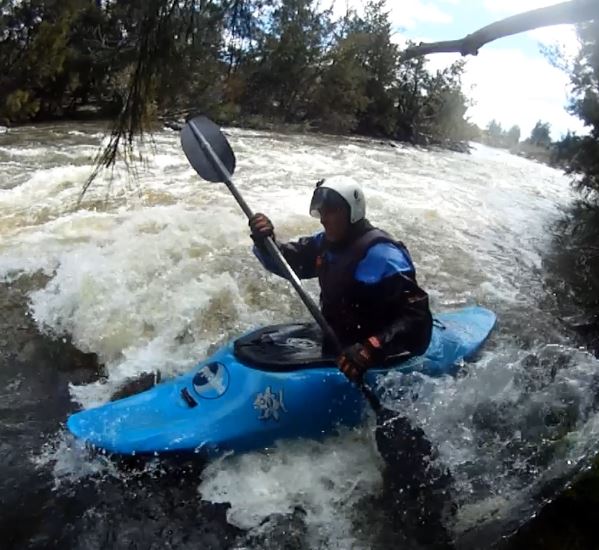
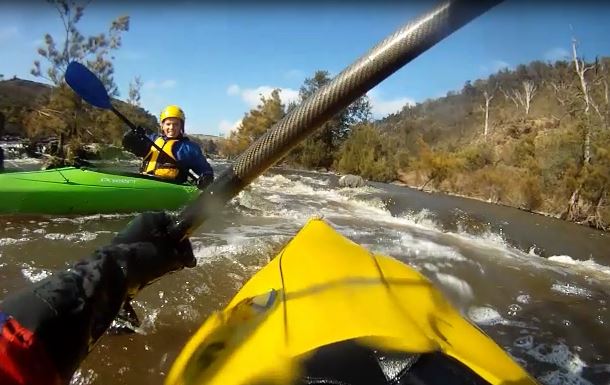
Caleb paddled hard up-stream from the river’s edge, then forced his way onto the stopper wave. Surfing back and forth, sometimes spinning his paddle above his head. Turning round and back-surfing in the hole. A thumbs up and smile in my direction. Not showing off. Just in the zone. In his element. Almost on the edge but somehow in control. Delight writ large on his face and in his fluid movements. Action packed. At this level the river is strong and his reactions sharp. In tune with the power and force of nature. Riding and playing in the flow. He drives the nose deep then pops back onto a rail and flips over. Eskimo roll. Paddle back up for another go.

“Be back home by 5.00”, Mum would say when I was a primary school little fellow in the afternoons after school. A friend and I would launch into games of cricket, touch footy. Around athletics carnival we’d dig out a long jump pit or make a high jump in the back yard. Or alone I’d tear around a track on my bike. Grass never had much of a chance. Climb a tree. Make a new tree house and sit up there spying on the neighbours or look out across the valley. Later I’d explore the bush, making cubby houses with branches and rocks, wander along the creek, climb in the small sandstone cutting looking for quartz pebbles, make tin boats to paddle across a pond, venture through the drains underneath the suburb. We had fun. We pushed our limits. We developed skills and awareness of what we could do. I grew to love the bush and feel at home in it. I shared time with best mates and in solitude. Burned off energy.

“Play is considered so important to child development that it has been recognized by the United Nations High Commission for Human Rights as a right of every child. Play — or free, unstructured time in the case of older children and adolescents — is essential to the cognitive, physical, social, and emotional well-being of children and youth.” Marie Hartwell – Walker. http://psychcentral.com/lib/the-benefits-of-play/ 

When we play and flow in the zone where our skills and experience are challenged at just the right level time and the rest of the world are left behind. Our best play is where our mind, body and senses are totally focussed. As our skills and experience develop we seek out higher level challenges that are necessary to take us into this zone. We are challenged at whatever level is right for us. Edgework is play at our threshold.

My skills are nowhere near those of Caleb. I surf in smaller waves, practice skills, easier tricks and enjoy the exhilaration. Refreshed. The cobwebs are blown away, washed away. I feel energised. Together we share the journey, watching out for each other, chatting down the slow pools between rapids. Appreciate patterns of ripples, the trees, the weather, the water.

The benefits of play for adults are evidenced in research. The overall effect on our wellbeing (depression, hurt, worries, feeling foggy, sadness, anger, insecurities, anxiety – can be left behind for a time and our perspectives on them changed) is huge.  All of this is multiplied if our play combines the health benefits of physical exercise and being in the natural world.

For me adventure is my primary form of adult play. Now I call up my friends and ask if they want to go climbing for a day or skiing up on the main range, or for a paddle on the river or to hike in the desert for 10 days or cycle down the Danube in Germany or do some via ferrata in Italy. Am I not just saying as I used to when I was a child, “do you want to come out and play”? The playground is bigger now and the games are more challenging.

“How about a second run down?”  Caleb asked.

As we paddled down and played just for the pure joy of it I wondered as an outdoor ed. teacher how many students he’d shown how to do this, how many had learned wholesome adult play ways – climbing, paddling, diving, hiking, caving.

“You can reclaim your inner child by setting aside regular, quality playtime. The more you play, joke, and laugh—the easier it becomes.

By giving yourself permission to play with the joyful abandon of childhood, you can reap the myriad of health benefits throughout life.”

http://www.helpguide.org/articles/emotional-health/benefits-of-play-for-adults.htm

 Capture 2

A walk to the creek with Mum

31

A walk to the creek with Mum

30/8/15

Pennant Hills Park


Sunday. Almost midday. Bright, warm sunshine. Cath and I closed the front door and walked over the road into the parkland. Into the bush. The narrow path curved around to the top of a sandstone shelf. Big Sydney bluegums towered skywards. A flock of white cockatoos squawked a raucous welcome from high above.

Thursday. 3 days before I had been at the snow with school.

Friday afternoon, 2 days ago I had called Mum who had gone into hospital. “This could be my last hurrah”. We’d driven straight up from Canberra.

The rock shelf gives a good outlook down towards the creek. We stepped down the stone stairs slowly absorbing the scene. On either side of the bush path was a profusion of wildflowers, red, yellow, mauve, blue, white. Grass trees stood like sentinels on the higher slopes.

Saturday morning. She was chirpy. Like her normal self. Chatty. A little uncomfortable but not distressed. There was a steady stream of family. My brothers. Daughters in law. Grandchildren. My own children were flying in from London and Alice Springs later but soon. We talked with Mum and the doctors about how she was going.

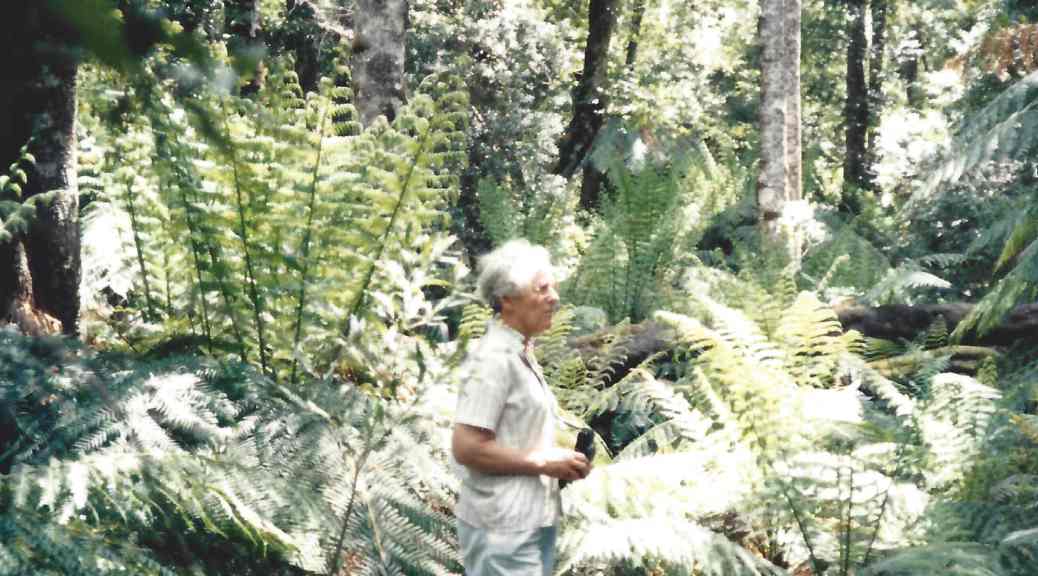
I’d walked down here countless times with Mum. We all had. In winter, summer, in the rain when the path was a creek. After the bushfires when it was all black and then soon after we delighted at each sign of new growth as the bush sprang back to life and colours emerged. In the wet when the sundews were sticky and frogs chorused like there was no tomorrow. The bush. This bush! Was Mum’s church. She told us this was where she felt at home, close to life, close to her bigger picture of what it is all about. We stood still and took in the smells of Spring, the sounds, the feel of the breeze.

Saturday night. Last night. I stayed with her. In the middle of the night she was moved into the ICU. The best doctors. The best facilities anywhere. They couldn’t quite figure out what she had. We all had to gown and mask up in an isolation room. Oxygen seemed to ease and relax her breathing. Still chatty and sharp as a tack. I slept a little. Nurses came and went as the night dragged on. Two weeks ago she had been gallivanting around on a holiday with a friend in Cairns, out to the Reef, to the Daintree.

Down at the creek. Water streamed and bubbled between rocks. My brother and I had come down here a month or two before in a storm. The creek had been in flood. I was all for pole vaulting the narrowest point in the rapids but eventually we did a bushwalkers river crossing over the torrent. Mum had enjoyed telling all her friends about her grown up boys taking silly risks in her creek. Over the years she had taken all the grandkids down there to play and explore. And when they were older on longer walks on the fire trails beyond.

Sunday afternoon. She knew. We all knew. The doctors knew. There was no coming back. The family. In turn we chatted with her. Said goodbye. Said what we needed to say. Surrounded her with love. We cried. Held hands. Hugged. She tired. Laughed and joked. Was strong. Clear eyed. Unflinching.

We walked back up the track then branched off on a faint little footpad through the scrub. This took us to the smaller side creek. It was darker in here. Less light. Moist and shaded. We’d been through here with Mum. After rain. The small stream had gurgled. Bushes crowded the banks so Mum led us up through the water, over slippery rocks, to a small grotto. Moss covered rocks. A tiny cascade. Miniature ferns. We worried that she would slip or fall or hurt herself. She wanted us to know it and to lead us through with an adventurist sparkle in her eye. This was a special place. Hidden. Protected.

Monday morning. She had held on fiercely. The last two grandkids had arrived. Lucid. More time to say goodbyes again. She told us the last day or two had been the best of her life. More hugs and laughs and tears.

Up towards the rock shelf on the way home lorikeets started piping to one another, filling the bush with song.

Sunday late afternoon. We all learned how to say “Ta tah” from life with grace and love as we held her hands and she left us. Outside her room as we cried and hugged the sun blazed the most beautiful sunset across the whole sky in the west above her bush.


57 mid later hug solo

Making The Most

30

Making the Most

25 – 27 Aug 2015

Perisher Valley Nordic trails

Cross country skiing


Snow had covered the mountains in the last couple of days. Branches hung heavily laden with white ice cream. The roadside was a snow bank from a recent snowplough. Many of the students had never seen snow before. It was like the classic photos and films from northern hemisphere white Christmases or Hokkaido in deep winter except the pine trees here were eucalypts, snowgums. We had a hassle with the tyre chains before driving higher into heavy snowfall. Excitement rocked the bus as the group booted up and sorted out their gear for the day.

Mitch then walked them through deep powder a short distance from the Perisher carpark up to the Nordic Shelter. He had been a student himself on trips here 6 years before, in the same year 11 and 12 outdoor education program. As a student he’d been into everything – snowboarding in Japan, diving and snorkelling at the Reef, canyoning, surfing up the coast. Camping and coast activities with his family laid some initial skills and interest but he became hooked in totally in the college program, like some of the students he was working with now as their teacher, guide and mentor. On the flat we covered the intro skills – using the skis, walking on the flat, star turns, gliding. Falling was fun but recovery practice difficult in the deep, soft snow. Shelter then in the warm hut with a cuppa.

At the front of the group Mitch set a slow pace along a flat groomed ski trail while I brought up the rear. The year after graduating from college Mitch worked pretty much full time as a barista/waiter. Threaded through this “gap year” he was able to complete a full Certificate III in Outdoor Recreation as part of a program of the college and the local university. He learned quickly about the difference between being a student and a staff person and about leadership while picking up his caving guide qualification on an expedition to the Nullarbor Plain. His snorkel guide qual was finished off on a second trip to the Reef. Canoe and kayak guide tickets were done on the Clyde River closer to home. He went on nearly every trip that year with the college as a trainee staff person becoming skilled in a very wide range of activities, landscapes, staff and students. Through all this he managed to save enough money to spend 3 ½ months travelling to Europe both solo and with friends, moving into Eastern Europe as the money ran low. At a flat rest spot we all threw the lightest, fluffiest snowballs at each other and made snow angels. Then back to the hut for a late lunch and a break from the still falling snow.

The afternoon was spent practising skills and funning round the 2 ½ km trail. Downhill skills are harder but most students were snowploughing away merrily by the end of the day. Mitch worked with a couple who were taking longer to pick it up. He had a knack of separating out the components of each skill so they could slowly build – probably a result of his work in high school as a tennis coach. The students had a terrific day. There was hardly an envious glance over to the crowded lifted downhill slopes and busyness on the other side of the valley. Even Mitch, an absolutely passionate snowboarder, had been able to leave his interest in the “other” skiing behind and model a genuine love of cross country skiing that was transferred straight to the group.

Overnight the weather had settled and cleared a little. After a freshen up of skills from the previous day we started on more advanced uphill techniques – herringbone climbing, side stepping, zig-zaging and downhill – linking snowplough turns and christries. Some students picked things up really fast. This is one of the pleasures of teaching Nordic skiing. Morning tea, then we set off around the longer 5km trail. Over the ridge we lost sight and sound of the resort and felt like we were in the backcountry. Mitch led the way and managed the group. This was his first teaching job, acquired even before he had quite finished his degree, headhunted. He had done 3 years at Canberra Uni doing PDHPE and Technology teaching, also picking up some more quals to add to his Cert III – top rope climbing guide, vertical caving guide, surfing guide. Canberra Uni runs a three semester program. In the optional winter terms Mitch relocated to the snow where he could shred the slopes during the day and work in hospitality in the evening. I can only imagine the fun that would have been living in a group house with his mates in Jindabyne with piles of other mates taking up floor space on the weekends. When uni finished each Xmas he worked full time as a gardener for the three month break. He also managed to fit in a semester exchange to Colorado where he studied outdoor adventure programming, fitness promotion, tennis, swimming and group fitness. He made lifelong friends from every continent and on weekends and short holidays like Halloween he went hiking and snowboarding in the Rockies at places like Vail and Breckenridge. Before his exchange time in Colorado he surfed the west coast in a van with a mate, like in a scene from “California Dreaming”, and travelled Europe for 6 weeks before that. Returning from exchange he had his final semester to complete at uni back in Canberra. We reached a good play spot with a good downhill slope and a marvellous view over snowy hills and the Monaro Plains to the east. The energetic skied up and down while the others rested. The snow had got heavier and harder to turn in off the groomed trail. The way home to the hut took longer as the track undulated. Mitch showed his own drive to improve in practising his telemark and Christie turns on the downhills, unconsciously setting a wonderful example to his students, striving for enjoyment and achievement.

The plan for Day 3 was to do a full day trip up to Porcupine Rocks which commanded a view over the Main Range and to distant horizons in 360 degrees. The weather had closed in again and threatened to be very bad in the afternoon so we opted for a longer trail lower down. Again Mitch led the group out and then onto the 7.5km trail. This led into pristine elevated plateau country away from civilisation. This untouched quiet landscape was as far as you could get from the crowded urbanisation of Shanghai where Mitch was able, 3 months prior, to do a Professional Teaching Placement. He had gained a scholarship from Cricket ACT who supplied 20kg of cricket gear which he took to Shanghai and then taught the sport as part of his prac. Of course he followed this with 2 weeks of personal travel in rural China where there was no written or spoken English. Along the trail we caught a glimpse of Kosciuszko and Porcupine Rocks in a break in the clouds. The students skied confidently up and down the steeper parts of the trail. Mitch recorded a formal assessment of their skills. He had also just completed his own assessment for a cross country ski guide qualification.

There was a feeling of comfortable, warm satisfaction on the bus on the way home. The diverse group had gelled well under Mitch’s care. He completed their overall assessments while they chatted or snoozed. As I drove I overheard two students in the seat behind talking to Mitch about his life and one marvelled at “how he is so young and has already done so much and already has such a good job”. With his characteristic twinkle and disarming smile he had opened himself up to them and given an insight into how a life could be lived to the full. He knew he’d been fortunate and learned from his family about having goals and working hard and saving but nothing that the two students wouldn’t be able to do themselves. I couldn’t help thinking that if my own children were their age how much they could learn from this young man and benefit from spending time in his company in the outdoors.

In the weeks that followed Mitch relayed how the students had thrilled and raved about the trip to their class peers. He thought that the cross country had been a better experience for the students with better outcomes than the more popular snowboarding trips. For Mitch, this first major trip where he was the leading teacher, had been a reconnection back to the college and the program and the actual classroom where he had been a student and was now the teacher. He also mentioned that he is now learning Spanish with a view to travelling to South America at some stage to do a language school in Peru or Chile (somewhere close to one of the classic surf breaks). The world is an amazing place with incredible opportunities.

Jagungal – Journey to the sacred mountain

29

Jagungal –  Journey to the sacred mountain

17 – 20/8/15

Kosciuszko National Park – Jagungal Wilderness

Ski touring


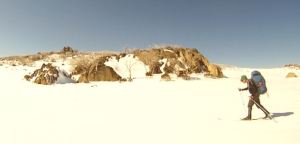
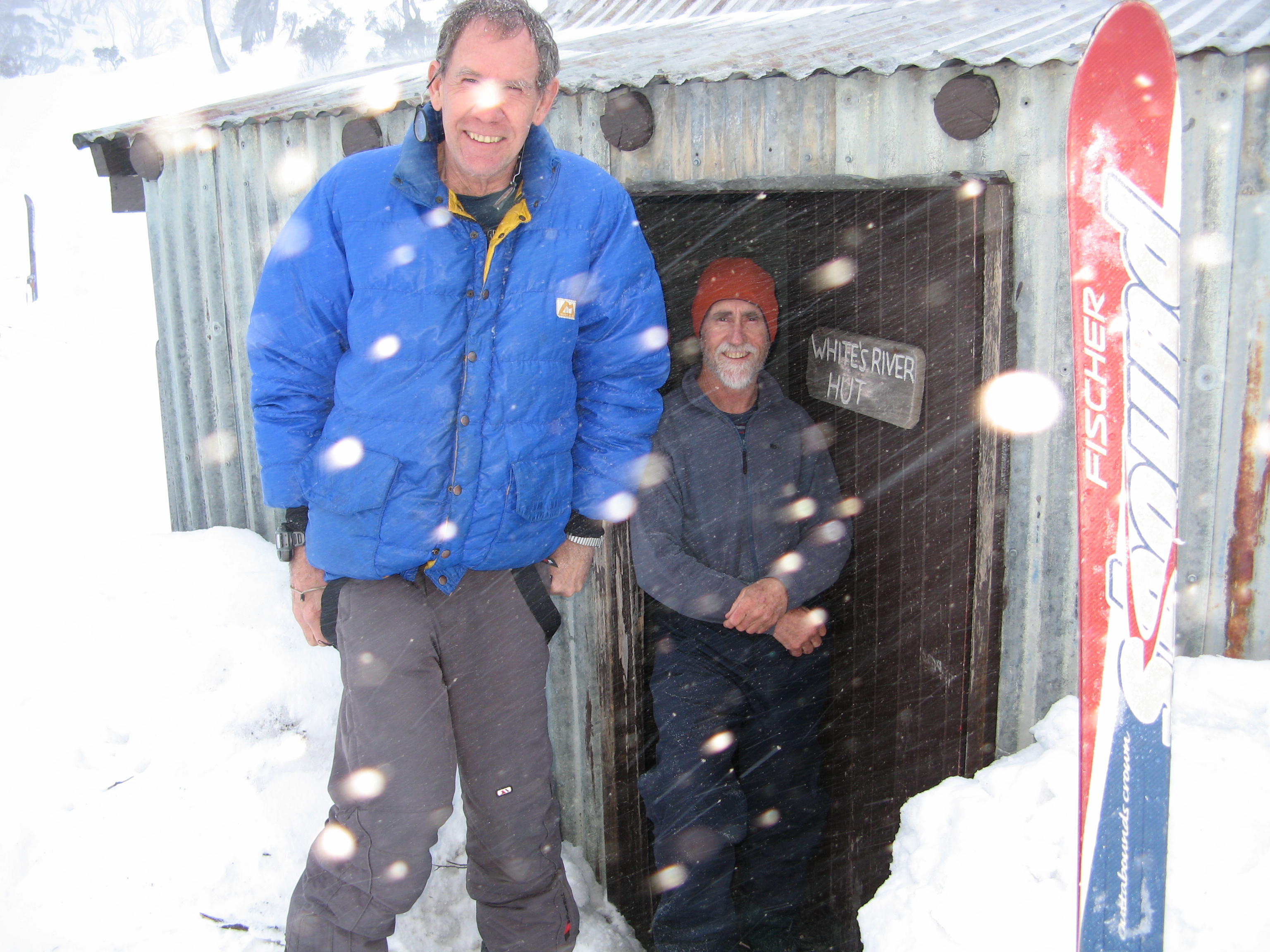
Wind blasted hail. Rain. Sleet. Sago snow. We’d chosen this. To go in while the weather was bad and then if things went to plan and the forecast was accurate our journey could be completed in a good weather window before the next front hit. We hiked up and the weather cleared at the top of a steep section long enough for us to put skis on before raging again. A couple of hours undulating up a fire trail brought us to a final flat section for the day where an Antarctic blizzard blew us off our feet on sheets of ice as we pushed to an old stockman’s hut at White’s River. Any remaining psychic cobwebs flew off with the wind.

Shelter from the storm. Chimney smoke. Warmth. An army adventurous training group had the fire going. We settled in, drank tea and soup and played chess and chatted. Outside snow bucketed down. Steve and Charles and I. Charles and I had attempted Mount Twynam a couple of weeks before. I’d worked with Steve for 8 years prior to us both retiring. While at work we’d talked often about doing a trip together, like the light at the end of a long tunnel. Here we were at last bringing our plan to fruition. The plan was a good one. All that was needed was for the weather to clear overnight and hold for the 3 days we would need to get over the Kerries Range and on to the summit of Mount Jagungal and then return.

Jagungal. The Big Bogong. 36 years it had been. My wife and I had cemented our relationship on a week long journey on skis that included a night camped on a grassy patch under the stars on its slopes. Family legend now. Jagungal sits isolated in a wilderness area. Visible to those who know its shape from afar in any direction. It’s a revered peak for bushwalkers and reserved for the adventurous few in winter who luck out with the weather long enough to summit and return to safety. Navigation in bad weather is difficult. There is no easy way in. With full snowcamping kit for us the trip in and out would take 4 days.

IMG_0004The group of young army officers were training to become alpine instructors. They cooked inside then slept in tents outside around which they had constructed elaborate sheltering snow brick walls. The hut had been refurbished inside. It was not the rat infested atmospheric hovel it once was.

Steve has been a teacher all his working life. Auto mechanics and metal engineering mainly. Helped kids weld and learn about motors. Helped kids finish school against the odds. Helped kids turn their lives around. Got them jobs. Not your regular teacher. Extraordinary. He played classical guitar and crafted them too. And very smart as well. The friendly army folk departed for their tents. We were enveloped by the darkness and the warmth from the slow combustion heater fire as the storm raged outside.

“Infernal world, and thou profoundest Hell
Receive thy new Possessor: One who brings
A mind not to be chang’d by Place or Time.
The mind is its own place, and in it self
Can make a Heav’n of Hell, a Hell of Heav’n.”

Steve wrapped us in Milton from within his poetic archive. Perhaps he had sensed the paradise we might enter the next day and the knife-edge of loss we were tempting by changing the climate of this alpine land. Or maybe some other unfathomable from deep within himself.

Day 1 –  Munyang (Guthega Power Station) to Whites River Hut. 12.30 pm – 3.00 pm. 7 km

Capture


Our weather dreams came true. In the morning no wind. Clear sky. Cold and still. Like a paradise regained.
We climbed steadily through misty frozen snowgum copses and open snowfields to Gungarten Pass. The bluebird day became hot along the valley of the Valentine River heading north. It had been a weird season up till then. Fronts started warm with rain then developed into colder temperatures and windy snow. The landscape was alternate ice sheets of frozen rain saturated snow and long patches of fine dry powder. Jagungal appeared as we rounded a bend into a broad open flat plain where we lost the lie of the river somewhere below us under the snow and ice. Heavy packs. Sunscreen. Sweat. The Kerries Ridge paralleled our route in the west as we made our way past the Brassy Peaks and Cup and Saucer Hill to Big Bend. The mountain became a companion beckoning us forward. Capture4Across a low ridge then down and across the Geehi River on a solid snowbridge. Up onto the Strumbo Range that led to the peak. The day was long but the mountain had come within reach. We camped high up on a flat section with views to every horizon. Late afternoon light turned the summit gold and glowed the spectacular Main Range in the distant south.

IMG_0044Just before sunset I climbed a little higher to a rise from where I could take in the whole upper part of the mountain. It was stunning. Untouched. Pristine. White. Smooth fresh slopes as yet untracked. Aloof. Still high above. A sacred mountain. Like Machapuchare and Meru. What makes a mountain sacred, special? Like the mythical Mount Olympus Jagungal is part of my personal story, my narrative myth. In this part of the world it is one of the tallest peaks, reaching towards the stars. Like Kailash it is the source of major rivers, the Geehi and the Tumut, which flow into the Upper Murray. For tens of thousands of years Aboriginal groups, the Ngarigo and others, have come to this mountain to feast in summer on bogong moths and meet in ceremony on its slopes. My own pilgrimage with my friends, was richly layered with meaning. Emotion choked my words as I soaked up the place and connected to the outside world, telling Cath on the mobile that we were camped about a kilometre or two from our camp of many years ago and describing the scene for her. I was overcome with thankfulness that the world was so beautiful, that I could be in it, right there at that moment.

Day 2 – Whites River Hut to Strumbo Range.  8.30am – 4.00 pm.  20 km 

IMG_0023The approach across high slopes led to zig zigs up the steepening then skis off stepping up the harder icy snow to the top ridge. The view expanded with each step up. It was like climbing any “real” mountain.
Windblown sastrugi between the east and proper western summit. We lost each other between mini peaks taking different lines. Capture6

Charles skinned straight up the final section silhouetted against a huge sky. IMG_0029


Then we were there. Whooping.
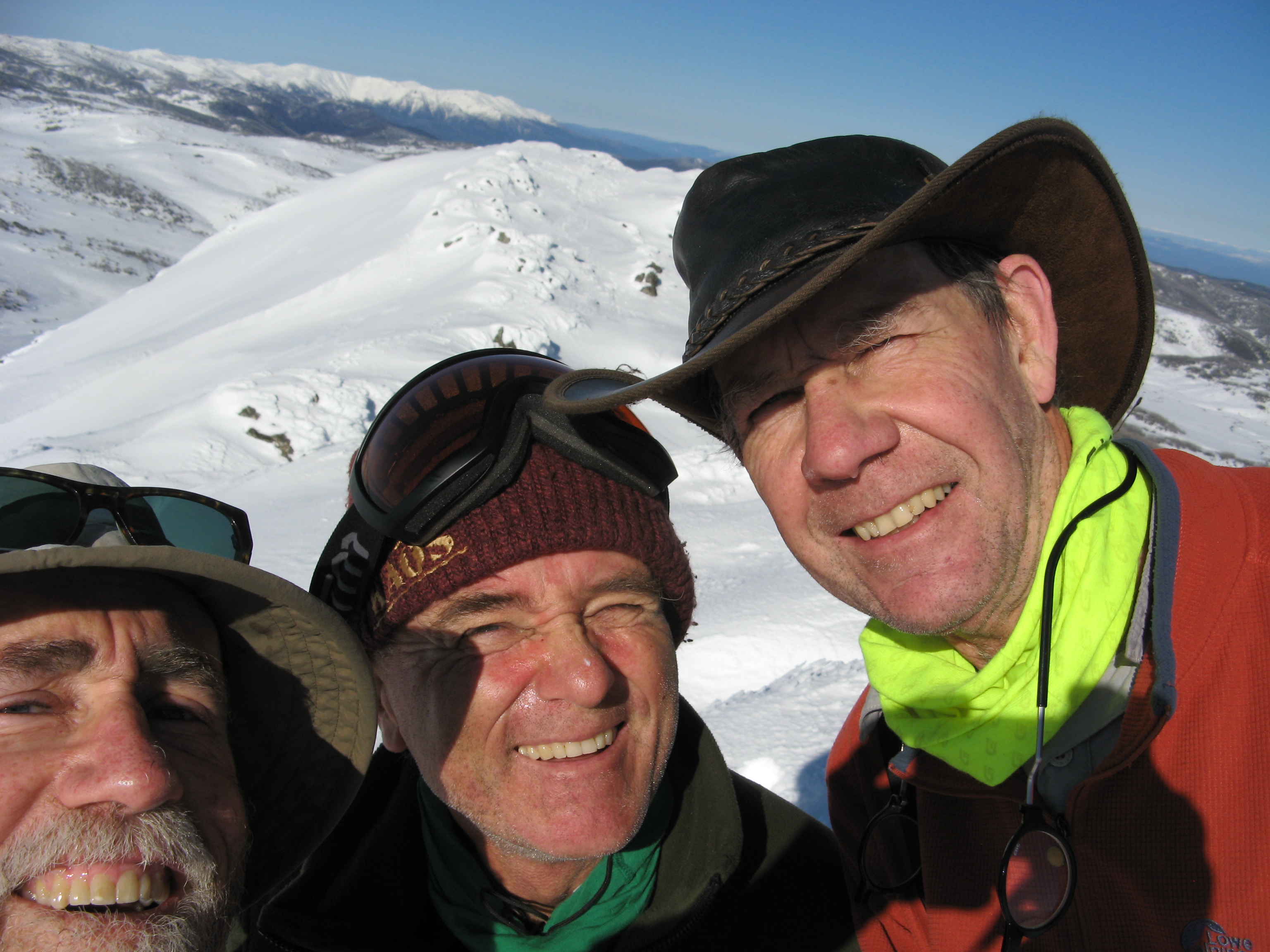
The whole Monaro was under cloud below. To the north towards Kiandra the Happy Jacks valleys were clouded in but the forested hills poked through. Watsons Crags, Twynam, Kosciuszko and Townsend were dramatic, close seeming. Mount Bogong beckoned in the distant south west as did the closer Grey Mare Range. Steve and Charles and I high fived. I was overcome again – reaching and climbing the mountain with Thearley, it had been a long time in the making, the feel of the perfect day, the natural beauty, support from Cath, coming back from illness, doing it just for me.IMG_0025

The steep ski back down was icy and fast and nerve wracking. Back at camp we packed slowly, savouring the moments. We retraced our tracks back to Big Bend. On the final section up to Mawsons Hut in the fabulous weather we discussed the death of Graeme Edinburgh. Like us he’d been returning from the Jagungal area with a mate, Greg. But in atrocious conditions. Without GPS, polartec and goretex. They had got near to Mawsons in a whiteout. Got cold and wet. Pushed on in search of the hut. Exhausted. Too late they’d given up their search for the hut. Made a snow cave. Froze up. Graeme collapsed and died in his friend’s arms during the night. Hypothermia. The story was drummed into us – uni students in the same club a few years later. Be conservative and safe. Take a good tent, good gear. Respect the forces of nature. I wonder now about his mate. The impact then and over the years. His family.

IMG_0054Over a brew we talked to the others passing time at the hut. A 72 year old guy who had taken up ski touring 4 years prior. He had the best lightweight alpine touring gear money could buy to go with the catamaran he’d solo sailed around the world. Tall tales and true. And a younger, fitter fellow who was skiing from Munyang to Jagungal and back to Munyang in one day. He had turned around ½ an hour from the summit to ensure a safe return. Impressive self-discipline.

IMG_0049I went for a quiet ski in the late afternoon. Sounds of the Valentine River in the valley below broke the silence. Rocky hills opposite glowed golden. Jagungal lay quiet and still in the distance.

More stories in the warm cosiness. A celebratory whiskey. And Steve again in the candlelight…..

”Say! why is the spirit of peace so weak,

And the spirit of wrath so strong,

That the right we must steadily search and seek,

Tho’ we readily find the wrong?

Mark:

Our parents of old entailed the curse

Which must to our children cling;

Let us hope, at least, that we’re not much worse

Than the founder from whom we spring.

Fit sire was he of a selfish race,

Who first to temptation yielded,

Then to mend his case tried to heap disgrace

On the woman he should have shielded.

Say! comrade mine, the forbidden fruit

We’d have plucked, that I well believe,

But I trust we’d rather have suffered mute

Than have laid the blame upon Eve.”

Adam Lyndsey Gordon – The Old Levan

Day 3 – Strumbo Range to Mount Jagungal to Mawsons Hut.  12 km. 8.30 am – 1.00 pm.

 The older fellow left for Cesjacks Hut early. On a hunch Steve followed the tracks he had left on a suspicious sortie just before his departure. Hidden in a tree bowl nearby was a large bag of his yucky assorted rubbish. It was hard not be angry with such flagrance.

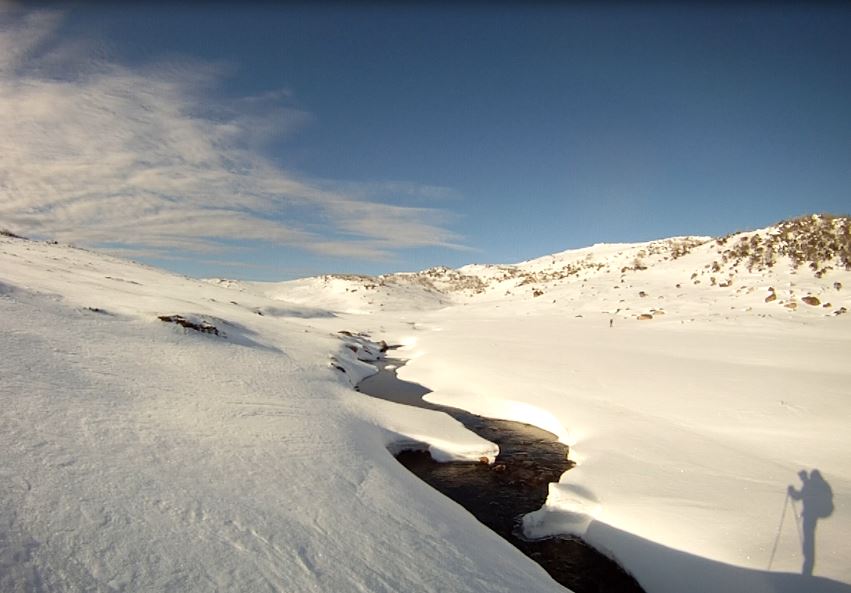
IMG_0055Back along the valley of Valentine Creek we threaded the best line that linked up the powder fields, trying to avoid the ice sheets. The white brightness was severe. Sunglasses, hats, long sleeves, sunscreen. Capture11Mounds and cornices and snow covered boulders cascaded down from the Kerries Ridge high above on the west and the Brassy Peaks on the east seemed to hem us in. Sublime beauty. Occasionally the creek appeared and bubbled downstream. White, dazzling white, grey and brown rocks, colours frozen out, covered in white, soft white, shining white, white reflecting, smooth, crunching white, silken white slopes, wedding cake white. And the white mountain now behind. Under a sapphire blue sky. In a way it was like a hostile desert, lifeless, still, intense. Every minute, every hour gliding and stepping the white landscape etched deeper into our psyches. Our fourth day immersed. Such a treat. As I followed in Charles’ tracks I marvelled at other friends’ journey across the Antarctic – 66 days on the ice, all in white.Capture9We crested the ridge through a scene from the Arctic. Boulders were festooned with wild growths of ice to windward. Wind blasted snow had iced up and built through each of the season’s winter storms. In the fore and middle ground were snow covered peaks and ranges. Lines of blue hills stretched off to the horizon in every distance. I held Jagungal in a farewell gaze for a long minute then stomped down through the lumpy ice field with Steve while Charles cruised down on his heavier ski gear and better skills. Lower down in the valley above Schlink Hut we struck perfect snow and whooped and ss’ed the bowls and delighted ourselves in the day, in the conditions, in the place and in the world in general.

We lunched in the hut with a young man whose job it was for 2 months to ski various routes through the back country laying baits for foxes. I had nearly burnt Schlink Hut to the ground decades before. Having arrived in a blizzard late and exhausted I had set up my stove on a table then filled it with shellite. I placed the fuel bottle safely down at the other end of the table, pumped up the choofer and lit it. Flame shot down a line of fuel I must have spilt along the table to the bottle which caught fire along with my hand which must also have been covered. “I’ve seen one of those explode!” yelled someone in the crowded hut which emptied immediately outside into the howling storm in their pj’s and thermals. I was mesmerised by a painless hand on fire. A friend had the sharp presence of mind to rip down the curtains and smother all the flames before they caught hold of the hut and me.

The ski back down from the mountains from Schlink Pass was glorious. Nice soft snow. Occasionally the grey deadwood forests of tree skeletons from the 2003 fires were interspersed with oases of old green snowgums. Skiing slowly along in my internal world I committed to a plan for the future. To ski and climb my own “seven summits”. The seven winter alpine summits of mainland Australia – Kosciuszko, Townsend, Twynam, Bimberi, Bogong, Feathertop and Jagungal. Already this season I had failed on one and been successful on another. Arguments could be had over the selection but in my mind these represent the most iconic mountains of the highest dozen in Australia. A fine adventure challenge which doesn’t involve burning masses of fossil fuels to get to far flung exotic locations round the world. If each provided a small proportion of the pleasure and satisfaction of this Jagungal journey then they would be worthwhile.

IMG_0042Arrival back at the car, at civilisation, back in the world of colours was anticlimactic compared to the brilliant white intensity of the alpine high country. On the way home we chatted about another trip next year. A shower of rain marked the closing of our weather window. Everything had gone according to plan. This time we were lucky.

Day 4 – Mawsons Hut to Munyang (Guthega Power Station). 19 km.  8.00 am – 2.00 pm.

 Total journey – 58 km, 3 ½ days.

Cross country ski trails

28

Cross country ski trails with winter olympians

14/8/15

Nordic Ski Trails – Perisher Valley

Cross country skiing


IMG_0647Perfect weather and perfect snow – light, dry and powdery. The trails had been freshly groomed and trackset following snowfall the day before. Rob picked up the basic skills on the flat section in front of the Nordic Shelter, a wonderful building financed by the cross country ski association and the national park.
We set off slowly around the 5km loop trail. This was part of the network of more than 100 km of trails in the area. Parents towed infants in small sleds. A local primary school group skied past us with great enthusiasm and a variety of gear types having the time of their lives. Steve was a skilled nordic skier and enjoyed using good skis and boots that gave him better control than his gear from the seventies used the last time he went touring back in about 1980. A pair of our Aussie winter Olympic team skated past with fluidity and finesse that was glorious to behold.

IMG_0659The day was a cracker. Steve and I revelled in
the views as we waited for Rob. He was gifted the most perfect conditions for his first foray onto skinny skis and a little taste of the backcountry in winter. The snowgums, so iconic in the alpine area, had been burnt severely in the devastating fires of 2003. Twelve years later they had mostly sprouted from their bases but will take decades to grow back.


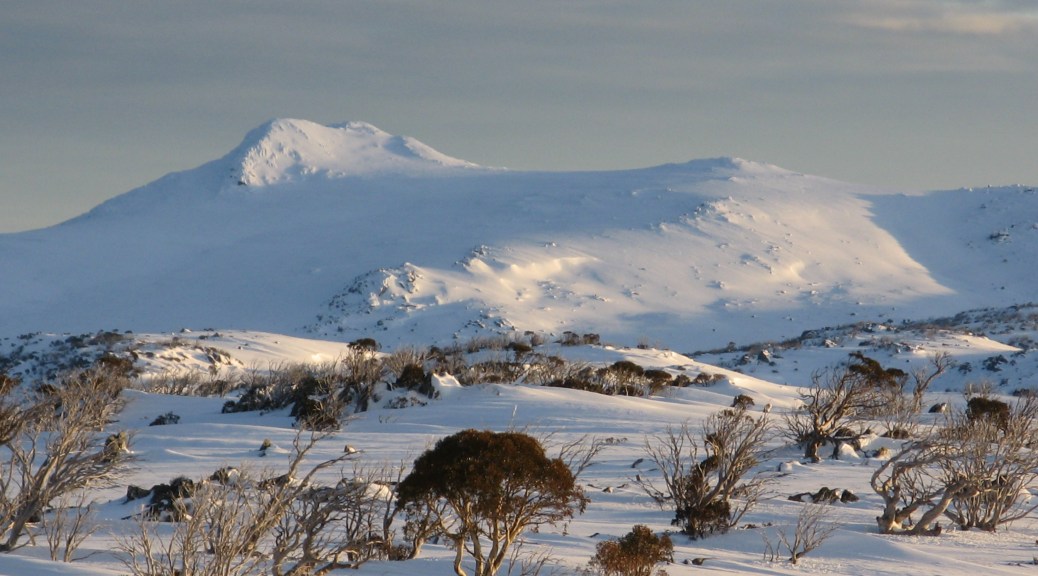
Out of sight of the Perisher resort we caught a glimpse of Kosciuszko, the highest mountain hill in Australia (2228m). It is one of the world’s famous “Seven Summits”, a list comprised of the highest mountain on each continent. A couple of years previous I had decided not to take a college group out there on a day of bad weather. On that same day a group of Japanese mountaineers had required a rescue having underestimated the blizzard on their final seventh summit. Just nearby a year later 4 snowboarders had died in a snowcave that had been buried by a huge snowstorm. 3 km from the summit is Seamans Hut which was built as an emergency shelter by the parents of a pair of skiers who had perished in bad weather in 1928. In the 70’s I had battled through a very stormy winter night camped outside the hut in a tunnel tent. Next morning a rescue was mounted for a missing scout group missing higher up on the mountain.

A Day In A Life

27

A Day In A Life 

Backcountry snowboarding – Mount Twynam – Kosciuszko National Park

Sometimes a treasured day in the mountains becomes even more precious when other things are going on in our lives. The wilderness environment, the weather, the company, the scenery, the adventure and the physical challenge can combine to make the day very special, whether we reach our goal or not.

Capture 2

Larapinta Trail – Part 2 – Ellery Creek to Simpsons Gap

26

Larapinta Part 2 Ellery Creek to Simpsons Gap 9 days

8/7 – 15/7/15

Western Macdonnell Ranges – Northern Territory – Central Australia

Hiking

Larapinta logistics

The logistics for the Larapinta are complex however you do it. Fantastic written resources are available

National Park package www.nt.gov.au/parks

Trek Larapinta website www.treklarapinta.com.au

John Chapman guidebook http://www.john.chapman.name/pub-lara.html

The simplest way is to walk the whole 220 km in one push. This requires from 12 to 18 days hiking for most people. On the sections we completed we saw lots of people doing this – some more experienced and better prepared than others. It’s a hard walk – long days, tough terrain, water carrying, hard on boots, feet, legs and shoulders. And sensational scenery in one of the most spectacular parts of arid Australia. In parts it’s more of a mountain walk than desert flatlands. You can either walk east to west (Alice Springs to Mount Sonder) or west to east. At Alice the walk starts or finishes in town so you only need to arrange transport to or from Mount Sonder (Redbank Gorge) – there are several transfer options. There are 3 regular food drop locations – you may be able to arrange transport of your food drops without you going out yourself.

A commercial trip is a good option for people wanting to do it as a series of day walks with transport, food and comfortable basecamping support. This will necessitate some long days and a fair bit of time in vehicles. You can do the whole trek or just the “highlights” (selected by the company). Reputedly fires each night and nice food.

Our trip

The Larapinta had beckoned for many years but sorting the best logistics was a challenge. In the end we did 121km in a 9 day continuous section that took in the commonly agreed best parts from Ellery Creek to Simpson’s Gap with an additional daywalk up Mount Sonder. In planning this route and itinerary some of the considerations were;

  • We wanted to camp along the way and be self-supported so we could be fully immersed in the landscape
  • Some of the best days are very long and have water logistics issues so we broke these long days into a series of shorter days where we would be able to carry enough water for overnight camps
  • We scheduled the hardest days to be when our packs would be lighter due to having consumed most of the food prior to the food drops
  • We would hire a 4WD to take in and bury an extra food drop in the middle of the hardest section – this was necessary as we could carry a maximum of 4 days food in addition to the water requirements day by day. We carried water for overnight camps on two occasions – Hugh Gorge to Birthday Waterhole (camping at Fringe Lily Creek) and Birthday Waterhole to Standley Chasm (camping on top of Brinkley Bluff)
  • We would go as lightweight as possible to ease the load on knees, hips and feet (ages of walkers 58, 58, 60, 54, 52, 25)
  • The overall cost for Cath and I was about $1250 each which included flights between Canberra and Alice Springs, accom in Alice, transfers, camp fees and our share of the 4WD
  • 4WD cost $640 overall for the two days – we drove it from Alice Springs to Birthday Waterhole (to bury food drop) and then to Redbank Gorge for the Mount Sonder daywalk. Then the car was driven to Ellery Creek where the main party was dropped off. I continued on back to Alice where the car was returned. Next morning I got a transfer back to Ellery Creek where we started the main walk together.

Day 1 Ellery Creek to Rocky Creek 15 km (9.30 am 4.00 pm)

Eastwards under the Heavitree Range we tramped weighed down by heavy packs – 4 days food and water for the day. We climbed up through a saddle that broke the range. IMG_5433The scene that spread out before us as we descended on the other side was reminiscent of the great African rift valley. Same landscape and ancient atmosphere. Dry acacia scrub and grasses covered a huge open plain that stretched to a distant range of blue hills. We crossed dry, sandy creek beds and walked up and over small hills then along low ridge lines. Out in the flat lands it was hot and dry.

We settled in to a slow rhythm. Walking in chatting pairs or off in our own worlds. I’d known Sue for a long time and had some snippet insights into her past, the sort you piece together from fragments over years of working and doing things together. But as we walked together it was like the journey into this land paralleled my journey deeper into her story. She had studied anthropology, indigenous studies and sociology at ANU then worked in the public service for a year. With itchy feet she then travelled and worked in Europe and Asia for 2 years. Following this she worked as a curator in the indigenous section of the Australian Museum then for a time with the Canberra land management agency TAMS. From there she became a ranger at Kakadu for 3 years and Uluru for 2 years. A teaching qualification through Uni of Northern Territory enabled her to then work for 3 years as a teacher of little kids at Ramingining in a remote part of Arnhem Land. At this point her Mum got sick so she moved to Canberra and worked in the indigenous education unit and preschool. The next stage was 13 years at the Birrigai Outdoor School where I got to work alongside her for about 5 years. Everyone knew her as a wondrous, lively, treasure of a person. Then she was off to the UK for two years at another outdoor centre before returning to Canberra to work with refugee and migrant children at an Introductory English Centre. I had thought my own life and career had been interesting but marvelled at Sue’s career and life jam packed with wonderful adventures and meaning. How fabulous can one life be?

IMG_5446

We reached camp tired but ok. This was one of the two less exciting days that were necessary for us to gain access to the best parts of the Trail. The night was filled with stars and milder than the frigid cold we expected. No fires so bed was a good prospect by 8.00 pm and sleep by 8.05.

Day 2  Rocky Creek to Hugh Gorge  16 km (8.30 am 3.30 pm)

This was a long day across the undulating open plain. Rocky ridges provided great views of the gap in the range we were heading for. Slowly it got closer. Horse (?) droppings. Nice campsite next to a creek bed. Wash in a rock pool. Late in the day I scrambled high up on the side of the gorge for enticing glimpses into the rugged country we would walk through the following day. Our creaky knees and feet were sore but still under control. We were at a point where recue would be very limited for the next few days. Cath’s exercises were working a treat.

Over dinner we talked about refugees and asylum seekers. Sue regaled us with tales of the young students she worked with. These were heart-warming, gut wrenching and delightful. I could have listened to her all night.

Day 3 Hugh Gorge to Fringe Lilly Creek  10 km (8.30 am 3.30 pm) *****

This was part of one of the long days we had broken into two. We carried double water as we were unsure of water supplies for the next night’s camp.IMG_5477

The gorge lived up to every part of its 5 star reputation. Pools reflected glowing orange walls that framed brilliant blue skies with dazzling white clouds. The white bark of gum trees seemed to shine with inner light. Over boulders. A side trip up a gorge, whose entrance was guarded on one side by a massive pinnacle buttress and on the other by a huge bluff, without packs, took us to the towering V shaped cliffs and an impassable pool. We collected some water here. More boulders.

IMG_5479At Fringe Lilly Creek we camped on the sandy creek bed. Lots of flat stones were arranged and balanced in a cooking circle. A kilometre downstream we located the water hole that we had been told about. This meant we could have plenty for dinner, breakfast and the next day rather than scraping by with just enough.

Day 4 Fringe Lilly Creek to Birthday Waterhole  7.5 km (8.30 am 3.00 pm) *****

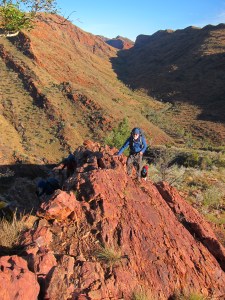
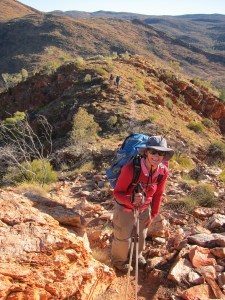
IMG_5506Uphill. Steep, zig zag track then a razorback ridge. Huge drop-offs each side. William and I scrambled some of the more spectacular narrow rocky ribs. Lookouts every 100 meters or so. Stupendous vistas all around stretching to far horizons. We were there. We were doing it.

This was better than the dreams and visions we had been picturing over years of anticipation. Like mountain walking in the French alps but with desert lowlands and no snow. Skirt the rocky outcrops. It was hard to believe we were climbing up this trail.
IMG_5509

Cath was overwhelmed for the second time. Tears in her eyes, her heart exploded with gratitude that she could do it, that she could be in this country.

There was a top up there somewhere. But it was no better than the rest. Spinifex slopes led up to cliffed peaks. Stunted white gums clung to rocky slopes. My favourite arid country. A narrow foot track wound down and across steep slopes back to the other side of the range. Down Spencer Gorge and eventually to Birthday Waterhole.
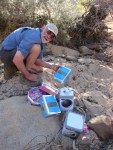
IMG_5528We excavated our food drop – sealed tins buried in the sand bed of the creek. Camp on the sand near the main waterhole. Later a couple of cars drove in and stopped nearby. IMG_5530One got bogged in the sand. I did them a favour, possibly saving a life, by using all my interpersonal skills to convince them to recover the car safely rather than the quick way they were planning. 4WD recovery training paid off. They were so pleased about getting sorted out that they happily took out our several kilograms of rubbish including the squashed tins. We would enjoy the benefits of this the next day.

Birthday Waterhole to Brinkley Bluff  8 km, (9.00 am 2.00 pm)  *****

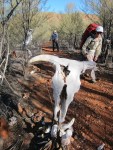
IMG_5531Cattle skulls and sun bleached bones had been collected and placed on trees on part of the track I called Death Valley. I lost concentration on this easiest part of the track which was flat and smooth underfoot leading up towards Stuarts Pass. My foot caught on a low termite mound and I tripped and landed face first on the hard ground. The pack, heavy with 2 days water and a new supply of food, pole drove my head into the dirt. It could have been curtains or at least a rescue but I was fine, just bleeding a little and with a growing egg on the forehead. Shaken up and reminded of the need to watch every step in this isolated place.

Stuarts Pass was named after the explorer John McDouall Stuart who had completed multiple epic feats of desert survival in attempts to cross through the centre of the continent from Adelaide to Darwin. He spent months at a time trudging in the heat with nowhere near enough food and water, half blinded by sandy blight. We morning tea-ed at his gap in the range. At home in the bush he was the hero of the colony when successful but his life ended poor and alone in the city.

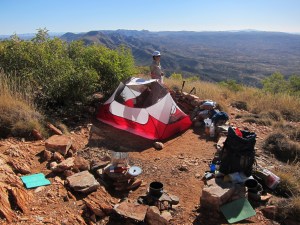
IMG_5533The climb up Brinkley Bluff was the biggest of the hike (500m ascent). With two days water! Slowly we inched our way up to a saddle then down to Rocky Cleft. It looked like the weather was going to hold so we kept on towards the top. Reputation had it that the top had few campsites and was very exposed. To camp on top was key to a lot of our planning. More zig zags tracked back and forth across the steep face of the mountain threading a route between rocky shelves. Up. Fabulous steep walking. More up. And then without the usual false summits we were on top. Whooping and hugging. A narrow track led through low scrub to the large cairn which was adorned with Himalayan prayer flags. They seemed strangely appropriate on this desert mountain top. The peak stood out proudly on its own affording amazing views in every direction. Amazing as well were the myriad of campsites that had been scraped out on top. Flat areas bordered with stones. Alone on the top, like the mountain, we found superb tent sites sheltered completely from the icy southerly wind in little sun traps just north of the summit ridge. It all had the feel of a high altitude mountaineering camp.

IMG_5544IMG_5540

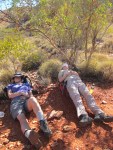
The afternoon was a heavenly treat. Perched above a million square miles of desert. Cups of tea on the mountain top. Exploring, photographing, doing exercises, relaxing. We felt on top of the world. IMG_5574As the sun slowly set the light changed a thousand hills and directions to look and be transfixed.
In awe.

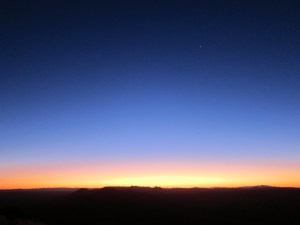
Colours changed on rocks, ranges, small eucalypts, spinifex and our multi-coloured tents. Rocky ridges plunged to the plains way below.
IMG_5584

Stars appeared slowly at first then eventually lit up the whole sky. You could almost dip your hand into the Milky Way. I pondered the Aboriginal dreaming story of their elders who had died. The stars of the Milky Way were the campfires of their spirits which they sat beside as they kept watch over the people living below. It was a powerful image and spiritually comforting. Unknown to me at the time I was to come back to this story twice in the months that followed.

Day 6 Brinkley Bluff to Standley Chasm  10 km (8.30 am 3.00pm)   *****

IMG_5587

The tent fly had been left off so we could lie in bed and see the stars. The morning star was still up when we awoke before dawn to an orange glow in the east below a deep blue canopy of sky. The night had been cold. Frost.

An extremely cold wind still blew on the southern side. Fully jacketed and thermaled we descended. The track twisted over narrow ridges, crossed through saddles and then traversed steep scree slopes. This reminded us of walking in the Dolomites. We had departed early and walked towards the light – peaks were shadowed, tussocks of spinifex shadow textured stoney hills. Rocky spines and ribs rose and fell away into crags dropping into the depths below.
DSCN0165Downhill with packs mercifully lighter. Only half a day’s water and virtually no food. In the long gully below Reveal Saddle we passed through gardens of coloured flowers – pink, yellow, purple, white, red. Scramble over boulders.

Standley Chasm was an extremely welcome home away from home. Hot showers! We did the “hikers pamper package” – scones with jam and cream and coffee, sumptuous three course dinner and cooked breakfast – bliss! Clothes wash. Two of our group departed from here having completed their 6 day “best of the Larapinta” walk. Our daughter joined us for the next 3 days, starting off with the pamper package. She brought out some fresh tomatoes and lettuce and fruit to supplement our last food drop which was collected from the café.

Day 7 Standley Chasm to Jay Creek  13.6km (9.00am 4.00pm)

IMG_5525Up steeply with food filled packs. Tortured rocky peaks and pinnacles split by narrow gorges. Up and steeply down then up and down again. Stunning scenery yet again. DSCN0150
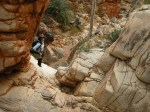
Scramble down a small crag that would have been a waterfall in the creek in the wet. Stony underfoot for kilometres. Hard work in the creek bed.

William and Elouise hiked up and down over the alternative high route as we made our way slowly along the flat. The last section was through deep sand.

Wearied we reached the shelter shed and water tank at Jay Creek.

Day 8 Jay Creek to Mulga Camp 11km (9.00am 2.30pm)

IMG_5493An easier day. Flatter terrain. We wound along the plain beside the range then passed through a gap and lunched “by a billabong under the shade of a coolabah tree”. We made camp early. Rest. This was another long day that we had decided to break into two. Relax. Snooze. Drink tea and soup. William was awarded the masterchef award. He broke out his Everest cake then showed us an extraordinary hook seeded bush he’d found. DSCN0209In the late afternoon together we scramble traversed the narrow ridge line between two gaps nearby.

At least once every day William exclaimed that this was the best walk he had ever been on.

Day 9 Mulga Camp to Simpsons Gap 14km (8.00am 2.30pm)

A long day for us. Gently undulating. The vegetation was always interesting and varied. Packs were light, only lunch and snacks for one day. Arenge Bluff reared up majestic beside the path. Up and down over small rises, along creek beds and through flat mulga country. Chatting then quiet. One foot then the other. Count some steps. Adjust the shoulder straps. Check the map. Look at the everchanging view. Life was simple. We moved in comfort with each other. Treading gently through the country. Nearing our finish we started counting down the trail signs with their distance markers. One at a time. 4km. 3km. I must have missed one. At 1km our spirits soared. We did the last 50m again for the video camera.

What a route. What amazing scenery. Every detail had gone smoothly. Our bodies were sore now but that was ok. We had done it. The privilege of being there and being able to complete our journey was wonderful. For us it had been one of the hardest and longest walks we had done. And by far it had been the very best. A mountainous, gorge-ous walk through the desert ranges and plains of central Aus.

Notes on the walk

  1. All water (from tanks and pools) was purified using micropur tablets or a ceramic filter – we had no upset tummies (some others did).
  2. I would recommend walking west to east for aesthetic reasons. In walking towards the sun the ridges and hills are shadowed which gives the landscape much contrast and texture. If walking the other way the shadows would not be seen ahead so the landscape would constantly appear with a flat light without contrast and texture.
  3. We found water in Hugh Gorge and at Fringe Lilly Creek – this may not be reliable. We did not find water between Birthday Waterhole and Standley Chasm although we had heard there may be some at Stuarts Pass further down the creek line (we didn’t look).
  4. On the hard days the distance doesn’t indicate the difficulties and time necessary. With a light daypack and smaller amounts of water to be carried longer distances could be achieved but there would be less time to immerse and savour the landscape.

Larapinta Trail – Part 1 – Mount Sonder

25

Larapinta Trail Part 1 Mount Sonder Day walk

7/7/15

Western Macdonnell Ranges – Northern Territory – Central Australia

Hiking

3.45 am. I stumbled out of the tent and put the stove on. Dark. Stars like a glittering carpet overhead, milky way rivered across the heavens.

4.30 am.  We set off from the carpark. Having checked the first section of the route the previous afternoon we knew how to pick a way across the stony river bed and up onto the beginning of the long ridge track.

The mountain was a dark mass. Groups of tiny torchlights like fireflies in the middle and far distance showed where earlier groups were making their way up. We climbed towards orion which hung above the far away mountain top. We bore witness to the approaching dawn as slowly the light, like alpenglow, suffused the ripples of hills and valleys below.

6.00 am. As we summited the sun blazed across the landscape. White rocks shone. Ranges spread out in all directions. Red cliffs dropped away from the double peak. 40 others shared the solitude of this desert wilderness peak – all wanted to experience this simplest and most basic life force – the flow of sunlight energy into the land, the plants, us, life.

IMG_5409

The higher summit stood aloof and untrodden. We were separated from it by a treacherous narrow spine of rock that dropped away sharply on both sides. The local aboriginal people discouraged anyone from attempting to climb it.

The hike up seemed easy, cool. Being focussed in the darkness on only a small pool of light from the headtorch enabled me to concentrate on the few steps ahead rather than the overall climb. Downwards took longer and was hotter.  Maybe we spent more time taking in the vistas and wondering how much longer it would take.

11.00 am. Returned to the carpark.

DSCN9662

This would have to be one of the best day walks in Australia.

15 km return from Redbank Gorge carpark. 600m ascent. The first or last section of the 220 km Larapinta Trail depending on which direction you are heading.

Winter in the Murrumbidgee

24

A chilly swim in the local river

30 June

Murrumbidgee River

Whitewater kayaking

A short day’s paddle from Casuarina Sands to Urriara Crossing. The level was about 1.2 at Mt. McDonald. Canberra has some great whitewater right on its doorstep – half an hours drive from the city. It is generally only paddleable for a short time after rain which makes it difficult to fit in with work, family and other commitments.

Sometimes things go to plan.

Air temperature max 6 degrees C. Water temp – cold. Check the video (GoPro chest mounted).

Cliffcare

22

Cliffcare

21 June

Honeysuckle Crag – Namadgi

Rockclimbing

½ day doing cliffcare tasks and ½ day climbing.

Many popular climbing areas have groups which take on cliffcare tasks – Arapiles, Blue Mountains etc. Typical tasks are track work, erosion control in descent gullies and rebolting routes with safer technology. Along with a good sized group from Canberra Climbers Association we worked in the morning then climbed in the afternoon. Charles and I climbed the classic of the crag, a 3 pitch route with a nice corner system then a run out slab followed by a steep wall to a final crack system. Deep Space/Sickle link up *** climbing. The crag has a different outlook to the main Booroomba Rocks – only a few distant signs of civilisation in a sea of rolling montaigne forest.

52 Adventures. That's the aim. One each week. Like any real adventure the outcome is unknown. The journey, the comrades, the solitude, the challenges, the special places are what matters. And this is the record – writing, images and video. Enjoy.