Outlaws, bushrangers and hidden treasure

21

Outlaws, bushrangers and hidden treasure

12 June

Canberra Nature Park – Rob Roy

Hiking


Out the front door, like Bilbo Baggins on his big adventure to tangle with dragon, we walked around the side of our hill. A management track then snaked us up and down and around about into Rob Roy Nature Reserve and eventually to the high summit of Rob Roy itself. So close to home we were immersed in the bush.

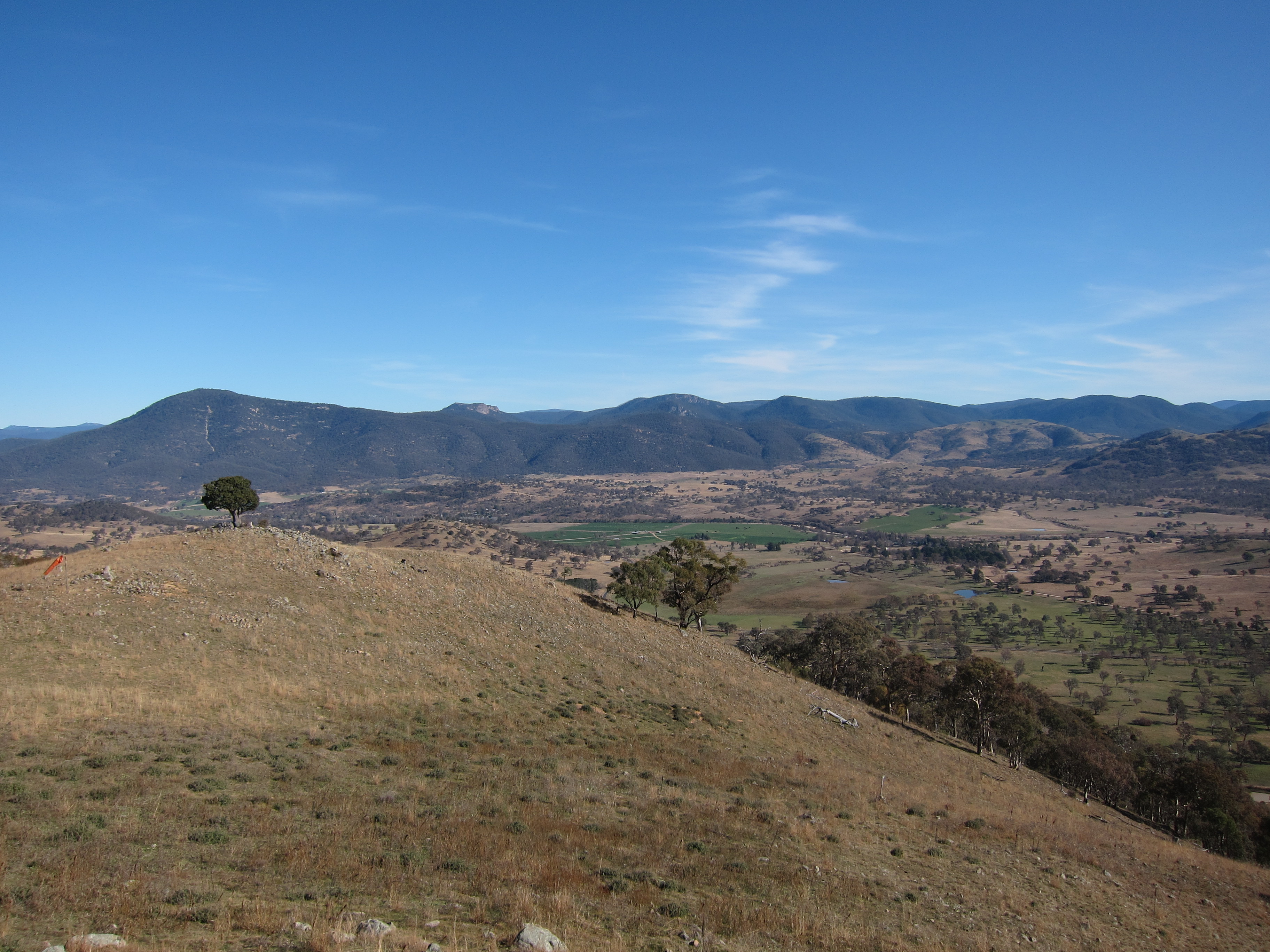
Vistas from high on the range over the suburbs and grassy fields to the blue Brindabella Mountains in the distance. Mt. Tennant, named after our local bushranger, lay proud and tall in the south. Legend has it that his treasure of gold is still hidden on the mountain.

Wombat, kangaroos, feral pigs, eagles.

The outlook from Big Monks sensational.

16 km “there and back again”.

Canberra Nature Park is a series of bushland reserves close to or within the urban area of Canberra. The hilltops are part of the reserve system. Most of the suburbs have easy access to one of these areas. The reserves and the proximity to the mountains help to make the city the Bush Capital of Australia.

Robert Roy MacGregor (Scottish GaelicRaibeart Ruadh MacGriogair; baptised 7 March 1671 – 28 December 1734), usually known simply as Rob Roy, was a famous Scottish folk hero and outlaw of the early 18th century, who is sometimes known as the Scottish Robin Hood.Rob Roy is anglicised from the Gaelic Raibeart Ruadh, meaning essentially “Robert the Red-Haired”.     From:  https://en.wikipedia.org/wiki/Rob_Roy_MacGregor

Mt Tennant on the left
Suburbs and nature park hilltops

Today our treasure is to have these areas preserved so when we make time to visit them on a beautiful winter’s day like this one we can feel like we’ve struck gold.

A walk in the old country – Gibraltar Peak

23

A walk in the old country Gibraltar Peak

26 June

Gibraltar Peak – Tidbinbilla Nature Reserve

Hiking

Lyre bird calling Tidbinbilla

Note to Australian Aboriginal people this post includes reference to deceased Aboriginal people.

The Time Trail led us from the visitors’ centre at Tidbinbilla across grassy kangaroo fields to the Birrigai Rock Shelter. Over many years I had visited this place many times, occasionally in the company of Aboriginal People – Paul and Matilda House, Don Bell, Eugene Vincent, Laddie Timbery, Jonnie Huckle, Dale Huddleston and Bobby Jabbanunga. As staff at the Birrigai Outdoor School we had made great efforts to highlight the people with connections to this country. Josephine Flood had excavated the site and found dramatic evidence that confirmed that people had lived in this shelter for at least 18,000 years. Since the last ice age.  We attempted to convey a sense of respect, awe and ongoing connection to Canberra students about the significance of the site and the living continuous culture.

On top of the grassy hill above I recalled lying on the grass in a circle with young students under the glittering night sky looking deep into the universe at light from stars so far away that it would have left when dinosaurs still roamed the earth. In winter we drew attention to the emu in the sky, a stunning feature of the cosmos visible in the southern hemisphere. Unlike the ancient Greeks the Aboriginal people of Australia storied the dark parts of the night sky, the areas between the stars. Beneath the southern cross is a dark section, the emu’s head, that links to a giant swathe of blackness across 2/3 of the Milky Way, the body, which then trails out in bent lines, the legs. Once appreciated it is impossible not to miss noticing it in future. Intriguingly its appearance seems to match the incubation of the emu eggs as the father sits on them for 8 to 10 weeks leading into spring.

We descended into an intimate glade, “Front Hollow”. Here we played hundreds of “web of life” games – kids having the time of their lives as carnivores chasing herbivores trying to hide out in the scrub or as higher order canivores chasing them all – learning about food chains as they dashed about. We had camp outs and cooked possum stew in camp ovens and spotted dick on sticks. As part of a cutting edge Earth Education program, Sunship III, we held one night a week an endangered species ceremony. Death sought out the troubled tales of the species, peregrine falcons and others then counselled the humans present. All very late at night. As staff we applied every bit of our creative educational energies to introducing, interpreting and building student relationships with the earth.

We followed a narrow trail up Bunyip Gully. The Birrigai Bunyip, a staff person in a fabulous costume with a tree stump head, was coaxed out of the woods here for special school kids with disabilities. They loved her to bits, sometimes hugging rather too hard. In a small clearing was the site “Cradles to Coffins” where students followed the cycles of a leaf growing, dying and decomposing. It’s nutrients to be used over and over again in the forest. Across a gully I spied Bunyip Castle. We had taken thousands of kids abseiling here.

As I walked on this ground and along trails that blindfold I could still pick out memories came tumbling in like a cascading river. Each small place deeply etched in memory.

Over Schoolhouse Hill I imagined how the grass trees would look in summer as their tall flower stalks fringed with white honeyed blooms.

On the trail up the ridge towards the back gate I kept an eye on the ground looking for the chert flakes from Aboriginal tool making left here over millennia. There were no remains of the site of the emus nest where we had watched a father and then the gorgeous striped hatchlings.

I had learnt how to manage groups moving through the bush up this trail to “The Peak”.  Pacing was the key to keeping balance between the fit and the strugglers. These skills I learnt leading bushwalks I later transferred to leading snorkelling, canoeing, xc skiing, back country snowboarding, mountain biking, kayaking, caving, SCUBA diving, canyoning – wherever there is a journey of people in a “remote” landscape.

We rested at Eliza Saddle. Nearby the dramatic rock formation, Lizards Tongue, was the place where I had taken my own children to hold their teddy bears in outstretched arms like in the Lion King.

In a bushy gully high on the mountain a cacophony of birds all calling loudly from the same place turned out to be a lyre bird trying to attract a mate. We picked out at least 10 different bird songs.

The final section of the ascent is a narrow winding staircase of granite steps leading upwards. In spring yellow grevilleas line the sides making a “stairway to heaven”.

The summit is a very special place. There is a sense of presence on the smooth slab among rounded tors. The view is truly spectacular. You get a different perspective on the city and The Bush. The city is a distant smudge among the rolling hills. Namadgi is a rugged wilderness to the south.

This is where we had spread Shirley’s ashes. She had been a teacher at the outdoor school who had felt a deep spiritual connection to the place.

The Birrigai camp was visible below – rebuilt after the fires. Sounds of happy voices drifted up from way below. I could pick out the ropes course and the gold village near the creek where we buried gold painted pobbles for the students to pan for and relive the experiences of the early gold diggers. Memories of conferences and Earthkeepers programs flooded back. These were days of magical learning experiences. I was reminded  of the thousands of students that we worked with. Bushdances at night in the hall. Memories and deep emotion flowed in like in the latest Pixar movie Inside Out – lots of joy but also sadness. Sadness that we were not there facilitating all that fun and learning and being in the bush, working in the most wonderful team, spending days and weeks then years in a single bush landscape that slowly etched itself into our beings.

We had established a garden, Gael’s wood, near a massive pine that must’ve disappeared in the fire. She had died too young while teaching with us.

In the middle distance I could make out the road to the deep space tracking station where the first footage of Armstrong stepping onto the moon were beamed. Gladdie had dinked me there on her new Harley. Life is short and death random. She had passed away after falling down some stairs holding her big dog shortly after.

I walked down quietly. Through the wetter forest where we used to read about diprotodons, giant megafauna, as we “walked the boundaries” and helped students adventure into the past. To the new viewing platform.

We lunched on the way back down into the Nature Reserve within a mob of kangaroos. I felt calm and at peace. I made a pact to walk this old country and feel it regularly.

Gibraltar Peak circuit. 12 km from Tidbinbilla Nature Reserve via the Birrigai Time Trail and Eliza Saddle.


If we could read this landscape?

20

If we could read this landscape?

6 – 8 June

Budawang Range – Morton National Park

Hiking

Five Blunts hit the trail. Father, aunt, son, brother, wife, husband, uncle. First overnight hike for one and others with hundreds under their belt.

IMG_5318

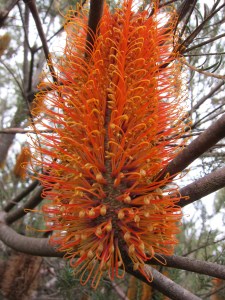
Banksias are adapted to fires. Some species are killed by bushfires but the heat also makes the seed pods open to enable germination in the soil.

IMG_5332

IMG_5282 IMG_5286

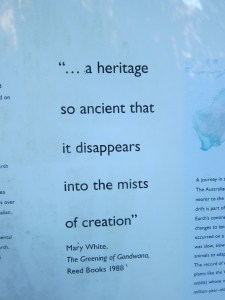
If we could read the stories written in the land around us what might we learn? Of the slow movement of the country northwards, riding on an ocean of magma? Of the ancient megafauna, diprotodon and the giant emu ranging across these hills? Of the passing ice age when the coastline was many kilometers further out than today? Of the lives of the Wandandian and Walbanga tribes that lived in these forests for 6,000 generations and more before the arrival of the modern boat people from Europe 200 years ago? Of the platypus in the pool nearby? Might we be able to read the future, where all things being “equal”, this bit of the crust will likely be 2,000 km north in 40 million years and a coral reef might have grown up in sight of Pidgeon House Mountain?

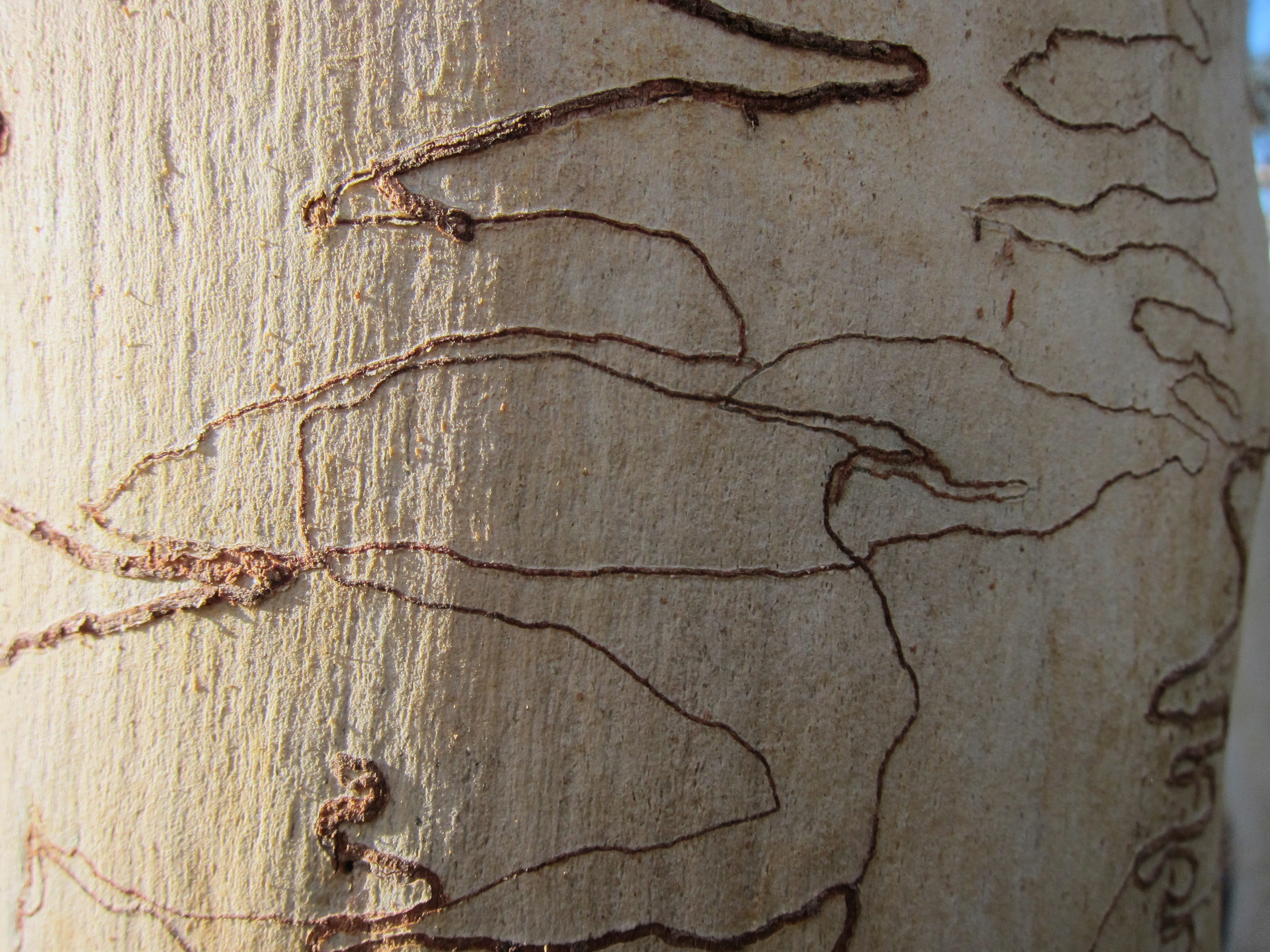
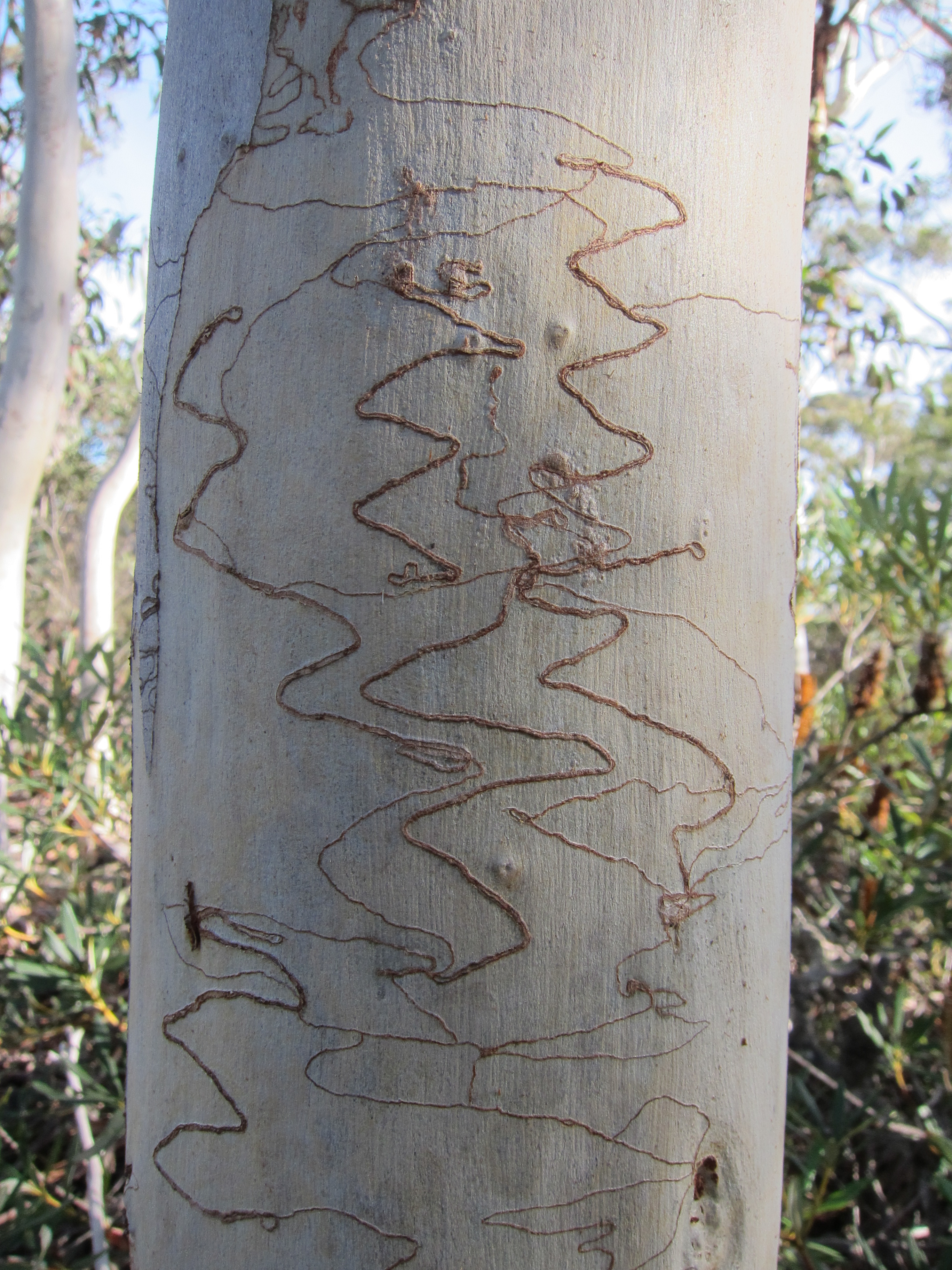
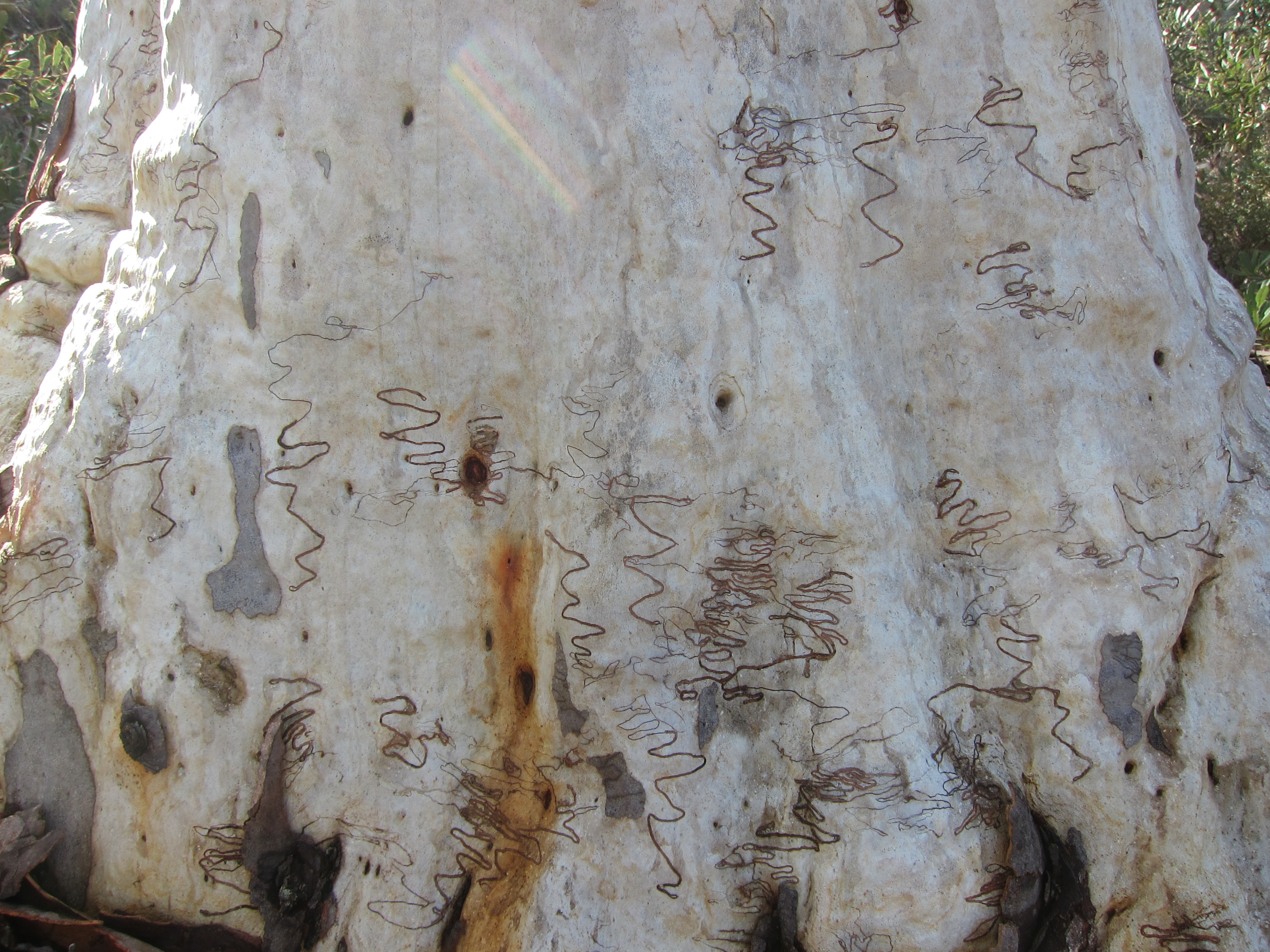
Old scribbly gum

(The writers here are the larva from the scribblly gum moth which burrow into the new bark of this species of eucalypt. as the old bark is shed the “scribbles” are revealed.)

3 day hike. Wog Wog to cascades camp on the Corang River – 8 km. Cascades camp east along the Corang River to more cascades at “Many Rock Ribs” at the junction with Canowie Brook then along Canowie Brook trail to Burrumbeet Brook camp caves and side trip up to Yurnga Lookout – 8km. Burrumbeet Brook camp caves over Corang Peak past Kora Hill and back to Wo Wog 14km.

Bucket List

19

Bucket List

4 June

Googong

Hiking

Remnants of snow lay on the track up the first hill. Shade, still, cool. As we paced into step with each other conversations blew through me like a strong breeze in a downwind spinnaker.

Stories in the landscape

Information shared on a 4WD trip I had etched in mind from hours poring over HEMA maps of deserts. Len Beadell’s Gary Junction Road linking with part of the Canning Stock Route then going west on through Rudall River to the Pilbara. Sounds perfect.

Koala surveys in the Tinderry area nearby.IMG_5271

Christmas Island Nature Week where people pay to volunteer with researchers looking into red tailed tropic birds and other wildlife. The volunteer fees fund the studies. Wow.

The track followed a high ridge crest most of the way. The sun warmed.

Rail trails for cycling suggested – Seymour to Mansfield, Orbost to Bairnsdale. I tucked these away in the mental archives adding them to the list.

My mouth gaped and my head spun with delight as I was related the intricacies of cross country ski routes in Norway. Villages linked by hundreds of kilometres of groomed trails. The Peer Gynt Trail. The Troll route.

We lunched by the still waters of the river into Googong Dam. Two swans ski landed nearby.

My bucket list was already overflowing.IMG_5259How to narrow it down? That was the trouble. Balancing the desire for full adventure with funds and loved ones and time and the planet.

In retrospect walking on that track on that day with those people was like being in the bucket itself.

Walking for Pleasure hike from Urilla to London Bridge Woolshed. 12 km

Karst country - London Bridge

Karst country – London Bridge

The Good the Bad and the Ugly

18

The Good the Bad and the Ugly

1 – 2 June 2015

Wee Jasper again – days 8 and 9 working underground

Caving

Caves are very sensitive environments. Formations and underground landscapes take aeons to evolve, are almost living in their growth and dynamic change. Geological time-frame.

Many of the Wee Jasper caves have been abused badly. Early farmers used them as rubbish tips. Early cave explorers left their signatures written with candle soot. Many speleothems are broken off – taken home to gardens and mantle shelves? Now uncontrolled and uninformed people scratch their names with rocks in the walls and wipe mud and touch the delicately dripping forms with oily fingers.

These are adventure caves. Open to the public to investigate.

There are still sections though, harder to get to or out of reach, that indicate the original beauty and majesty here. And down the road is Carey’s Cave – preserved and protected. And lots more the public don’t get to see, and probably caverns and hollow mountains nearby that people don’t even know about.

Caving Connections

17

Caving Connections

26 – 27/5/15

Wee Jasper again

Caving

Two more days guiding abseiling and intro caving. Perfect autumn weather. The Wee Jasper valley is beautiful. Deep green, blue hills, early morning mist. In the evening Canberra’s light reflects over the mountains in a faint glow as we exit the cave with pupils fully adjusted to the dark.

On the second day we negotiated access to the 30m abseil into the Daylight Hole entry to Dip Cave. Another school had taken first shift led by a teacher who I had taught at college as a student and then mentored through outdoor guide training. On exiting another bus drove in with a group from Victoria. It turned out I had trained the teacher in abseil guiding about 25 years previously. Driving back to pack up at the shearers quarters we passed the bus from my old college. They were heading up to abseil at Devils Punchbowl. You guessed it, guided by a fellow who I had taught at college. Time made one final circulation on itself over that morning as I chatted with the teacher from the school I was working with. He was just starting out with a deep interest in gaining qualifications in outdoor education. I felt humbled to be in this valley with others who shared the desire to take on responsibility for giving young people opportunities to experience the place and the excitement of roping and the underground world.

The sun shone a golden warmth as we synched together through the valley.

Campbell High School

Wodonga Secondary School

Lake Ginninderra College

Gold Creek School

The Outdoor Education Teacher Underground

16

The Outdoor Education Teacher Underground

18 – 20/5/15

Wee Jasper

Caving


Five years ago the national outdoor education conference highlighted a video featuring interviews with young uni students as they trained in teaching and outdoor education. They described how they viewed their chosen vocation, their approach to adventure and their dreams for their future careers. They were a very special group, talented and energised young people with stars in their eyes and great hopes in their hearts. They had a diversity of philosophies and outlooks on life.

Driving to the campsite at the beginning of three days of caving with 20 year 9 and 10 students she chattered on about her class and the trips she had run. Her first 15 months of real teaching she had worked extremely hard to re-establish an outdoor education program from almost nothing. She already had in place a program well regarded by the Principal and parents, respected and appreciated by the students. One of the uni students in the video had recounted how his most abiding goal was to work in a program that he had set up and that was successful. In a very short time she had already achieved this. Managing guides and staff, ensuring safety, providing quality education in a very challenging field that takes time and care and dedication.

On the first afternoon we guided abseiling together at Devils Punchbowl, a collapsed cave crater with a perfect rising cliff that offers abseil setups from beginner to advanced level. She set the big one and supported and extended students through. Later she played frisbee games with them all prior to dusk then supervised cooking with an eagle eye to safety and the fire and then conducted a debrief and made the plan for tomorrow and oversaw bedtime settle down. Herself quiet, calm, focused. She helped negotiate and juggle the plan with very much more experienced and older staff. The students were quiet in their tents by 10.00 pm – first night of a camp with high school kids – this was very impressive.

Next morning was cloudy with impending showers. A group tarp went up while the first of three caving groups left. Punchbowl cave, 30 m abseil in, multiple chambers, complex navigation, scrambles, slides, risks and hazards carefully judged and managed. Riding the tricky edge of letting boisterous teenagers have some freedom and rein while keeping them in a safe activity context. Students having the sort of fun, smiling, happy, deeply achieving, self reliance enhancing time of their lives that would last in them for decades. “Remember the advanced outdoor ed caving trip we did in year 10?” they might say to each other at their forty year school reunion. “Oh yeah, sure do.” Like I’d said at my own reunion on the previous weekend about my most special experience of school.

She belayed the students up the caving ladder to exit the cave. I had worried they would struggle to cope but found they all cruised this difficult physical and psychological challenge having trained extensively at school beforehand. Well prepared. It was raining. A bit miserable. The tarp was fine tuned. A fire lit in a break in the weather lifted the mood. Later in the glowing warmth the chatter was high spirited. Sense of accomplishment and having handled the difficult cave they had heard so much about. Young for the challenge, it was an ambitious plan but they were well prepped. Cooking on trangias again. Showers pass through. Some tents had leaked in the downpour. She manages the loan of extra dry sleeping bags and mats she’d packed in the trailer for such an eventuality. Sit around the fire. Boys take a football off into the darkness nearby- she follows and brings them back. Late evening the 22 students head off to bed and sleep. Stars glitter above in a break in the clouds.

Regular people, including many other teachers, will rarely understand her work. 24 hours a day duty of care. Activities during the day after early morning camp group action which she facilitates. Food, camp, fires. Emotional upsets. First aid incidents. Group dynamics. Debriefing and enhancing transference of learning and personal development from camp back to school and home. Life skills. Role modelling. Being an example to young impressionable people searching for their own identities. Sharing herself around the fire and walking to the cave. Why does she do it?

Overnight in the distance a glider screeches 4 times. She tells me in the morning that she’d slept like a log but had awoken in her tent and sat bolt upright at the screeching.

Day 3 the same. Switched on, tuned in, vigilant 360 degrees. In time she will learn to do it while conserving energy. And the students will be skilfully, subtlely developed to live out their own sense of personal safety consciousness and maturity and responsibility so it all becomes a little easier. There’ll be setbacks too when things don’t go quite to plan. She’d battled back at school to bring some students whose behaviour there is marginal but as she predicted on camp they were terrific.IMG_5040

Dip Series Cave. Four parallel chambers, 2 tricky abseils, navigation underground. She’s the last out. Lunch, packup tents and gear, load the bus. She runs a tight ship, on top of all the details.

Is it that she just loves The Bush to bits, the ocean, the mountains, the caves and wants to share it as widely as one person can? Does she want others to know and feel the joy that she has derived from the activities? Is it that she wants to make a contribution to the world and sees this as a way of doing it to the best of her ability while enjoying life herself? I suspect it’s all of these but didn’t have a quiet moment to ask. Let’s just hope that whatever it is that she keeps doing this work so that the thousand and more other eager students can benefit from her leading and guiding and teaching. And countless more parents will wish that they too had opportunities like their kids with her. What a lucky school they are.

Walking with Dad

Bellbirds in the forest soundscape

15

Walking with Dad

9 – 10/5/15

Blue Mountains – Blue Gum Forest

Bushwalking

As part of the younger generation we like to think we are doing new things, pushing new boundaries, making new discoveries. When I started rockclimbing and cross country skiing and whitewater kayaking and hiking in Tasmania I felt bold and adventurous. This hike was a shake down and acclimatisation for 10 days on the Larapinta Trail a few months later.

My brother, William, and I walked out along the ridge crest from The Pinnacles to Lockley Pylon. I could make out the route of Fortress canyon below where I had taken lots of college groups as part of my work as an outdoor education teacher. The views down the Grose River Valley stretched past lines of blue hills towards Sydney in the distant east. The ground fell away in a huge sucking drop close by in the west. Fortress Creek spewed out over orange sandstone verticality. We talked about Dad. His war record. How his boat had blown up in New Guinea and he’d narrowly escaped the tragic fate of some of the crew. PTSD had never been diagnosed or even mentioned. I had wanted to do this walk for a long time. I knew from family legend that it was a favourite place of Dad in his early years.IMG_4953

Charles is a climber, “It looks like Yosemite”, from the edge at Du Faur Head. A steep track led us zig zagging down among cliffs. We then followed a ridge down and down and down to the Grose River where it met Govett’s Creek.
IMG_4942IMG_4970

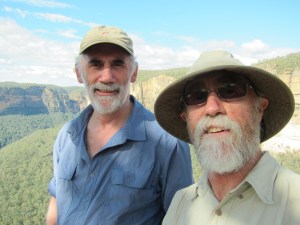
In the late afternoon light we found an enormous log forming a bridge over the stream. I crossed with William and had a photo taken of us in the middle. It was like we were entering some special kingdom. The blue gums towered everywhere. Massive trunks disappearing skywards to small pleading canopies. Scrubby undergrowth. Impossibly difficult to photograph and capture the grandeur. I explored on my own for a while between the trees and could almost feel Dad’s presence in the stillness. At 16 he had left school to be a message boy man with the GPO. 1936. He joined the Sydney Bushwalkers who would meet on Saturday lunchtimes at Central Station for the train trip to the Blue Mountains for the weekend bushwalking. Often Dad would have to work Saturday afternoons so caught the night train and then hiked down to Bluegum and other places to meet up with his mates by torchlight. He was apparently a “tiger” of a walker accomplishing feats like Katoomba to Kanangra and return in an Easter weekend. His father helped him construct his own frame and rucksack. The only tale we got direct from him was told at the Three Sister Lookout from where he pointed out Mount Solitary as the place where he had put his rucksack down on a ledge which gave way. Two weekends were spent then searching for it. I rejoined the others and we walked the short distance to Acacia Flat to camp among the gums in a grassy clearing. IMG_4993IMG_4986

Collecting water from the creek which was noisily cascading I was reminded that Dad had taken up canoeing and became an active member of the River Canoe Club. In rereading his memoir for the first time in the 30 years since his death the night before the walk I’d found that he had built his own canoe, bending the spotted gum timbers with steam and covering the deck and hull with stretched canvas. He’d described a an epic trip down the Kangaroo and Shoalhaven Rivers in 1938 from Hampden Bridge to Burrier. Part of this trip, now on the backwaters of Tallowa Dam I had also taken numerous college groups on.

Bluegum Forest had been rescued in the early 1930s from a commercial leaseholder who was about to clear the land for farming and transport out the timber. A group of bushwalkers, just prior to Dad’s time, got together and raised enough money to purchase the lease to protect the area. They, and a little later our father, and then us 85 years later would camp under these same trees. The night was cold without a fire.

In the tent it was cosy and warm and still but all hell had broken loose in the tops of the trees. Rushing air like a freight train built up speed and momentum down from the cliffs before hurtling across the forest canopy above then rushing off down valley. Gusts built up and crashed past every half minute or so for hours. I thought again of Dad during the windstorm. He had taken up sailing just before and after WW2. In the second Sydney to Hobart race he had encountered “a force South West blow as we rounded Tasman Island and Storm Bay certainly lived up to its name”. Apparently his father too had done some sailing.
IMG_4992By morning the wind had blown itself out. We had a last wander through the blue gums. William and I found a massive old ancient eucalypt. It stood tall like Dad as I remember him. Strong, dependable, gnarled, firmly rooted to the earth. Standing quiet among its kin. Was there a twinkle in the sun’s reflection on the leaves above?

My three brothers and I have all had adventurous lives in different ways. Between us William, David and I have ascents of aspiring, the Matterhorn, Mt Blanc, Big Ben, Balls Pyramid, new routs at Point Perpendicular, descents of many of the canyons of the Blue Mountains, expeditions to Antarctic, trekked in Nepal. Following time with the army John has worked in Aceh, Pakistan, Swaziland, PNG, Gambia and Botswana. Dad never talked about the war that gave him “bad nerves” that made him “physically unfit for Naval service”. PTSD? He didn’t talk about his adventuring much either. He wasn’t comfortable being the centre of attention. He worked hard. Became Chief of Naval Supply. And when we were around only had time for family and work.
IMG_5003

The track wound beside the creek. At Junction Rock we rested. Then a little more along the flat until we branched up hill on a wrong path towards Evans Lookout. The un maintained trail was a ripper, rising steadily and then surprisingly through the cliff band. Among the calling bellbirds I considered the things in addition to family that sustain and mean so much to me – the natural world, adventure, making a contribution to the world – that I’ve been lucky enough to forge a career out of. My father’s been gone for nearly thirty years now but in coming to this place and rereading his story and talking to William and my wife Cath its only now becoming clear that he’s been the source of all these things that I cherish. Without even speaking about it.  I remember him so diligently involving us in Scouts, building a big white two ended canoe that took the whole family, with Mum taking us on family camping trips, supporting all our interests.

From a high rock shelf at the head of the valley we look across at the huge orange cliffs of Carn wall. There’s a terrifying roofed corner that I’m sure has been climbed. Charles and I have our eye on another easier long route near Mount Hay further down the Grose. It occurs to me that what we are doing isn’t new at all. Maybe now I can accept this easier because I’m not part of the younger generation anymore. Dad’s own adventuring was cut short by the war. We haven’t had a war, we’ve had different opportunities.
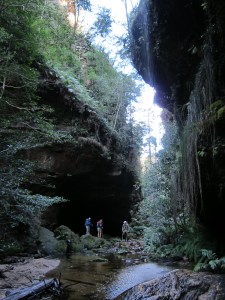
IMG_5016We’d come up the unmaintained horse track instead of the intended Rodriguez Pass Track and ended up high on the ridge below Evans Lookout. So we headed down the steps to pick up the Grand Canyon Track. It’s an old trail built in the Depression, hewn out of rock in some sections. Along the creek was sublime. Waterfalls tumbledover green walls past perched tree ferns to the black canyon floor. Cold. Moist. Water bubbling over smooth rocks. In his book Dad wrote about his first trip to the Blue Mountains. His father had taken him on a hike with borrowed pack, sleeping bag and swag. The trekked through Wentworth Falls, camped in a picnic shelter, Laura, Katoomba, Medlow Baths. They stayed a night in Wall’s Cave which left a great impression him. “Firelight and shadows on the roof of the cave many feet above”. From there they went through the Grand Canyon and down Beauchamp Falls which was our intended route up. They finished going up Govetts Leap and back to the train station. Quite a walk. On the track above the canyon I tell Bob and Sue, friends from work at the outdoor school years ago, about the abseil and canyon trip I have guided lots of times for students in the depths below.

The final walk up from Neates Glen to the car is tough. Sore knees, tired muscles, packs that seem heavy. I’ve felt very close to Dad. Like we’ve been walking together almost. I wonder about what I’d say to him if we could connect across the divide somehow. Maybe just “thanks”. And him to me and us? If he could talk, father to son, or his father to him and me to my daughter and son? “Look after Mum? Love each other? Take care of the family? Keep adventuring? Do something good in the world? Look after the special places? Live life to the max! See you in the blue gums?”

For all of us the walk has been a cracker. Classic. Wonderful. Great to share it with a bro and our Dad. A confidence booster for our big walk later.

IMG_5006IMG_4987

Day 1. The Pinnacles on Mt Hay Rd, Lockley Pilon, Du Faur Head, Bluegum Forest, Acacia Flat. Approx 6 km with 600m descent.

Day 2. Acacia flat, Junction Rock, Evans Head Lookout Track, Grand Canyon Track, Neates Glen, Evans Lookout Rd. Approx 9 km with approx 800m ascent.

Conversations while Walking for Pleasure

14

Conversations while Walking for Pleasure

7/5/15

Canberra Centenary Trail

Walking

Cross stitch

Air force

Learning the keyboard

The Larapinta

Retirement

On the river I was the oldest by at least 25 years. A week later hiking the best section of the Centenary Trail I was the youngest at 57. The pace was spritely.

Travelling the USA

Walking in NZ

The Coast to Coast

Injuries

Teaching

IMG_4937

Walking lends itself to chatting. It passes the time, develops friendships. Some psychologists even carry on therapy sessions with clients as they pace together. Only some of the conversation topics were predictable.

Ailments

Painting

Marathon running

Customs

The West Highland Way

One fellow was planning a walking trip to UK. His itinerary involved two long walks linking some of the best long distance trails. 497 miles over 42 days. Solo. The day’s trek had been a little slow for him.

Dodgy hips and knees

Stories

The Milford Track

Painting

The walk was led from the front. Making her contribution to the group. Some like her walk nearly every day of the week.

IMG_4936

Changes in the Budget to pensions

Walking Britain

The Routeburn

Leading walks

Ray had a bit of a limp and had a slightly slower but no less determined gait. He asserted that his imminent op was due to his 13 marathons run in years past. He deserves to be on “Australian Story”. 79.

Inspiring.

Hall to Forde. 17.2 km. 420 m of ascent. 9.00 am – 1.50pm.

Walking With The ACT WFP (Walking For Pleasure)

http://www.actwfp.org.au/


IMG_4941

Back at School – On the River

12

Back at school – On the river

30/4 – 1/5/15

Clyde River

Canoeing and kayaking two day tour between Nelligen and Anglers Reach.

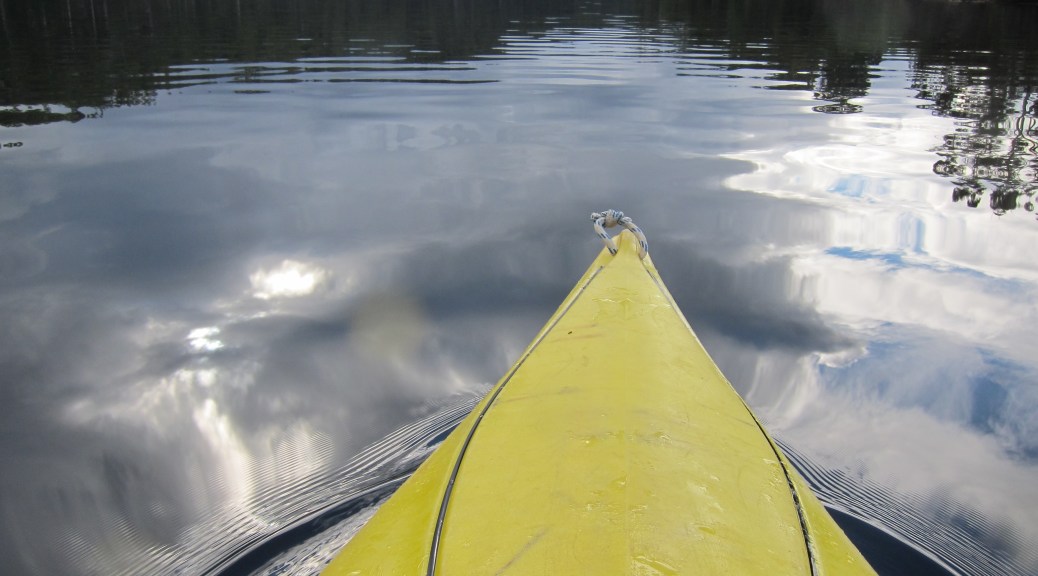
Glassy smooth water. The sharp nose of my very old “dancer” kayak rippled the surface reflections. Clouds built but didn’t spill. Multicoloured canoes and kayaks moved along closer to the shore and contrasted to the shades of bush greens on the bank. The Clyde River. The river all Canberrans know as they speed over the concrete bridge at Nelligen on the summer pilgrimage to or from the coast. Our group of students and teachers were some of the very few that ever venture further than the road or shore.

On the first day I had mixed emotions being back with a school group in the outdoors with that ever present niggling duty of care. The beauty of the late afternoon conditions and a short stretch slightly away from the group helped as the slow calm of the river seeped back to my core. I was working with a group of trainee guides who were assisting the teachers who were overseeing the students who were also under the tutelage of a student teacher along with a couple of ex student helpers. A tangled complex web of skills and knowledge transfer and mentoring. This was a true learning community. I felt a deep sense of satisfaction that I had been able start this program and that now it was seeming sustainable.

At dusk the would be guides dived into their rescue practice tasks. The water was cold. The final part was completed as the moon rose.

Later evening sent us all from the fire to bed. In the middle of the night mist covered the moon.

The weather in the morning had improved. We paddled off in mainly sunshine. The trainees took control and kept it moving and made it fun and swapped the canoe pairs and gave them turns in the kayaks and smiled lots and wound us in and out of overhanging trees in the still water, and cared for them and handled all the scenario rescues and did everything right. I had to relearn that on nearly all of these adventure trips it takes time for the experience to have its effect on people. The change from the first day in the individuals and the group was noticeable if you tuned in. Something subtle often takes place. For this group and some students it would take a few more trips in beautiful surroundings and away from mobile reception with skilful leaders for special characteristics to start showing through. Generosity, inclusiveness, confidence, being at ease in a group.

It did feel good to have a small bit part in it all again.

52 Adventures. That's the aim. One each week. Like any real adventure the outcome is unknown. The journey, the comrades, the solitude, the challenges, the special places are what matters. And this is the record – writing, images and video. Enjoy.